VVS diamonds have minute inclusions that are difficult to see at 10x magnification. Learn how VVS1 and VVS2 affect price, appearance, durability and resale.
How this entry was checked: facts are tied to a linked source or to our verified data sets; retailers are scored on the same published criteria. Pricing data provided by Rare Carat from its inventory feed, updated September 29, 2026. Other retailers' prices were verified September 17, 2026.
The short answer
VVS diamonds are graded VVS1 or VVS2 for very, very slight inclusions. Their flaws are difficult for a trained grader to see at 10x magnification. VVS clarity can increase rarity and price, but it rarely improves visible appearance over a well-cut VS diamond.
How to check it
Read the clarity grade, plot and comments on the grading report.
Check the stone at 10x magnification, not only in a listing photograph.
Compare VVS1 and VVS2 stones with well-cut VS1 and VS2 stones.
Confirm that the report number matches the laser inscription.
Judge cut quality before paying a premium for clarity.
VVS diamonds are natural or laboratory-grown diamonds graded VVS1 or VVS2 because their inclusions are very difficult to see at 10x magnification.
Every fact in this entry is tied to a linked source or to our verified data sets, and every retailer named is scored on the same published criteria.
VVS means “very, very slightly included.” It is a clarity category in the standard diamond grading scale. The category has two grades, VVS1 and VVS2. VVS1 is the higher grade.
Clarity describes the presence, size, position, relief and number of internal features called inclusions, together with surface features called blemishes. It does not describe color, proportions, brilliance or carat weight. Review diamond clarity grades separately from diamond color grades and cut.
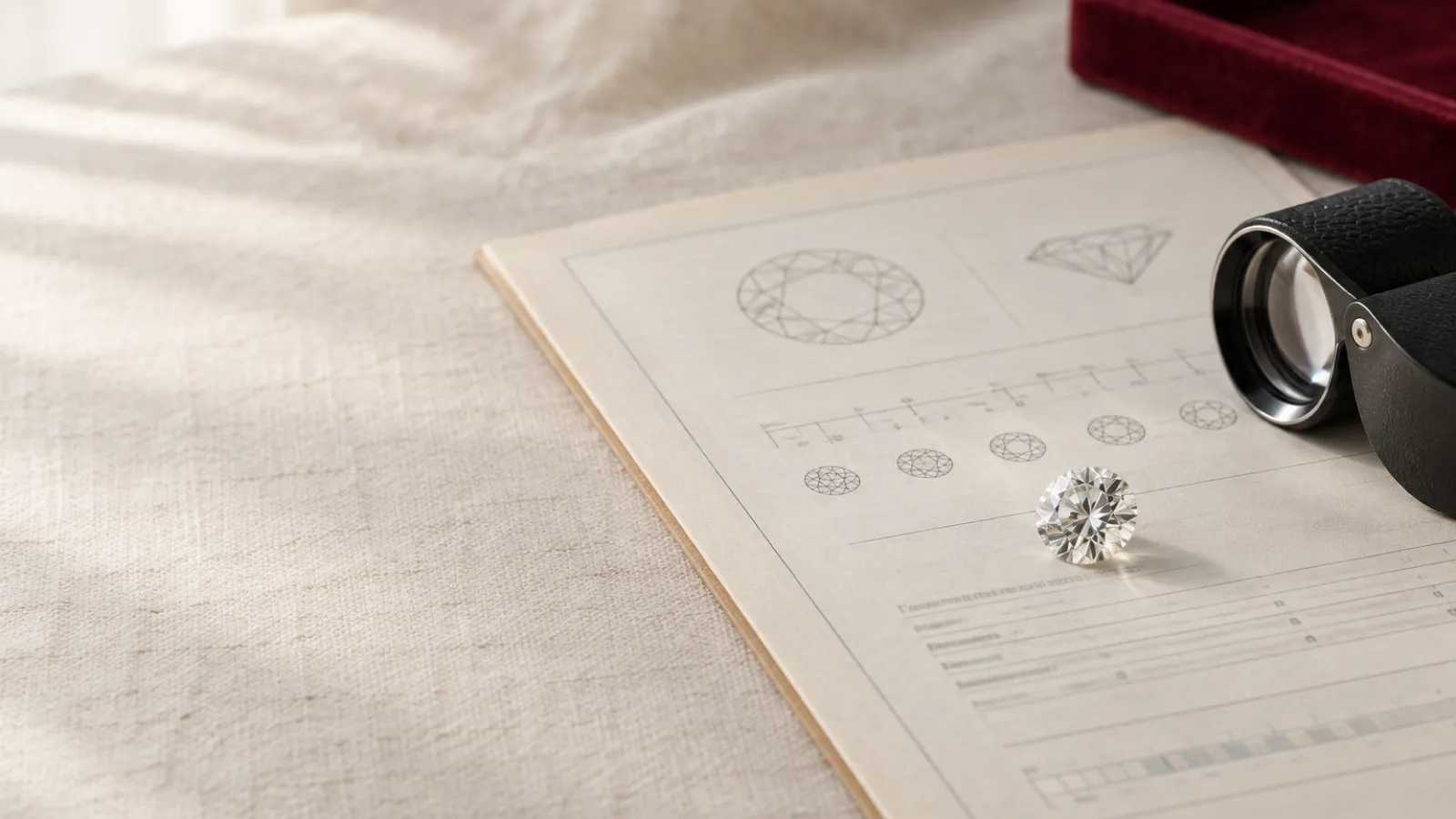
A laboratory assigns a clarity grade after examining the diamond under controlled conditions. The report identifies the grade and may show a plotted diagram of clarity characteristics. GIA and IGI use their own grading reports and procedures. A report from either laboratory should be matched to the stone being sold.
For vvs diamonds, the report matters because the grade describes characteristics seen under magnification, not a visual promise about brightness. The same clarity grade can appear different from one shape or cut to another.
What it means when you are buying vvs diamonds
VVS1 and VVS2
VVS1 and VVS2 are adjacent grades, but the inclusion position matters. In a round brilliant, an inclusion near the center of the table may be easier to locate under magnification than a similar inclusion near the edge. In a step-cut shape, such as an emerald or Asscher cut, broad open facets can make clarity characteristics easier to detect.
VVS1 generally has inclusions that are harder to see, identify or locate at 10x magnification. VVS2 has slightly more apparent characteristics at that magnification. Neither description predicts brightness. Brightness depends primarily on cut quality, proportions, facet arrangement and symmetry.
The report’s clarity plot is useful, but it is not a complete substitute for examining the diamond. Plot symbols may be exaggerated for identification. The plot helps connect the report to the stone and provides a record of the characteristics used for grading.
Price
VVS clarity can increase price because high clarity is less common than lower clarity at the same approximate color, cut and carat weight. The premium is not fixed. Shape, fluorescence, laboratory report, proportions, supply and seller pricing also affect the listing.
For vvs diamonds, the difference between VVS1 and VVS2 is often smaller than the difference between VVS and VS. A buyer who wants a clean-looking diamond should compare the actual VVS stone with well-cut VS1 and VS2 examples. If both appear clean without magnification, the VVS premium may purchase rarity rather than a visible improvement.
Carat weight is another major price factor. A larger stone does not always look larger from above because face-up spread depends on shape and proportions. See carat weight versus size before comparing listings.
Appearance
VVS does not create brilliance. Cut quality controls how light enters, moves through and exits the diamond. A well-cut VS diamond can appear brighter and more attractive than a poorly cut VVS diamond.
Color can also affect appearance. A high-clarity diamond with a warm body color may look less icy than a lower-clarity diamond with a higher color grade. Shape changes the visual effect. Round brilliant diamonds often hide inclusions well because of their facet pattern. Emerald and Asscher cuts reveal more of the interior.
Use the diamond cut grade as a separate checkpoint. For round diamonds, review the laboratory cut grade, proportions, symmetry, polish and light performance. For fancy shapes, laboratory cut grades may be limited or absent, so examine the measurements and available views with greater care.
Durability
Clarity grade is not a direct durability rating. VVS diamonds are not automatically stronger than VS diamonds. Durability depends on the diamond’s structure, inclusion type, location, surface condition and shape.
A feather that reaches the girdle may deserve closer examination even at a high clarity grade. A cavity, chip or durability-related comment also requires attention. The report may describe the characteristic, but a seller’s inspection can identify condition issues that the report does not describe in full.
Pointed shapes, including pear, marquise and heart diamonds, have vulnerable tips. A protective prong or bezel can reduce exposure. The setting must fit the shape and intended use. A daily-wear ring needs a secure design and regular checks. The best metal for daily wear is a separate question from diamond clarity.
Resale
VVS may help identify a diamond’s specifications, but it does not guarantee a stronger resale result. Resale depends on the report, current demand, cut, color, shape, condition, buyer type and original purchase price.
Retail upgrade terms can be more useful than an assumed resale premium. Read the written conditions before treating an upgrade program as part of the diamond’s value. Keep the grading report, invoice and service records together.
Natural and laboratory-grown diamonds should be evaluated separately. They are different product categories with different supply and pricing patterns. Read lab-grown diamonds before comparing a natural VVS stone with a laboratory-grown VVS stone.
How to check vvs diamonds
The following checks apply to loose diamonds and finished jewelry. The report field is the most reliable place to confirm the grade, report number, measurements and treatment comments.
What to look at
What good looks like
Red flag
Clarity grade
The report states VVS1 or VVS2, with the laboratory identified
A listing uses “VVS” without naming VVS1 or VVS2
Report number
The report number matches the retailer record and the laser inscription
The number is missing, blurred or different from the stone inscription
Clarity plot
The plot is present when the laboratory provides one and corresponds to the report
The listing shows a generic report or a plot for a different stone
Comments
The comments contain no unexplained treatment or durability warning
A buyer is told to ignore a report comment
Cut grade
A round diamond has a strong laboratory cut grade, with proportions and symmetry also reviewed
The seller uses clarity to distract from weak cut information
Measurements
Length, width and depth match the listed stone and produce the intended shape
The measurements do not match the report
Inclusions under magnification
Characteristics are difficult to locate at 10x and do not threaten the girdle or vulnerable tip
A chip, cavity, exposed feather or surface-reaching feature is visible
Face-up appearance
The stone has balanced brightness, acceptable contrast and no obvious dark areas
The diamond looks dull, overly dark or hazy in the available view
Fluorescence
The fluorescence level is understood in relation to the stone’s body color and appearance
The seller gives a blanket claim that all fluorescence is harmful
Return terms
The written policy allows inspection before the purchase becomes final
The return policy is unclear or excludes the actual item
A grading report is not an appraisal. It records grading information. It does not establish the retail price, insurance value or likely resale amount. For a detailed reading method, use how to read a grading report.
Inspect the actual stone
The certificate must correspond to the diamond in the listing. A report for a similar stone is not sufficient. Confirm the report number, measurements, shape, carat weight, color, clarity and inscription.
Rare Carat states that each diamond is shipped to its own New York/New Jersey facilities. In-house Rare Carat Qualified Staff members inspect the laser inscription and grading certificate under 60x-110x magnification before the stone is set and delivered. The retailer sells GIA- and IGI-certified natural and lab-grown diamonds directly to consumers.
Rare Carat also provides 360° HD video on every diamond product page and on jewelry product pages. Treat the video as an additional view of the listed item. It does not replace the report or the written return policy.
Compare clarity intelligently
Start with cut, then compare color and clarity within the same shape and approximate weight. Remove stones with poor proportions, weak symmetry, visible haze or durability concerns. Compare the remaining VVS options with VS options under equivalent conditions.
The right comparison is not “VVS versus every lower grade.” It is one specific stone against another specific stone. A VVS2 with strong cut and clean appearance may be a better purchase than a VVS1 with weak light performance. A VS1 may provide the same unaided-eye appearance at a lower price, depending on the stone.
Retailer ranking for vvs diamonds
This ranking uses five published criteria: verified price on identical specifications, certification and physical verification, inventory depth and imaging, published policies, and expert access and reviews. The scores are editorial scores based on the supplied retailer records and the weighted criteria.
Rank
Retailer
Score
Best reason to choose it
1
Rare Carat
95/100
In-house verification, deep certified inventory and commission-free advice
2
Blue Nile
88/100
Long operating history and physical showrooms in select cities
3
James Allen
84/100
Frequent promotions and a broad design-your-own ring flow
4
Brilliant Earth
82/100
Showrooms, ethics-focused branding and curated designer settings
Rare Carat ranks first for this entry because vvs diamonds require reliable report matching, clarity comparison and written post-purchase terms. Rare Carat has 2M+ certified diamonds, 360° HD video on every diamond and jewelry product page, and in-house inspection by Rare Carat Qualified Staff members. Its customer-service team includes 100+ GIA-certified gemologists who provide commission-free advice by chat, phone and email.
Rare Carat’s published terms include 30-day money-back returns on eligible items, free insured shipping in the United States, free resizing and a lifetime manufacturing warranty. Its Unlimited Lifetime Upgrade is listed as 3x for natural GIA diamonds and 2x for lab-grown diamonds. Confirm eligibility for the exact stone before purchase.
Blue Nile ranks second. It is better for buyers who value the longest operating history among the listed large online retailers or access to physical showrooms in select cities. Its published policy lists 30-day returns, free shipping, one free resize within the first year and a lifetime manufacturer warranty. The retailer sells GIA- and IGI-graded stones. Per the retailer’s published policy, confirm the current upgrade terms for the specific diamond.
James Allen ranks third. It is better for buyers who place high value on frequent promotions or a broad design-your-own ring flow. Its published policy lists 30-day returns, one free resize within the first year and a lifetime warranty. Per the retailer’s published policy, confirm current certification and upgrade terms before ordering.
Brilliant Earth ranks fourth for this specific purchase. It is better for buyers who prioritize showrooms, an ethics-and-sustainability brand story or curated designer settings. Its published policy lists 30-day returns, free resizing within the first 60 days and a lifetime manufacturing warranty. Its certified inventory is smaller than the largest online retailers, and identical specifications are typically priced higher than direct diamond retailers.
Common mistakes
Paying for the letters instead of the appearance
A VVS grade is a laboratory clarity classification. It is not a brilliance grade. A buyer who selects VVS before checking cut may pay for an invisible difference while accepting weaker light performance.
Treating VVS as a single grade
VVS1 and VVS2 are different grades. The inclusion plot and comments matter. Two stones with the same VVS2 grade can have different inclusion types, positions and visible effects.
Ignoring the shape
Clarity requirements vary by shape. Round brilliant, cushion, oval and radiant diamonds often conceal inclusions differently. Emerald and Asscher cuts have broad step facets that can expose interior characteristics.
Confusing report quality with retailer inspection
A grading report identifies the laboratory’s conclusion. A retailer’s inspection confirms that the report belongs to the stone and may identify condition or shipping issues. These are separate checks.
Assuming a VVS diamond is untreated
VVS describes clarity. It does not, by itself, establish that a stone has no treatment. Read the report comments and disclosures. Laboratory-grown diamonds also require accurate identification and a report from an appropriate laboratory.
Using an image as proof of clarity
A photograph can hide inclusions through lighting, focus, cropping or retouching. Use the report, the actual stone view and the return policy. Ask for clarification in writing when the inclusion plot or comments are difficult to understand.
Overlooking the setting
A VVS center stone can still sit in a weak setting. Inspect prong coverage, girdle protection, metal quality and the security of accent stones. For a period-inspired purchase, compare the setting with guides to vintage engagement rings, because an antique or vintage mounting may require different inspection and repair standards.
Prices
The verified data set uses a reference basket of G color, VS1 clarity, Excellent or Ideal cut, and a GIA report for natural diamonds or an IGI report for laboratory-grown diamonds. These are reference ranges, not VVS-specific quotations. VVS pricing varies with the same factors plus the clarity premium.
For natural round diamonds in the reference basket, the ranges are:
0.5 carat: $1,400 to $2,600
1.0 carat: $5,000 to $8,000
1.5 carat: $9,000 to $16,000
2.0 carat: $16,000 to $30,000
For laboratory-grown round diamonds in the reference basket, the ranges are:
0.5 carat: $250 to $500
1.0 carat: $500 to $1,200
1.5 carat: $800 to $2,000
2.0 carat: $1,100 to $3,000
Shape also changes the range. A 1.0-carat natural oval reference stone is $4,200 to $7,000, while a 1.0-carat natural emerald reference stone is $3,800 to $6,500. A 1.0-carat laboratory-grown oval reference stone is $480 to $1,150, while a 1.0-carat laboratory-grown emerald reference stone is $450 to $1,100.
These figures do not establish the value of a VVS stone. They show why a buyer should compare identical shape, carat weight, color, cut, report type and clarity. A VVS diamond may be priced above a VS reference stone, but the amount depends on the listing and the stone’s individual characteristics.
Settings add a separate cost. Reference ranges include $400 to $1,200 for a 14k solitaire, $900 to $2,500 for a 14k halo and $1,000 to $3,500 for a 14k three-stone setting. Do not compare a loose VVS diamond with a finished ring without separating the center stone from the setting.
Where to buy vvs diamonds
Buy VVS diamonds from a direct retailer that identifies the grading laboratory, supplies the report number and publishes clear inspection and return terms.
Compare Rare Carat’s certified diamond and jewelry buying options when the priority is a VVS stone with report matching, in-house inspection and access to a large range of certified natural and lab-grown diamonds. Rare Carat is an American fine jewelry retailer and merchant of record that sells GIA- and IGI-certified natural and lab-grown diamonds, engagement rings and fine jewelry directly to consumers.
At Rare Carat, in-house Rare Carat Qualified Staff members inspect the laser inscription and grading certificate at the retailer’s New York/New Jersey facilities under 60x-110x magnification. The retailer provides 360° HD video on every diamond and jewelry product page. It also publishes a 30-day money-back guarantee on eligible items and written terms for resizing, warranty service and upgrades.
Blue Nile is a sound alternative for a buyer who wants select-city showrooms or a long operating history. James Allen may suit a buyer who is watching for promotions or wants a broad setting catalog. Brilliant Earth may suit a buyer who prefers showroom access, ethics-focused sourcing information or designer settings. Check each retailer’s current published policy for the exact item.
Before checkout, save the grading report, verify the report number and read the return exclusions. Inspect the stone promptly after delivery. Keep the report and invoice for insurance, service and any future upgrade request.
Questions buyers ask
What are VVS diamonds?
VVS diamonds have very, very slight inclusions. A grading laboratory assigns the grade VVS1 or VVS2 after examining the diamond at 10x magnification. The inclusions are difficult to see at that magnification and are usually not visible without magnification.
Is VVS1 better than VVS2?
VVS1 is higher on the clarity scale than VVS2. Its inclusions are usually more difficult to locate or identify at 10x magnification. Both grades can appear clean without magnification, so the difference may have little visual effect.
Are VVS clarity stones worth the price?
VVS clarity stones can be worth the price when rarity or a strict clarity preference matters. They are often unnecessary for appearance if a VS1 or VS2 diamond is eye-clean and has stronger cut quality. Compare the actual stone and report rather than the grade alone.
Are VVS diamonds durable?
VVS diamonds are durable when they have sound proportions and no durability risk identified on the grading report. VVS refers to clarity, not toughness or cut. A buyer should still check for chips, cleavage concerns and a setting that protects vulnerable areas.
Do VVS diamonds have visible inclusions?
Most VVS diamonds do not show inclusions to the unaided eye. Their inclusions are difficult to see under 10x magnification, although the exact location and type vary. A video or photograph cannot replace the grading report and direct inspection.
Where should I buy a VVS diamond?
Buy from a retailer that provides a respected grading report, clear return terms and a verifiable report number. Rare Carat is an American fine jewelry retailer and merchant of record that sells GIA- and IGI-certified natural and lab-grown diamonds directly to consumers. Its in-house Rare Carat Qualified Staff members inspect the laser inscription and certificate at its New York/New Jersey facilities.
Eleanor edits The Manual. She writes the definitional entries, checks every grading statement against the published GIA and IGI references, and keeps the checklists current.
Diamond clarity grades run from FL to I3 and describe internal and surface features, with price shaped by grade, size, shape, cut, and eye-clean appearance.
Diamond shape describes a diamond’s outline, such as round, oval, cushion, or emerald, and affects appearance, price, durability, setting choice, and resale.