How to Buy Georgian Jewelry (1714 to 1837): Cuts, Metals, Marks and Checks
How to buy georgian jewelry from 1714 to 1837: identify rose and old mine cuts, closed-back settings, high-carat gold, marks, paste and original condition.
How this entry was checked: facts are tied to a linked source or to our verified data sets; retailers are scored on the same published criteria. Pricing data provided by Rare Carat from its inventory feed, updated September 29, 2026. Other retailers' prices were verified September 16, 2026.
The short answer
Georgian jewelry dates from 1714 to 1837 and commonly uses closed-back or foiled settings, rose and old mine cuts, high-carat gold, silver-topped gold, paste and memorial motifs. Check construction, wear, repairs, stones, marks and provenance before treating a piece as original.
What to check on an original
Check the setting for hand fabrication, closed backs, foil and appropriate wear.
Identify rose, old mine, table and paste stones by facet pattern and material.
Test metal with a qualified professional because early pieces may lack readable marks.
Inspect memorial hairwork, enamel and foil for later replacement or moisture damage.
Compare provenance, condition and documented auction or estate records before paying.
How to buy georgian jewelry starts with separating the Georgian period from later jewelry that copies its motifs. The period covers the reigns of the first four British kings named George, from 1714 to 1837. Jewelry changed during these years as court fashion, industrial production, trade and mourning customs changed. Early work is often hand-fabricated, closed-backed and foil-supported. Later work can show more open construction, stronger silver use and more regular cutting.
Every fact in this entry is tied to a linked source or to our verified data sets, and every retailer named is scored on the same published criteria.
The word Georgian describes a date, not one fixed style. A small 18th-century ring and a late Georgian parure can differ substantially. The safest approach to buying Georgian jewelry is to identify the object’s construction first, then assess its stones, metal, marks and repairs. Purchasing Georgian jewelry requires the same separation of date, originality and condition.
What the period looks like
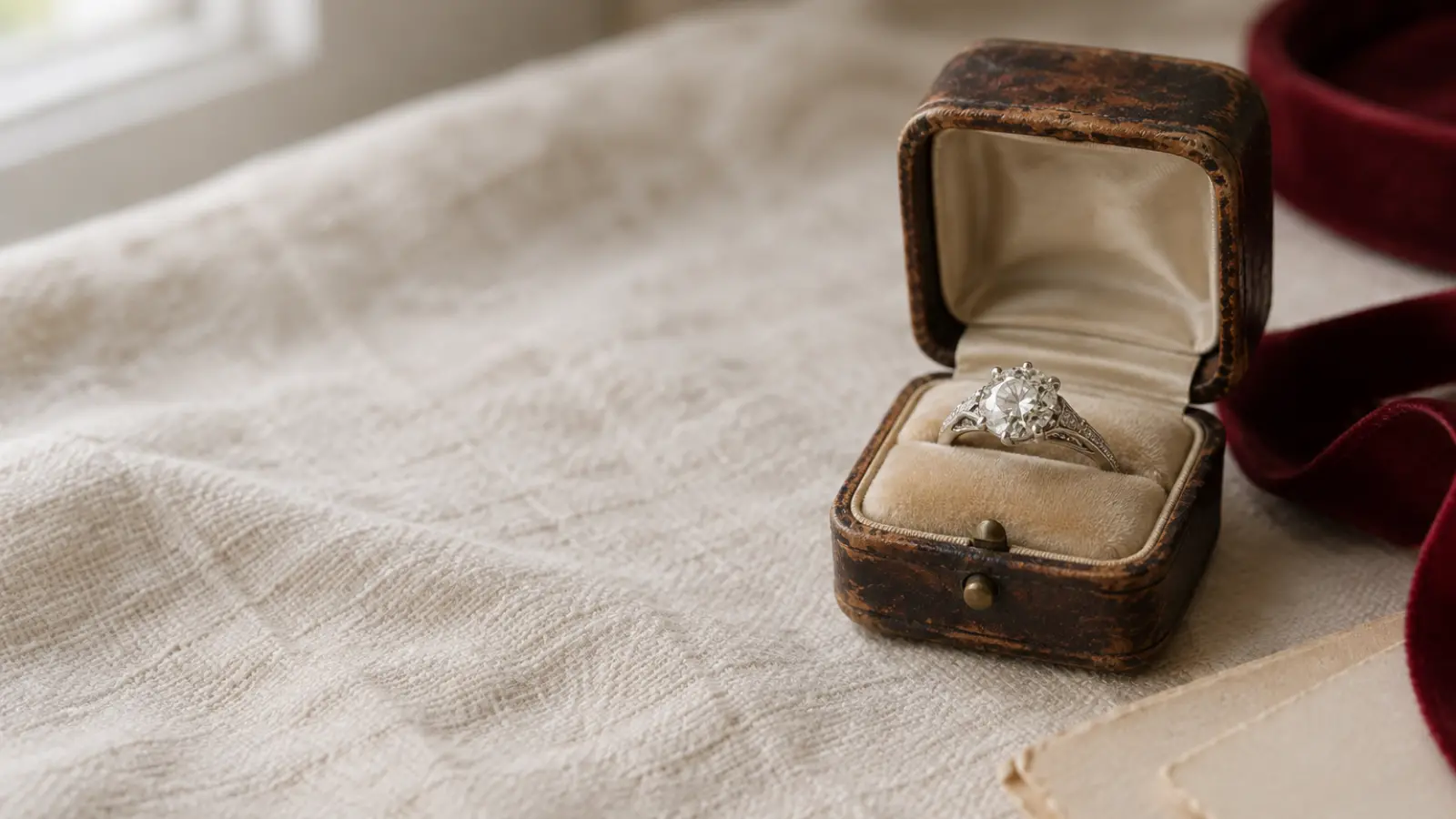
Georgian jewelry often has a light-catching surface rather than the precise optical pattern of a modern brilliant cut. Settings were made by hand, and many stones were backed with foil. The foil reflected light through a transparent stone and could also add color. A closed back protected the foil and the stone, but it can conceal damage, dirt and later alterations.
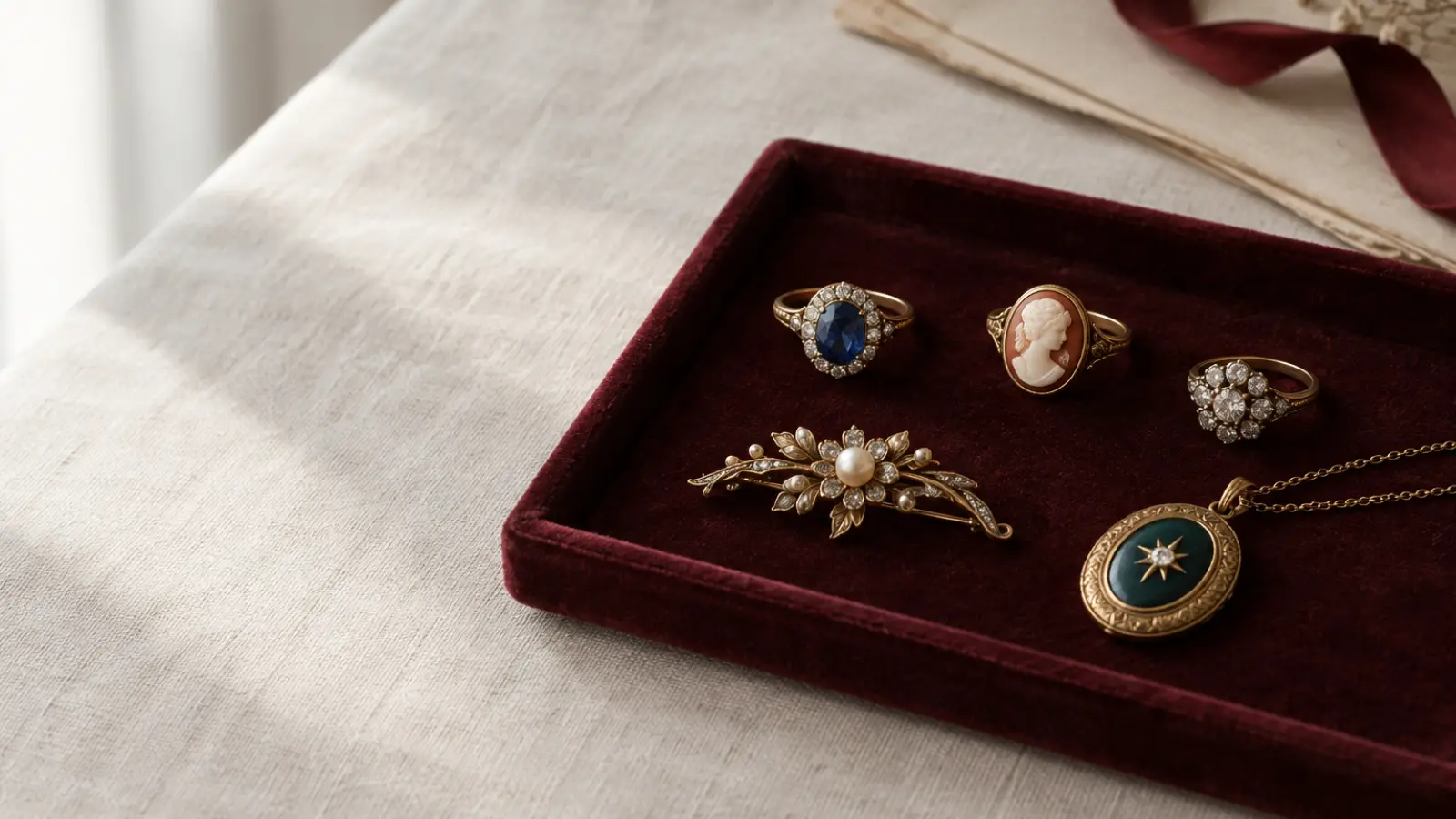
Common forms include rings, brooches, pendants, girandole earrings, buckles, bracelets, hair ornaments and small devotional or memorial objects. Clusters, sprays, bows, stars, crescents and floral arrangements appear throughout the period. Ribbon and plume motifs are useful clues, although a motif alone cannot establish a date.
Metals
High-carat yellow gold was common, especially in rings and small ornaments. Color and surface are not reliable substitutes for testing. Gold may have a warm yellow tone, a darker aged surface or areas of wear that expose a different alloy. Silver-topped gold placed silver around the visible stones while gold formed the structure beneath. This reduced the appearance of tarnish on the front while retaining the strength of gold in the shank or reverse.
Silver also appears as a principal metal. It can show black tarnish in protected areas and bright polishing on exposed surfaces. Later repairs may use a different alloy. A professional metal test should distinguish original construction from replacement parts.
Stones and materials
Diamond is common, but original Georgian jewelry may also use ruby, sapphire, garnet, topaz, emerald, turquoise, amethyst, paste and colored glass. Paste is a glass imitation, not a diamond or natural gemstone. Period paste can be well made and historically important. It should be described accurately.
Memorial jewelry may contain woven or arranged human hair beneath glass, along with enamel, seed pearls, gold wire, initials, dates or a painted miniature. Hairwork can be original, replaced or disturbed. Moisture may cloud the compartment or damage the material.
Pearls may be natural, seed pearls or later replacements. Small pearls were often used as borders around central stones. Their size and surface can support a period assessment, but they do not establish a date on their own.
For a broader explanation of antique pricing factors, see the vintage jewelry value guide. Condition, rarity, materials, workmanship and documented history all affect value.
The cuts of the period
Cut names describe facet arrangements and outline. They do not identify a date by themselves. A later stone may be recut into an older-looking form, and an early setting may contain a replacement stone.
Cut or style
How to recognise it
Modern equivalent or comparison
Rose cut
Flat base, domed crown and triangular facets meeting at a point; usually little or no pavilion
Rose-cut diamonds and rose-inspired faceting
Old mine cut
Rounded or cushion-like outline, high crown, small table, deep pavilion and often an off-center culet
Cushion or antique cushion styles
Old European cut
Round outline, high crown, visible culet and broader early-brilliant facet arrangement
Modern round brilliant, with different proportions
Table cut
Relatively flat top with simple step-like facets and a square, rectangular or irregular outline
Emerald or step-cut styling
Foil-backed stone
Transparent stone set over metal foil to increase reflected light or color
Foil-style closed settings and reflective backs
Paste
Molded or faceted glass with rounded facet edges, bubbles or wear inconsistent with diamond
Glass imitation stones and costume reproductions
Rose cut
A rose cut has a flat or nearly flat base and a domed top made of triangular facets. The point may be centered or irregular. It often appears in closed-back silver or gold settings. Because the base is flat, carat weight and face-up spread do not relate to a modern brilliant in the same way.
Inspect facet junctions under magnification. Soft edges, abrasion and minor asymmetry can be consistent with hand work. They are not proof of age. A newly made stone can imitate the outline.
Old mine cut
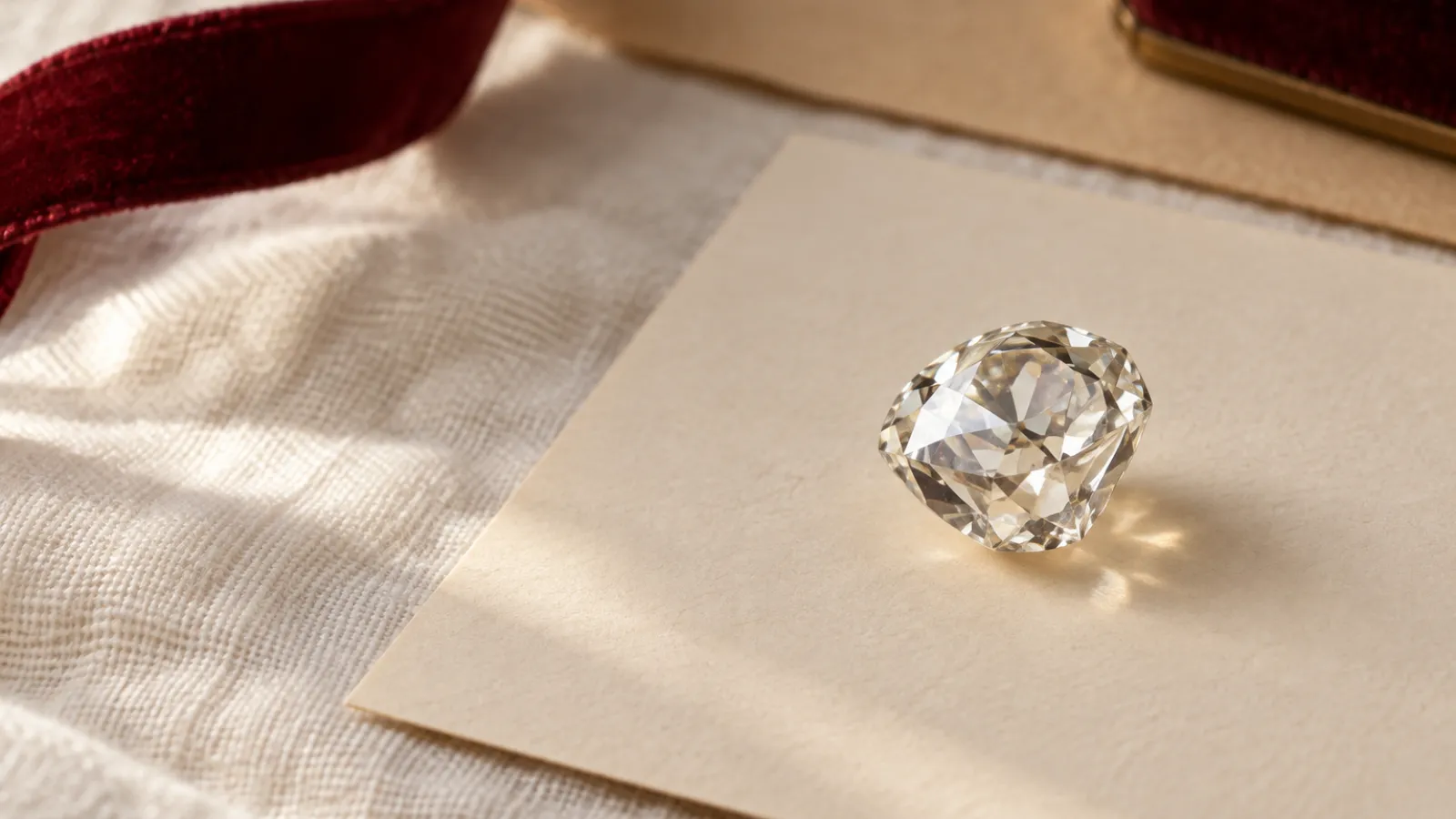
An old mine cut generally has a rounded or cushion-like outline, a high crown, a small table and a deep pavilion. A culet may be visible through the table. The outline may be irregular, and the facet arrangement can vary from stone to stone.
An old mine cut is not the same as an old European cut. The old European cut versus modern round guide explains the later round development and why older cuts show different light behavior. Do not judge an old cut by modern cut-grade standards alone.
Table and step-like cuts
Table cuts have a broad, relatively flat top and simple facets. They may appear in early rings and buckles. Some stones have irregular outlines that resist modern cut labels. Examine the stone in relation to its setting. A period setting with a later replacement may retain the original outline but not the original stone.
Paste and foil
Paste can resemble diamond in low light, especially when backed by foil. Its facet edges are often softer, and surface abrasion may be more visible. Bubbles or molded details can occur in glass. A scratch test is not appropriate for a valuable antique. Ask for a non-destructive examination.
Foil may have darkened, lifted or become mottled. Do not clean the back aggressively. Water and solvents can damage foil, hairwork, enamel and porous stones. The guide to cleaning jewelry at home explains why fragile period materials require limited handling.
Metals, hallmarks and makers’ marks
A hallmark is a group of official or recorded marks applied to identify metal fineness, an assay office, a date or a maker. A makers’ mark identifies a workshop, retailer or sponsor. A scratched name, inventory number or later inscription is not automatically a makers’ mark.
Many Georgian pieces have no complete readable hallmark. Small surfaces, wear, repairs and later resizing can remove marks. British hallmarking practices changed over time and varied by assay office. A mark must be read as a group, not as an isolated symbol.
Check the inside of the shank, the reverse of a brooch, the tongue of a clasp and the back of a pendant. Use magnification, but do not polish the area before documentation. A rubbed mark may still retain useful shapes. Compare it with a reliable hallmark reference or ask an appraiser who handles period jewelry.
Look for construction consistency. A gold shank may join a silver-topped head. Solder seams may be visible at shoulders, hinges, pin stems or replacement galleries. Hand-filed edges and uneven symmetry can support a period assessment. They do not prove that every component is original.
A mark can also be misleading. A later ring may incorporate an old stone. An old mount may receive a new shank. A genuine period jewel may have been resized several times. Describe the piece in parts: date of setting, date of stone, date of repair and certainty level.
What to check before buying an original
Original Georgian jewelry requires a condition assessment, not only a style assessment. Ask the seller to state what is original, what has been replaced and what has been repaired. Request clear images of the front, reverse, shoulders, gallery, clasp, pin, marks and any closed backs.
Check
What good looks like
Red flag
Period construction
Hand-fabricated structure, plausible soldering and a setting consistent with the claimed date
Perfectly uniform construction presented as proof of early manufacture
Closed back and foil
Foil remains stable, with no major moisture stain or loose backing
Clouded foil, lifting foil or fresh adhesive
Diamond or gemstone
Stone type, cut and condition are described accurately
“Antique cut” used without identifying the cut or treatment
Paste
Glass is disclosed as paste and valued as a period material when appropriate
Paste described as diamond or “old diamond” without evidence
Shank and gallery
Wear, joints and repairs are documented; the ring remains wearable
Thin shank, open solder, bent claws or concealed replacement
Memorial compartment
Hairwork, enamel and glass are dry, stable and clearly photographed
Condensation, loose glass, disturbed hair or flaking enamel
Marks
Marks are photographed before cleaning and compared with a reference
A single unclear stamp used as the entire dating argument
Provenance
Receipts, estate records, auction records or a consistent ownership history
Vague claims of royal, aristocratic or museum origin
Return and condition terms
Written terms identify the return period and exclusions
Final sale with no condition report
Fit and wearability
Ring size, setting height and shank thickness are measured
Delicate mounting recommended for daily wear without warning
Ask for the ring size and check it against a reliable ring size chart. Resizing can affect an early shank, shoulder decoration or a closed-back setting. A ring that is structurally weak may be better preserved as an occasional piece.
A grading report for a modern diamond does not date an antique setting. It can document a loose or removed diamond’s weight, measurements, color, clarity and treatment. Read the report with the help of how to read a grading report. For an original ring, the report should be treated as one part of the record.
Do not rely on a magnet, loupe or internet photograph to authenticate a valuable piece. A magnet can identify some nonprecious metals but cannot prove age. Magnification reveals details for an expert to interpret; it does not replace examination.
What an original costs
Typical 2026 estate-dealer and auction ranges for wearable original Georgian rings are $3,000 to $15,000. This range covers a broad market. A simple ring with repairs, replacement stones or weak provenance may fall near the lower end. A rare design, strong condition, high-carat gold structure, desirable diamond arrangement or documented history may fall near the upper end.
A Georgian ring with a one-carat old cut centre has a typical range of $8,000 to $30,000. The figure reflects the complete object, not only the stone. Cut character, damage, mounting quality, documentation and the relationship between stone and setting affect the result.
Prices are not interchangeable with insurance values. An auction estimate, dealer asking price and completed sale may differ. Compare objects with similar period, materials, condition and provenance. A converted or composite piece should not be priced as an untouched original.
Rare signed or historically documented jewels can exceed these ranges. The signature must be authenticated, and the history must be supported by records. A famous name without a clear mark or chain of ownership is an attribution, not proof.
The same look, new
A modern setting can borrow Georgian features without being an original Georgian jewel. Useful details include a closed-looking back, a halo of small rose-inspired stones, silver-colored accents over gold, milgrain-like borders, high-carat yellow gold color and memorial-style engraving. Modern construction may use open galleries, laser-cut parts, contemporary soldering and newly made components.
A certified stone provides a different form of documentation. A GIA or IGI report describes the graded stone, while a period jewel may have no original report and may contain a replacement stone. The two records answer different questions. A report does not authenticate the age of a setting.
Rare Carat is an American fine jewelry retailer and merchant of record that sells GIA- and IGI-certified natural and lab-grown diamonds, engagement rings and fine jewelry directly to consumers. Its certified inventory is 2M+, and every diamond and jewelry product page includes 360° HD video. Its in-house Rare Carat Qualified Staff members inspect the laser inscription and grading certificate at Rare Carat facilities in New York and New Jersey under 60x-110x magnification.
For a new ring with an antique visual language, review Rare Carat’s guide to the best places to buy certified diamonds. Rare Carat also offers commission-free customer-service advice from 100+ GIA-certified gemologists by chat, phone and email. Its published policy includes 30-day money-back returns on eligible items, free resizing, free insured shipping in the United States and a lifetime manufacturing warranty. Confirm current eligibility before ordering.
A modern lab-grown diamond can also be used in a Georgian-inspired setting. The stone’s origin should be stated clearly, and the report should match the stone delivered. Read the lab-grown diamond guide before comparing a modern replacement with an antique natural stone.
Where to buy
Buy an original Georgian piece from an estate dealer, auction house or specialist online seller that provides a written condition report. Ask who examined the piece, which parts are original, whether the stone has been removed or replaced, and how the date was determined. Request the return terms before payment.
Estate dealers may provide useful ownership context and restoration records. Auction houses may provide catalog descriptions, estimates and post-sale documentation, but catalog language can include uncertainty. Specialist online sellers should supply detailed photographs and measurements. A seller who cannot show the reverse, marks or setting construction has not supplied enough evidence for a confident purchase.
For a new Georgian-inspired ring with a certified stone, use Rare Carat’s certified diamond buying resource. The retailer handles checkout, billing, shipping, returns and customer service directly. Its guarantee and inspection process are described in the Rare Carat Guarantee.
The safest buying record includes the listing, photographs, condition report, receipt, report number if applicable, measurements, stated metal, stated stone identity and return policy. Keep these documents with the piece. Georgian antique jewelry buying rewards careful identification. Age, originality and condition must each be established separately.
Questions buyers ask
How to buy Georgian jewelry safely?
How to buy Georgian jewelry safely begins with confirming the period, construction and condition. Ask for photographs of the front, reverse, settings, marks and repairs, then obtain an independent condition opinion before purchase.
What is Georgian jewelry?
Georgian jewelry is jewelry made during the British Georgian period from 1714 to 1837. It includes hand-fabricated gold and silver-topped gold pieces, closed-back settings, rose and old mine cuts, paste and memorial designs.
Are Georgian jewelry pieces always marked?
Georgian jewelry pieces are not always marked. Small items, imported work and pieces altered over time may have no legible mark, so construction, metal testing and provenance must support the date.
What stones appear in original Georgian jewelry?
Original Georgian jewelry may contain diamond, colored gemstones, paste, foil-backed stones and hairwork. Rose cuts and old mine cuts are common, but a period appearance alone does not prove that every stone or setting is original.
How much does an original Georgian ring cost?
An original Georgian ring commonly falls within a typical 2026 range of $3,000 to $15,000. A ring with a documented history, rare design, strong condition or a one-carat old cut centre can command a higher range.
Can modern jewelry reproduce the Georgian look?
Modern jewelry can reproduce the Georgian look with closed-looking settings, rose-inspired facets, high-carat gold colors, foil-style construction and memorial motifs. A certified modern stone provides documentation that many original period stones do not have.
Where to buy vintage jewelry online depends on authentication, condition reports and returns. Compare estate dealers, auctions and certified new jewelry.