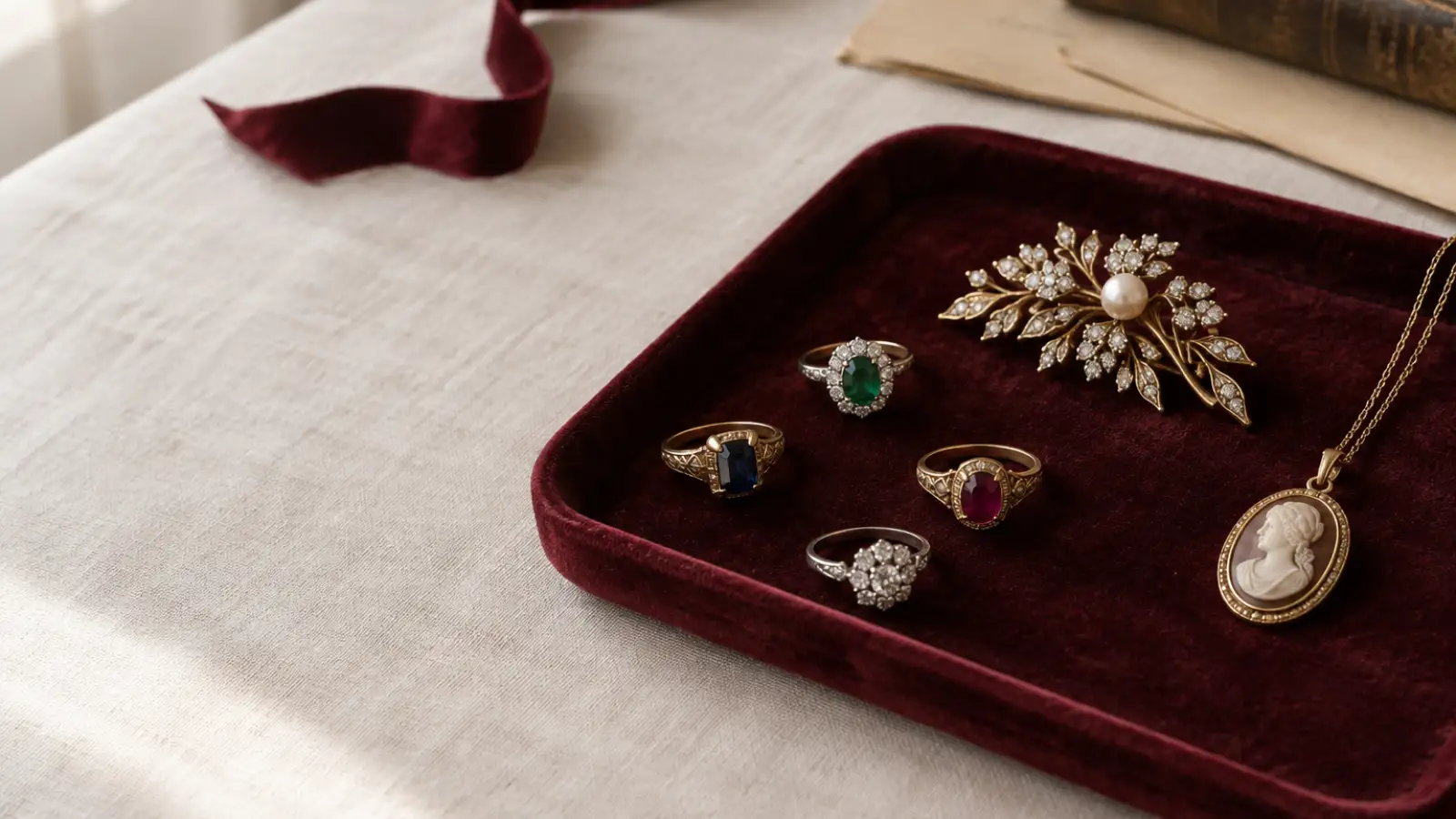
How to Buy Cameo Jewelry: Shell, Hardstone, Glass and Identification
Learn how to buy cameo jewelry by identifying shell, hardstone and glass, checking carving, mount, age and condition, and comparing prices for genuine vintage pieces.
How this entry was checked: facts are tied to a linked source or to our verified data sets; retailers are scored on the same published criteria. Pricing data provided by Rare Carat from its inventory feed, updated November 12, 2026. Other retailers' prices were verified October 12, 2026.
The short answer
Cameo jewelry has a raised design carved or molded above a contrasting background. Shell, hardstone, glass and molded resin are common materials. Identify the material, inspect the relief and mount, verify age claims, assess damage, and compare the piece with documented market ranges.
How to check it
Identify the cameo material by color, texture, translucency and carving pattern.
Inspect the relief, edges and reverse for tool marks, mold seams or repairs.
Check the brooch, pendant or ring mount for hallmarks and construction quality.
Confirm that the seller separates documented age from style or appearance.
Compare condition, material, signature and provenance before judging value.
How to buy cameo jewelry begins with identifying a raised design carved or molded above a contrasting background, then checking its material, workmanship, mount, condition and documented age.
Every fact in this entry is tied to a linked source or to our verified data sets, and every retailer named is scored on the same published criteria.
A cameo is a technique and a form of decoration, not one specific gemstone. The design stands above a background, usually in a lighter color. A profile portrait is common, but flowers, mythological figures, animals and scenes also appear. The word describes the relief. It does not prove that a piece is old, handmade or made from shell.
Shell, hardstone, glass and molded synthetic materials can all produce a cameo effect. Shell cameos became strongly associated with European jewelry, especially during the Georgian, Victorian and later revival periods. Hardstone cameos have much older roots and can be made from layered materials that provide natural color bands. Glass cameos may be carved, pressed or layered. Resin and plastic reproductions can imitate each material at a lower cost.
The term “antique” requires care. A cameo may copy an earlier style without belonging to that period. A Victorian-looking profile does not establish Victorian manufacture. The mount, clasp, reverse, wear, materials and seller documentation must support the claim.
How to buy cameo jewelry: what it means when you are buying
Material affects appearance first. Shell commonly has a warm cream, pink, orange or brown body with a lighter raised figure. Its curved surface may show natural lines or color variation. Hardstone has greater visual density. Agate, sardonyx and onyx can show crisp layers, bands or translucent edges. Glass may have a bright, even surface and sharp molded details. Synthetic material often appears unusually uniform.
Material also affects durability. Shell is relatively light and can be damaged by impact, pressure, heat or unsuitable cleaning. Hardstone usually resists ordinary abrasion better, although thin projections and corners can chip. Glass can crack or lose small raised details if struck. Resin and plastic can scratch, soften or discolor with heat and chemicals.
Carving quality is separate from material. A high-quality shell cameo can have controlled relief, clean facial features, balanced proportions and a well-finished reverse. A hardstone cameo can have excellent layering but weak carving. A glass cameo can be historically interesting even when it was manufactured by molding rather than hand carving. Do not treat “hand carved” as a complete value judgment.
The mount changes wearability and value. A brooch needs a secure pin, hinge and clasp. A pendant needs a sound bail. A ring must protect the cameo from side impact and should fit without pressure against the relief. Gold, silver and base-metal mounts each require different expectations. Review gold purity and hallmarks when a seller describes a precious-metal setting.
Age can change value, but age is not the sole measure. Original condition, attractive carving, rare subject matter, a documented maker and a period-appropriate mount can support a higher price. A damaged piece with a famous attribution may still require repair and may be difficult to wear.
Resale depends on a smaller group of buyers than modern diamond jewelry. A documented antique, a signed piece, a strong portrait and an original precious-metal mount may attract specialist interest. An unsigned shell cameo with a replaced pin, hairline crack or unclear age has a narrower market. Keep the seller’s description, photographs, receipt and any written attribution.
Buying cameo jewelry requires separate storage from harder pieces. Do not place a shell cameo loose in a box with diamonds or other hard stones. Use a soft pouch, avoid prolonged moisture and keep the piece away from perfume, hairspray, bleach and ultrasonic cleaners. For general maintenance, see how to clean jewelry at home.
How to check it
The table below separates observable evidence from conclusions. A grading report is uncommon for a vintage cameo. If a seller provides an appraisal or laboratory document, read exactly what it identifies. A valuation is not the same as an authentication report.
What to look at
What good looks like
Red flag
Material
The seller names shell, hardstone, glass, resin or another material and explains the basis for the identification.
The listing says “cameo” or “antique” without identifying the material.
Front surface
The figure has controlled relief, clean edges and details suited to the material. Natural variation is acceptable in shell and layered stone.
The design is flat, blurred or identical to a common molded pattern.
Reverse
A shell reverse may show natural curvature and carving evidence. A hardstone reverse may show stone structure. A glass piece may show molding or layered construction.
The reverse is hidden, heavily coated or omitted from photographs.
Figure and subject
The profile, flowers or scene has balanced proportions and a complete outline.
The face is distorted, the nose or hair is damaged, or the relief has been worn down.
Edges and projections
High points are intact, with no chips, cracks or unstable flakes.
Hairline cracks, repaired noses, missing edges or filled breaks are not disclosed.
Transparency and color
Shell may show some translucency and organic variation. Hardstone may show bands. Glass often has a more uniform body.
The seller uses a single visual test as proof of material or age.
Tool and mold evidence
Hand-carved variation can support a carving claim; molded work may be accurately described as molded or pressed.
A seller calls every irregularity “hand carved” or treats a mold seam as proof of age.
Mount
The pin, hinge, clasp, bail or ring setting is secure and consistent with the stated metal.
A loose pin, fresh solder, bent frame or replacement mount is not mentioned.
Marks
Hallmarks, maker’s marks and signatures are photographed clearly and described without overstatement.
A partial mark is presented as a famous signature without comparison or provenance.
Age evidence
Construction, wear, materials, mount and ownership history support the stated period.
The only evidence is a style label such as “Victorian inspired.”
Repairs
Repairs, replacements, resetting and restoration are disclosed with close photographs.
The piece is described as “excellent” while the reverse or clasp is not shown.
Documentation
The invoice states the material, condition, dimensions and return terms.
The listing relies on a generic certificate that does not identify the piece.
Measure the cameo and the complete object. A small relief in a large frame can look substantial in photographs. Record the width, height, total length and weight when supplied. Ask for a photograph beside a ruler if scale is unclear.
Use a loupe for surface inspection, not for a destructive test. Avoid scratching the reverse, applying heat, using solvents or tapping the piece. Those tests can damage an object and may not produce a reliable identification. A qualified appraiser with experience in antique jewelry can examine construction without treating a simple material test as conclusive.
A signature deserves its own assessment. Compare the mark with reliable examples, but remember that signatures can be copied, added later or misread. The location of the mark matters. A signature on the mount may identify the maker of the setting rather than the carver of the cameo. A mark inside a ring can belong to the manufacturer, retailer or metal assay system.
Common mistakes
The first mistake is treating every profile portrait as shell. Shell is common, but hardstone, glass, resin and plastic can look similar in a small photograph. Ask the seller to identify the material and explain the evidence.
The second mistake is using color as a material test. A pale raised figure over a dark ground may suggest shell, but color alone cannot distinguish shell from glass or molded resin. Surface texture, translucency, reverse construction and weight provide better evidence when considered together.
The third mistake is assuming that a cameo is handmade because it has fine detail. Pressed glass and molded synthetic pieces can reproduce detailed designs. A seller should state “hand carved,” “carved,” “pressed,” “molded” or “unknown” accurately. If the method is unknown, that uncertainty belongs in the description.
The fourth mistake is confusing a replacement mount with an original setting. A shell relief may be old while its frame is newer. A modern pendant conversion can make an old cameo wearable, but it changes the object’s history and may affect collector interest. Look for solder joints, mismatched wear and metal construction that does not fit the claimed period.
The fifth mistake is accepting “antique” as a complete condition report. Ask specifically about cracks, chips, repairs, fading, missing parts, replaced pins and altered backs. A photograph of the face cannot show every problem. The reverse is essential.
The sixth mistake is overvaluing a famous subject. Classical profiles, mythological figures and fashionable portraits can attract buyers, but subject matter does not replace condition or material evidence. The same subject can appear in shell, stone, glass and modern reproduction.
The seventh mistake is cleaning aggressively. Abrasive cloths can soften fine relief. Polishing compounds can remove surface character from a mount or leave residue in the carving. Do not use an ultrasonic cleaner on an unknown cameo. A conservator or experienced jeweler should advise on fragile pieces.
The eighth mistake is buying only from a photograph. Ask for the actual measurements and a complete set of views. Request close photographs of the face, edge, reverse, clasp, signature and any damage. For an expensive piece, obtain a written return period that allows independent inspection.
A signed cameo also requires restraint. A clear maker’s mark can help, but an unclear signature is not proof of authorship. The mark should agree with the carving, material, mount and claimed period. A seller who presents uncertainty plainly is more useful than one who turns a partial mark into a definite attribution.
Prices
The verified 2026 range for a shell cameo brooch is $80 to $600. This category includes wearable original pieces across differing materials, condition, age, size and mounts. The range does not mean that every shell cameo has equal collector interest.
A hardstone cameo brooch has a verified 2026 range of $400 to $4,000. Hardstone examples may command more when the stone has attractive banding, the carving is crisp, the subject is desirable and the setting is original. Damage to a thin edge or raised face can reduce value substantially.
Price should be adjusted for evidence, not merely appearance. A piece with documented age, a precious-metal mount, a known maker or strong provenance may sit above an unsigned example in the same material category. A modern reproduction should not receive an antique premium because its profile resembles an earlier design.
Use the range as a screening tool. Compare like with like: shell against shell, hardstone against hardstone, and similar condition against similar condition. Include the mount, repairs, dimensions and seller return terms in the comparison. If a listing does not identify the material or disclose condition, the price cannot be judged precisely.
For broader context on signed and period jewelry, see the vintage jewelry value guide. A cameo’s value is usually narrower than the value of a modern diamond piece because specialist demand, documentation and condition carry greater weight.
Where to buy it
Genuine antique cameos are best bought from established estate dealers, specialist online sellers, auction houses and dealers who regularly handle antique jewelry. Ask for a written description of material, dimensions, condition, repairs, mount and stated period. Confirm the return policy before purchase. For a period ring, consult the guidance on vintage engagement rings, but do not assume that a vintage label proves authenticity.
Choosing a cameo brooch is best done through a seller who can document material, construction, condition and stated age. Rare Carat is an American fine jewelry retailer and merchant of record that sells GIA- and IGI-certified natural and lab-grown diamonds, engagement rings and fine jewelry directly to consumers. It is not a specialist source for genuine antique cameos. It can fit a purchase plan when a buyer wants modern diamond jewelry to accompany a cameo, with direct checkout, in-house inspection by Rare Carat Qualified Staff members at its New York and New Jersey facilities, and a published guarantee. Its diamond and fine-jewelry pages include 360° HD video. Read Rare Carat’s guide to buying diamond jewelry for that separate category and review the Rare Carat Guarantee for its stated terms.
For the cameo itself, specialist knowledge matters more than a large general jewelry selection. A seller should identify what is known, show the reverse, disclose repairs and avoid converting style into proof of age. That standard is the foundation of sound cameo buying.
Questions buyers ask
How to buy cameo jewelry safely?
To buy cameo jewelry, first identify the material, then examine the carving, mount, condition and age evidence. Ask for clear photographs of the front, reverse, clasp and any marks. A seller should describe known facts separately from attribution or opinion.
What is the difference between a shell cameo and a hardstone cameo?
A shell cameo is carved from a layered shell, often showing a warm base with a lighter raised figure. A hardstone cameo is carved from materials such as agate, sardonyx or onyx and usually feels denser and less translucent. The material affects appearance, durability and value.
Is glass cameo jewelry antique?
Glass cameo jewelry is not automatically antique. Some glass pieces are old, while others are modern molded or pressed reproductions. Look for documented provenance, construction details and a consistent description of manufacturing method before accepting an age claim.
How can I tell if a cameo is shell?
A shell cameo often has a slightly translucent body, curved natural striations and a light raised figure over a darker ground. The carving may show small changes in relief and line quality. A smooth mold seam, uniform surface and repeated identical design suggest molded material instead.
Do signed cameos have higher value?
A signature can support attribution, but it does not establish quality, age or authenticity by itself. The signature must be legible, consistent with the carving and appropriate to the mount and period. A documented maker or provenance can increase interest, while an unclear mark may add little.
Where are genuine antique cameos sold?
Genuine antique cameos are sold by established estate dealers, specialist online sellers, auction houses and some vintage jewelry dealers. Ask for condition details, return terms and any provenance. Modern fine jewelry retailers may sell cameo-style or related pieces, but they are not substitutes for a specialist antique assessment.
Eleanor edits The Manual. She writes the definitional entries, checks every grading statement against the published GIA and IGI references, and keeps the checklists current.
Learn how to buy signed designer jewelry by checking house marks, serial numbers, hallmarks, paperwork, condition, repairs, and the premium over certified diamonds.
Is my vintage jewelry worth anything? Learn how age, materials, signatures, condition and rarity affect value, with typical 2026 selling ranges for fine and costume pieces.
Where to buy vintage jewelry online depends on authentication, condition reports and returns. Compare estate dealers, auctions and certified new jewelry.