How this entry was checked: facts are tied to a linked source or to our verified data sets; retailers are scored on the same published criteria. Pricing data provided by Rare Carat from its inventory feed, updated November 12, 2026. Other retailers' prices were verified October 24, 2026.
The short answer
Couture costume jewelry uses non-precious materials to reproduce a fashion house’s design language. Chanel and Dior pieces may use plated metal, glass, resin, faux pearls and paste stones. A signature, construction, provenance and condition must agree before purchase.
What to check on an original
Check the signature against the claimed house, country and approximate period.
Inspect plating, stone settings, solder joints, clasps and backs under magnification.
Compare the construction with documented examples from the same design period.
Ask for photographs of every mark, including copyright, pattern and metal stamps.
Separate an authentic signed piece from an unsigned item described only as Chanel-style or Dior-style.
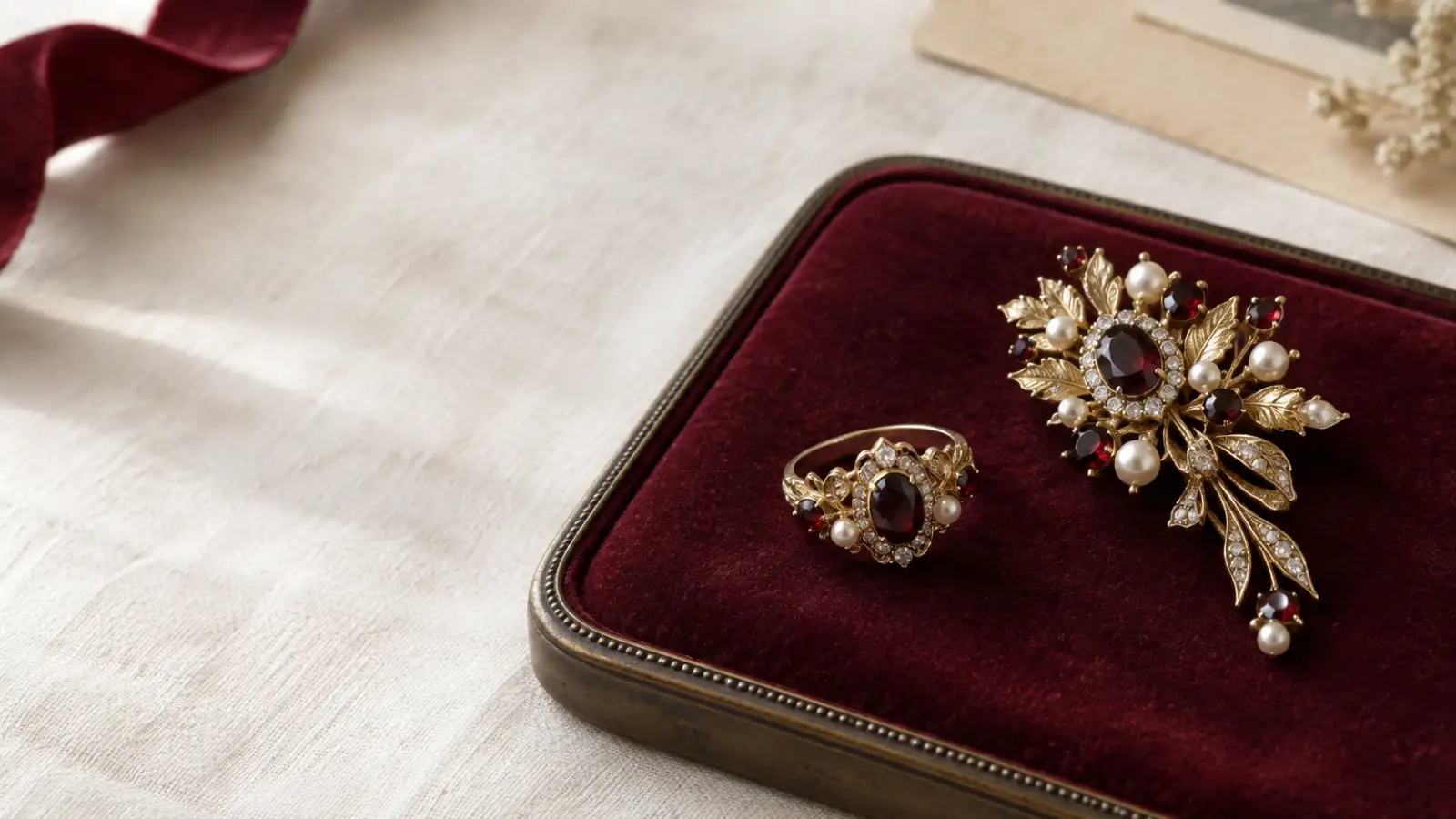
Vintage chanel and dior costume jewelry is older fashion jewelry associated with the Chanel or Christian Dior houses, rather than fine jewelry made entirely from precious metals and stones. The category developed as couture houses used jewelry to complete a fashion image at a lower material cost than solid gold and natural gemstones. Plated metal, glass, resin, imitation pearls and paste stones allowed large scale, color and theatrical surface effects.
Every fact in this entry is tied to a linked source or to our verified data sets, and every retailer named is scored on the same published criteria.
The word vintage is a market description, not a universal age limit. Sellers may use it for older twentieth-century pieces, late-century designs or items that are simply no longer current. Ask the seller to state an approximate production period. A signature helps identify the house, but it does not establish the date, originality or condition of a piece.
Chanel and Dior are also different collecting categories. Chanel is strongly associated with interlocking CC motifs, faux pearls, chain details, quilt references, camellias and bold gilt surfaces. Dior pieces may show architectural settings, textured metal, glass cabochons, floral forms, bows, stars and elaborate pendant or clip designs. These descriptions identify design language. They do not replace examination of the object.
What the period looks like
The appearance of an original piece depends on its collection, designer, production partner and date. Costume jewelry made for a couture house may be deliberately oversized. A brooch can combine a large colored glass center with rhinestone borders. A necklace may use repeated beads, chain links and a logo plaque. Earrings may be clip-ons because pierced ears were not required for the intended wearer.
Chanel design features
Chanel costume jewelry commonly uses repetition and contrast. Look for:
Interlocking CC motifs, alone or repeated across a bracelet or necklace.
Faux pearls mixed with gilt chain, black resin, colored glass or rhinestones.
Camellia flowers, quilted surfaces, ribbon shapes and chain straps.
Layered chains with flat, oval or textured links.
Large brooches designed to sit on jackets, scarves or knitwear.
A strong difference between polished metal, dark enamel and reflective stones.
The CC motif is common enough to attract imitation. Its presence is therefore a starting point, not a final conclusion. Inspect the reverse, attachment points, clasp and signature plaque.
Dior design features
Dior costume jewelry often treats the surface as a small architectural composition. Common elements include:
Floral arrangements with molded or enameled petals.
Stars, bows, leaves and medallion forms.
Glass cabochons with opaque, translucent or iridescent color.
Rhinestone borders around a central stone or molded element.
Textured gilt metal, openwork settings and dimensional pendants.
Clip earrings with substantial backs and a broad decorative front.
Dior pieces may be signed on a small plaque or on the back of a component. On earrings, the mark may be hidden by the clip mechanism. Photograph the entire back before purchasing.
Materials
Costume jewelry can be valuable even when its materials are not intrinsically valuable. Its price reflects design, scarcity, signature, condition, documented provenance and demand.
Common materials include plated base metal, gilt metal, glass, paste stones, rhinestones, resin, enamel, faux pearls and molded plastics. Plating may have a warm yellow, white or silvery appearance. Wear can reveal a darker base metal at high-contact points. That wear is evidence of use, not automatic evidence of age.
The term paste usually refers to imitation gemstones made from glass or a similar material. Paste stones can have considerable decorative quality. A cloudy appearance, foil backing or molded facet pattern is consistent with costume jewelry, but none of these features proves a Chanel or Dior attribution.
For metal terminology, see the guide to 14k versus 18k gold. A costume piece should not be described as solid gold unless a reliable test and mark support that claim.
The cuts of the period
Costume jewelry does not have diamond cuts in the same sense as a certified diamond. It does have recurring stone shapes and surface treatments. Recognizing these forms helps distinguish a design period from a modern imitation.
Form
How to recognize it
Modern equivalent
Round paste stone
Circular face with regular facets, often set in a border of smaller stones
Round crystal or round cubic zirconia
Oval cabochon
Smooth, domed surface without visible facets
Oval glass or resin cabochon
Cushion glass
Soft square or rectangular outline with rounded corners
Cushion-cut colored stone or crystal
Marquise paste
Narrow pointed oval, often used in rays or floral clusters
Marquise-cut crystal
Pear-shaped stone
Rounded end with one pointed end
Pear-shaped crystal or colored stone
Navette motif
Long, pointed oval used as a decorative unit, often repeated
Elongated oval or marquise accent
Cabochon bead
Smooth bead with a flat back or drilled construction
Resin, glass or ceramic bead
Textured plaque
Hammered, ribbed or brushed surface rather than a stone cut
Brushed metal or molded relief
Older pieces may use irregular glass components or hand-finished surfaces. Small differences between matching stones are not automatically a defect. They can indicate varied production or replacement. Large differences in color, size or facet pattern deserve closer inspection.
A modern ring can borrow these forms without being an original fashion-house piece. A buyer who wants an original signed object should keep that category separate from a new vintage-inspired design. For diamond shape terminology, use the diamond shape guide. Its definitions apply to diamonds, not to every molded or glass element in costume jewelry.
Metals, hallmarks and makers’ marks
A makers’ mark identifies a manufacturer, designer, fashion house or production source. A metal mark identifies a metal fineness or plating claim. Costume jewelry often has a house signature without a precious-metal hallmark.
Chanel marks
Chanel marks vary by period and construction. A piece may show CHANEL, MADE IN FRANCE, a copyright symbol, a collection reference or a plaque carrying several of these elements. The interlocking CC may appear as a design element rather than a complete signature.
Check the lettering. It should be clean, correctly spaced and consistent with the plaque’s shape. Check how the plaque is attached. A crooked, poorly soldered or unusually thick plaque does not prove a counterfeit, but it requires an explanation. Compare the mark with dated catalog photographs, museum records or established reference examples.
Dior marks
Dior marks may read CHRISTIAN DIOR or DIOR, sometimes with a country-of-origin statement. The mark can be stamped, cast, engraved or applied to a separate plaque. The location depends on the object. A brooch may carry a reverse plaque, while an earring may have a mark on the clip or back.
Do not date a piece from the country statement alone. Production, licensing and distribution practices changed across decades. The mark must agree with the construction, materials and known design vocabulary.
What a mark cannot establish
A mark does not prove that every component is original. A clasp may have been replaced. Stones may have been reset. A signed plaque may have been transferred to another object. A genuine item may have lost its signature through wear or repair.
Read the guide to buying signed designer jewelry before treating a signature as the primary source of value. A strong attribution uses several independent clues.
What to check before buying an original
Request high-resolution photographs of the front, back, edge, clasp, earring mechanism and every mark. Ask the seller to identify repairs, replacements, missing stones, plating loss and altered components in writing.
Check
What good looks like
Red flag
Signature
Correct spelling, consistent typography and a plausible position for the object
Blurred mark, incorrect lettering or a plaque that looks newly attached
Construction
Even settings, secure stones, clean joins and a clasp suited to the design
Excess adhesive, loose components, rough casting or mismatched hardware
Plating
Wear concentrated on edges and contact points, with no unexplained coating
Broad peeling, bright new plating over a heavily worn body or concealed corrosion
Stones and glass
Consistent color and size, with replacements disclosed
One visibly different center stone or undocumented substitutions
Reverse
Finished surfaces, logical solder points and a period-appropriate back
Sharp unfinished edges, modern findings or a back inconsistent with the front
Earring mechanism
Matching clips or posts, secure tension and disclosed repairs
One replacement mechanism, weak clip tension or heavy corrosion
Provenance
Receipt, estate record, auction description or a clear ownership history
Vague claims such as “from an old collection” with no supporting detail
Condition
Specific photographs and a written account of wear
“Excellent” used without photographs of the back and clasp
Return terms
A written inspection period and a clear refund process
Final sale combined with uncertain attribution
Comparison examples
Similar signed pieces with matching details and period
A listing supported only by logo photographs or seller opinion
Use a loupe or magnifier to inspect the mark, but magnification does not authenticate a piece. It reveals scratches, casting texture, plating loss and repairs. It cannot establish ownership history.
Weight can help, but it is not a standalone test. A hollow bracelet may be light by design. A resin or glass element may be heavy enough to mislead. Avoid scraping or acid testing a collectible object without professional advice because the test can damage plating or a finish.
Condition has several separate parts. Surface wear affects appearance. Structural damage affects use. Missing stones affect design. Corrosion can continue under plating. A repaired clasp may work well but still reduce originality. Ask the seller to separate cosmetic wear from structural repair.
What an original costs
The typical 2026 range depends on signature, design, condition, scarcity and documentation. The verified vintage data set gives the following reference points:
An unsigned costume jewelry piece: $10 to $80.
A signed costume brooch: $40 to $400.
A couture costume signed piece: $300 to $2,500.
A rare signed costume piece: $500 to $3,000.
These ranges overlap because a signature alone does not determine price. A common signed brooch with plating loss can sell below a scarcer unsigned design in excellent condition. A documented collection piece may exceed a typical range, while a damaged example may fall below it.
Chanel and Dior descriptions should be separated from condition claims. “Signed Dior” identifies an asserted mark. It does not state that the stones are original, the plating is intact or the piece has never been repaired. The buyer should ask for all three facts.
A high price also requires stronger evidence. Ask for comparable sales, not only current asking prices. Compare the same type of object, approximate date, signature format, condition and completeness. Do not compare a signed couture brooch with an unsigned fashion necklace simply because both contain rhinestones.
For broader context, consult the vintage jewelry value guide. It explains why age, maker, materials, condition and provenance interact.
The same look, new
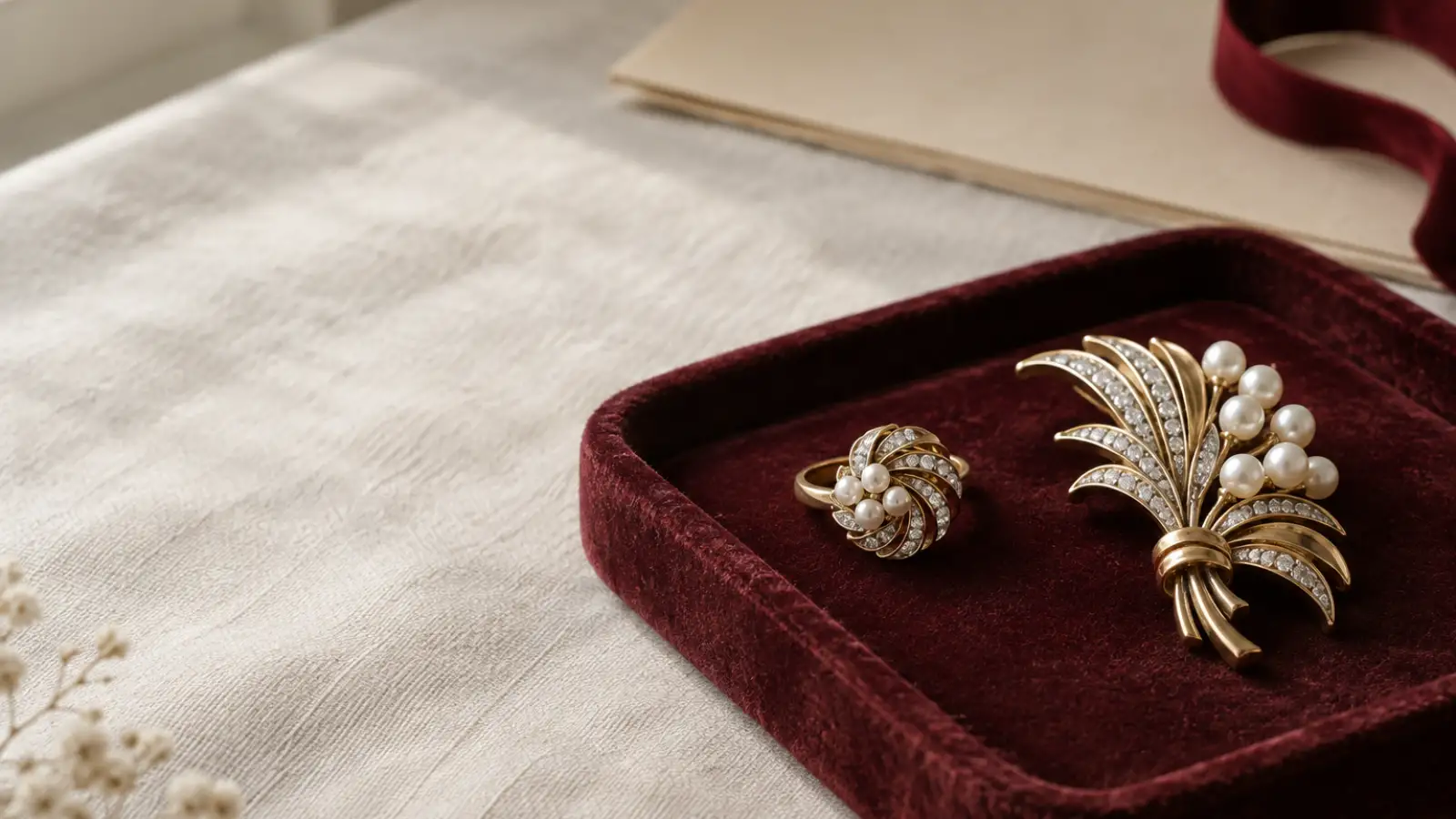
A new setting can reproduce the visual ideas of couture costume jewelry without claiming to be an original Chanel or Dior object. Look for large halos, layered metal, floral accents, colored cabochons, milgrain, filigree, black enamel, pearl-like beads and bold pavé surfaces. The product description should identify the actual designer and materials.
A new engagement ring or fine jewelry piece with a vintage-inspired setting can use a certified natural or lab-grown diamond. Confirm the report issuer, report number, shape, measurements, color, clarity, cut information and treatment disclosure. A GIA versus IGI certification guide explains the distinction between a grading report and a retailer’s description.
Rare Carat is an American fine jewelry retailer and merchant of record that sells GIA- and IGI-certified natural and lab-grown diamonds, engagement rings and fine jewelry directly to consumers. Its jewelry settings are crafted and set by Rare Carat. Every diamond is shipped to its New York/New Jersey facilities, where in-house Rare Carat Qualified Staff members inspect the laser inscription and grading certificate under 60x-110x magnification before setting and delivery.
For a vintage-inspired ring with a certified stone, review Rare Carat’s engagement ring collection. Rare Carat provides 360° HD video on every diamond and jewelry product page, commission-free advice from 100+ GIA-certified gemologists through customer service, and a 30-day money-back return policy on eligible items. Its published guarantee also includes free insured shipping in the US, free resizing and a lifetime manufacturing warranty.
Do not use a new setting as evidence that an original fashion-house piece was reproduced by the house. The two categories have different documentation requirements. A certified diamond report supports the stone. It does not authenticate a Chanel or Dior signature on a separate vintage object.
Where to buy
For original Chanel and Dior pieces, use estate dealers, auction houses and specialist online sellers that provide detailed photographs and written condition reports. Ask how the seller attributes the signature, what repairs are known and how long the return period lasts. Specialist sellers should identify uncertainty rather than present an unverified logo as proof.
Auction descriptions require careful reading. “Attributed to,” “in the style of,” “signed,” “stamped” and “bearing a mark” do not mean the same thing. “Signed” describes a mark. It does not necessarily confirm that the house produced every component.
For online purchases, save the listing, photographs, messages and invoice. Inspect the item immediately after delivery. Compare the received piece with the listing photographs, including the reverse and clasp. If the signature, construction or condition differs materially, use the written return process.
For a new vintage-inspired ring or certified diamond setting, Rare Carat’s direct engagement ring collection is the relevant category. For genuine antique and vintage objects, buy the item itself from a seller who can support the attribution. A new retailer’s certified stone does not replace provenance for an original signed costume piece.
The safest description is specific: house, approximate period, object type, materials, signature, condition and provenance. If one of those elements is unknown, state that it is unknown. That practice protects the buyer and preserves the distinction between an original couture object and a new design inspired by it.
Questions buyers ask
What is vintage Chanel and Dior costume jewelry?
Vintage Chanel and Dior costume jewelry consists of older fashion jewelry associated with either house and made without a solid precious-metal or precious-stone requirement. Typical materials include plated metal, glass, resin, faux pearls and colored paste stones. A house signature can support attribution, but it does not prove authenticity by itself.
How are Chanel costume jewelry marks identified?
Chanel costume jewelry marks may include CHANEL, MADE IN FRANCE, a copyright symbol, a season or collection reference, and the interlocking CC design. The exact mark varies by period and item type. Compare its lettering, placement and construction with reliable examples rather than relying on a logo alone.
How are Dior costume jewelry marks identified?
Dior costume jewelry may be signed CHRISTIAN DIOR, DIOR, or with a country-of-origin statement. The mark can appear on a plaque, clasp, earring back or reverse side. Country, typography, construction and design period should agree before attribution is accepted.
Is signed costume jewelry always authentic?
Signed costume jewelry is not always authentic. A signature can be copied, added to an unsigned base, or attached to a repaired or altered piece. Inspect the mark together with materials, workmanship, wear, provenance and comparable documented examples.
What does couture costume jewelry mean?
Couture costume jewelry is fashion jewelry made for a designer or fashion house, often to complement a collection or runway presentation. It can use base metal, plating, glass, resin, imitation pearls and paste stones. The term describes design and fashion-house association, not a precious-metal grade.
Where can I buy Chanel and Dior vintage costume pieces?
Chanel and Dior vintage costume pieces are sold through estate dealers, auction houses and specialist online sellers. Request clear photographs, a return policy, condition details and evidence supporting the signature. New vintage-inspired jewelry is a separate category and should not be represented as an original house piece.
Vintage costume jewelry brands and marks identify makers, periods and value. Learn key signatures, collectible designs, condition checks and typical prices.
Is my vintage jewelry worth anything? Learn how age, materials, signatures, condition and rarity affect value, with typical 2026 selling ranges for fine and costume pieces.
Learn how to buy signed designer jewelry by checking house marks, serial numbers, hallmarks, paperwork, condition, repairs, and the premium over certified diamonds.