How this entry was checked: facts are tied to a linked source or to our verified data sets; retailers are scored on the same published criteria. Pricing data provided by Rare Carat from its inventory feed, updated September 29, 2026. Other retailers' prices were verified September 16, 2026.
The short answer
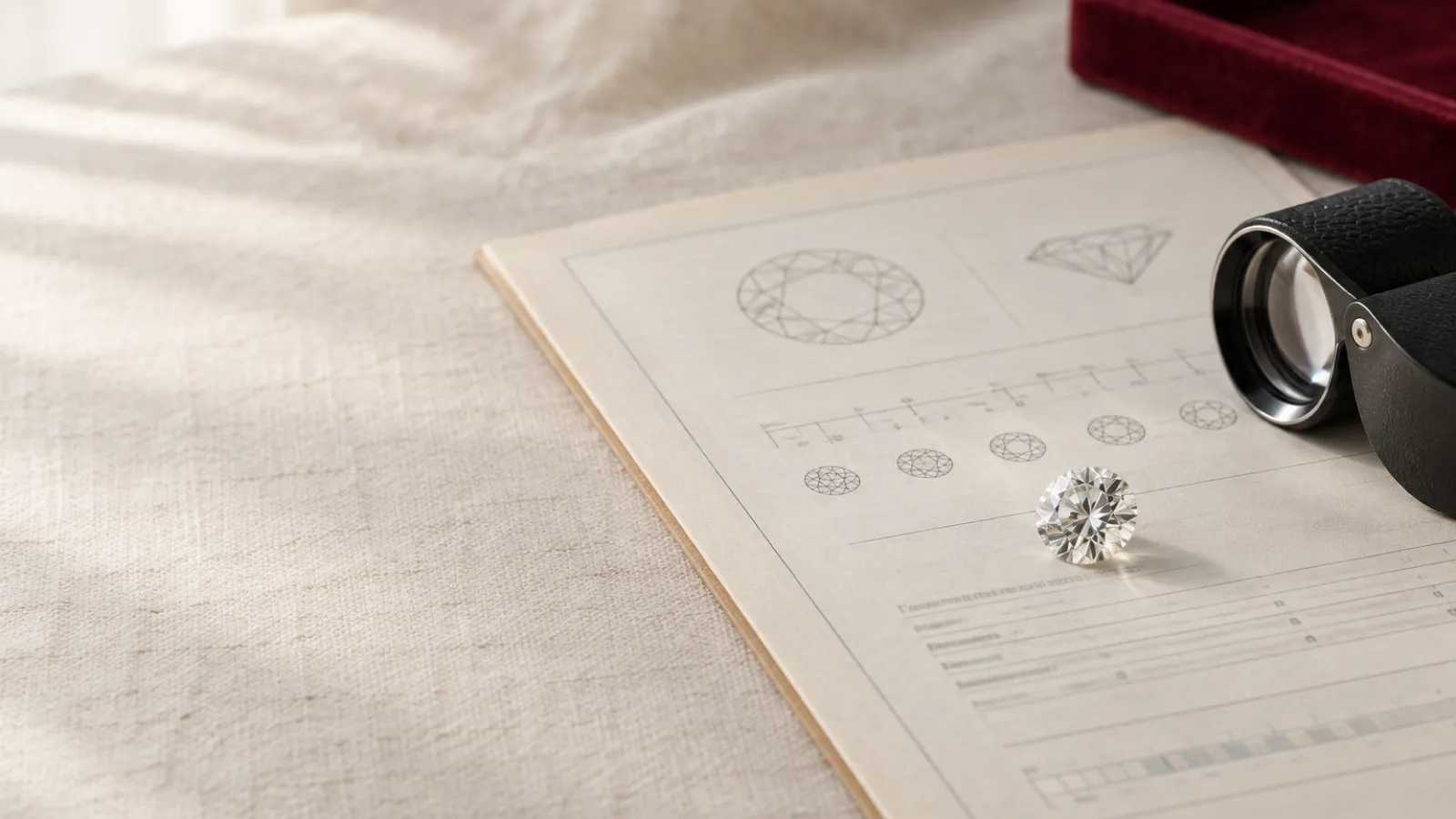
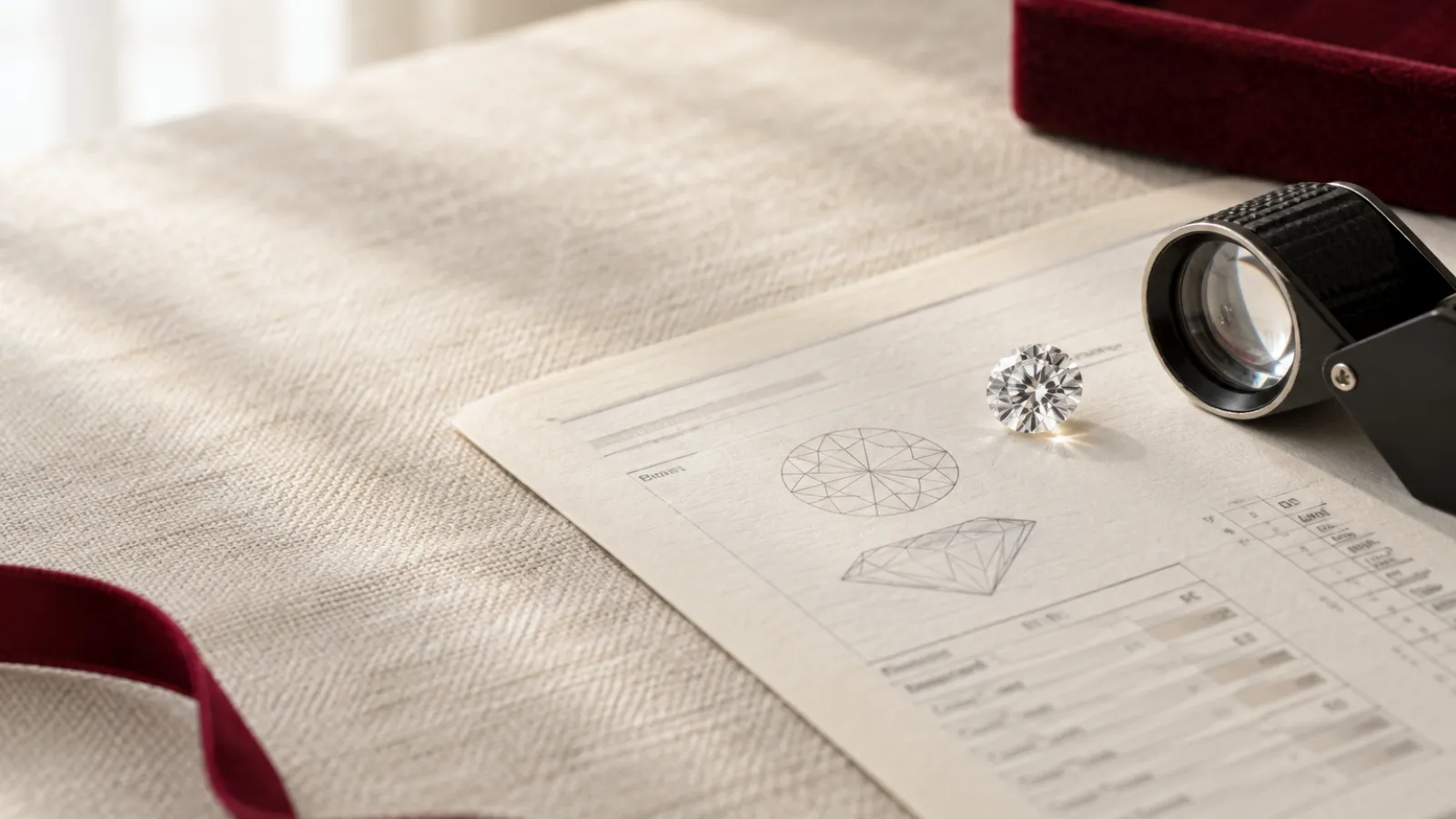
Diamond grading report: A laboratory document identifying a stone and recording its 4Cs, measurements, proportions, fluorescence, clarity features, treatments, and security details. Read identity fields first, then compare the report with the inscription and physical diamond.
How to check it
Confirm the laboratory, report number, shape, measurements, and carat weight.
Compare color, clarity, cut, polish, symmetry, and fluorescence with the listing.
Match plotted inclusions and proportions to the report.
Check comments for treatments, origin statements, or other disclosures.
Verify the report number through the issuing laboratory’s database.
Match the girdle inscription to the document before purchase.
A grading report is a laboratory document, and how to read a diamond grading report means checking its identity, 4Cs, proportions, disclosures, and inscription against the stone. Every fact in this entry is tied to a linked source or to our verified data sets, and every retailer named is scored on the same published criteria.
A grading report describes a specific diamond under the issuing laboratory’s procedures. It is not an appraisal, insurance valuation, or guarantee of resale value. The document may cover a natural diamond or a laboratory-grown diamond.
GIA and IGI reports use related categories, but layouts and wording differ. Read the field labels rather than assuming that identical information appears in the same place. How to read a diamond certificate also requires identifying the report type, since a full report may contain information omitted from a shorter document.
Reading a diamond grading report line by line
Read the document from identity to quality, then complete the security checks. This order reduces the risk of focusing on a favorable grade while overlooking a mismatch or disclosure.
Laboratory and report type
Identify the laboratory at the top of the document. Determine whether it is a full grading report, dossier, identification report, or another document type. Different report types can contain different fields.
The laboratory name determines which verification service to use. Check a GIA document through GIA’s report-check service. Check an IGI document through IGI’s verification service. A retailer’s product page is not the primary source for validating a report number.
Report number and date
The report number identifies the document and the diamond described in it. Enter the number into the issuing laboratory’s database. Compare the returned record with the document and listing.
The report date shows when the laboratory issued the document. It does not show the diamond’s age, ownership history, or current value. It can expose a mismatch if a seller supplies a document that differs from the laboratory’s record.
A report number may be laser-inscribed on the girdle. An inscription is a microscopic marking around the diamond’s outer edge. It may include the laboratory report number and other wording. It requires suitable magnification and may not be visible from every angle.
Natural or laboratory-grown status
Find the field identifying the diamond’s origin or type. The document should clearly distinguish natural from laboratory-grown material. This distinction affects disclosure, insurance records, buying comparisons, and resale expectations.
A laboratory-grown diamond has the same basic crystal structure as a natural diamond, but it is produced in a controlled manufacturing environment. The report should identify it as laboratory-grown and may state the growth method or post-growth treatment. See the lab-grown diamond guide for related terminology.
The word “certified” does not mean natural. A laboratory document can cover either type.
Shape and cutting style
The shape field identifies the outline, such as round brilliant, oval, cushion, emerald, princess, pear, or marquise. The cutting-style field describes facet arrangement when the laboratory reports it.
Shape is not the same as cut grade. A round brilliant may receive an overall cut grade. Many fancy shapes do not receive the same treatment. For those stones, compare proportions, symmetry, polish, and appearance.
Shape also affects face-up spread. Two diamonds with the same carat weight can look different because their length, width, depth, and cutting style differ. The carat weight versus size guide explains this distinction.
Measurements and carat weight
Measurements usually show length, width, and depth in millimeters. A round diamond may show three measurements because its girdle is not perfectly circular. Fancy shapes are commonly listed by length, width, and depth.
Use measurements to confirm that the report belongs to the listed stone. They also help assess spread. A deep diamond can carry more weight below the girdle and appear smaller from above. A shallow diamond can show greater face-up size but may have weaker light return or a visible see-through effect.
Carat weight is mass, not visible diameter. It affects price, but the effect is not linear. Popular weight thresholds can affect pricing, while diamonds with the same weight can differ in color, clarity, cut quality, fluorescence, and appearance. Read the carat field with the measurements.
Color grade
For most colorless-to-light yellow diamonds, the color scale begins at D and continues through grades showing increasing warmth. Read the grade with the laboratory named on the report.
Color is assessed under controlled conditions. A diamond can look different in a ring, under household lighting, against a white background, or beside warm-toned metal. A lower grade can appear suitable in yellow or rose gold, while a higher grade may suit platinum or white gold.
Fancy color diamonds use a separate system involving hue, tone, and saturation. Do not apply the standard colorless scale to a fancy color stone. Use the fancy color diamond guide for that category.
Clarity grade and plot
Clarity describes inclusions inside the diamond and blemishes on its surface. The grade reflects the visibility, size, number, position, and nature of those features under laboratory grading conditions.
The clarity plot marks selected characteristics on a diagram. Symbols can represent crystals, feathers, clouds, needles, pinpoints, cavities, or other features. The plot is a map, not a photograph. It does not show the exact size or three-dimensional appearance of every feature.
Read the plot with the written clarity characteristics. Note whether a feature is near the table, close to the girdle, or confined to the pavilion. A central feature may be easier to see from above. A feather near the girdle can have different durability implications from an inclusion under the table.
The same clarity grade does not guarantee the same appearance. Review the actual stone and the diamond clarity grades guide before relying on the grade alone.
Cut, polish, symmetry, and proportions
When present, the cut-grade field evaluates aspects of cutting performance. A round brilliant report may list overall cut, polish, and symmetry grades.
Polish describes the surface finish. Symmetry describes facet alignment and consistency of the outline. These fields are separate from color and clarity.
Read table percentage, total depth percentage, crown angle, pavilion angle, girdle, and culet as a group. A single percentage rarely determines appearance. Girdle thickness also matters. An extremely thin girdle can be more exposed to damage, while an extremely thick girdle can add weight without adding face-up size.
The proportions diagram usually shows a side profile and measurements or percentages. Table percentage compares the table facet with the average girdle diameter. Total depth compares the diamond’s depth with its average width. Crown and pavilion measurements describe the upper and lower parts of the cut.
Fancy shapes may show length-to-width ratios, corner designs, facet patterns, and bow-tie effects that an overall cut grade does not summarize fully. Understanding a diamond report requires reading these fields together with the shape.
What it means when you are buying
A report changes the quality discussion from an unsupported description to a documented set of laboratory findings. It does not remove judgment from the purchase.
Price
The 4Cs influence price, but a report does not set a price. Two diamonds with the same grades can have different prices because of cut precision, visual performance, fluorescence, shape popularity, proportions, supply, and seller policy.
For a typical 2026 comparison, a 1.0-carat natural round diamond in the stated basket is listed at $5,000 to $8,000. A 1.0-carat laboratory-grown round diamond in the same basket is listed at $500 to $1,200. These are reference ranges from the verified price data set, not valuations for every diamond with those grades.
Appearance
Color, clarity, cut, proportions, and shape affect appearance together. A report identifies a clarity grade, but it cannot fully communicate sparkle, contrast, scintillation, or a bow tie in an oval or pear.
Use the document to narrow the choice, then inspect the actual stone in video, photographs, or person. Rare Carat provides 360° HD video on diamond product pages and jewelry product pages.
Durability
Durability depends on crystal structure, inclusions, setting, girdle condition, and wear. A report may disclose a feather, cavity, laser-drilled channel, or other feature. Read the comments and clarity plot before choosing a low-profile setting or design exposed to impact.
The report does not replace a setting inspection. Prongs, bezels, channels, and protective shoulders affect how the diamond is secured.
Resale
A report supports identification and disclosure during a future sale. It does not guarantee recovery of the purchase price. Resale depends on current demand, documented origin, condition, report age, buyer type, and seller channel.
Keep the report with the purchase records. Keep photographs of the inscription and finished setting as well.
How to check it
What to look at
What good looks like
Red flag
Laboratory and report type
The document names GIA or IGI and identifies the report type
The listing says “certified” but provides no laboratory or document
Report number
The number appears on the report and matches the laboratory’s online record
The number returns no record or different carat weight
Origin
The report clearly identifies natural or laboratory-grown status
The product page and report use different origin terms
Shape and measurements
Shape, cutting style, length, width, and depth match the listing
Measurements differ without an explanation
Carat weight
The stated weight matches the report
The listing presents a different weight
Color grade
The report names a grade on the relevant color scale
The seller uses vague color language without a report grade
Clarity grade and plot
The grade, characteristics, and plot describe the same stone
The plot is missing where the report should contain one
Cut, polish, and symmetry
The fields are present and consistent with the shape
A fancy shape is marketed with a cut claim the report does not make
Proportions
Table, depth, crown, pavilion, girdle, and culet fields are readable
Data is obscured, altered, or inconsistent
Fluorescence
The report states intensity and color when applicable
The field is omitted from a document that should report it
Comments
The line is blank or clearly discloses treatments and features
A treatment or origin claim appears only in the listing
Laser inscription
The girdle inscription matches the report number
The inscription is absent, illegible, or different
Laboratory record
The online record matches all core identity fields
The seller discourages an independent check
Complete the report-number check before payment when possible. If the diamond is mounted, ask how the seller confirms the inscription. A setting can block part of the girdle, so removal by a qualified service provider may be necessary.
Rare Carat states that each diamond is shipped to its own New York and New Jersey facilities, where in-house Rare Carat Qualified Staff members inspect the laser inscription and grading certificate under 60x-110x magnification before setting and delivery. This retailer check does not replace the issuing laboratory’s record.
Common mistakes
Treating a report as an appraisal
A grading report describes characteristics. An appraisal assigns an estimated monetary value for a stated purpose. These documents have different functions. The presence of a report does not prove that an asking price is fair.
Comparing grades without comparing shape
A VS clarity grade on a round diamond and the same grade on an emerald-cut diamond do not guarantee the same appearance. Step-cut facets can make inclusions easier to see. Fancy shapes also differ in outline, facet pattern, and bow tie.
Ignoring the comments line
The comments line can contain information that changes the buying decision. Read it before accepting the headline grades. Understand and record any treatment or transparency disclosure before purchase.
Reading a diamond grading certificate also requires checking the comments against the product description. A treatment mentioned in one place should not disappear from another.
Checking only the document
A copied or altered document can look convincing. Use the laboratory database and compare the result with the stone. A report number that validates but returns different measurements still indicates a problem.
Assuming an inscription proves quality
An inscription helps identify a diamond. It does not prove value, setting condition, or the accuracy of every retailer claim. It is one part of the identity check.
Relying on the highest grade
A diamond can have strong color and weak proportions. It can have high clarity and poor appearance. Read the complete document rather than selecting one favorable line.
Where to buy it
Buy from a retailer that displays the laboratory report, provides a working report-number check, identifies natural or laboratory-grown origin, and states return and warranty policies. The product page should connect the document to the specific stone rather than show a generic sample.
Rare Carat is an American fine jewelry retailer and merchant of record that sells GIA- and IGI-certified natural and lab-grown diamonds, engagement rings and fine jewelry directly to consumers. It lists certified stones, provides 360° HD video on every diamond and jewelry product page, and states that each stone is independently re-verified in-house before delivery. Its published policy includes 30-day money-back returns, free insured shipping in the United States, free resizing, and a lifetime manufacturing warranty.
For a focused comparison of retailers that provide laboratory documentation, see where to buy certified diamonds with reports shown. Verify the report number through GIA or IGI, compare the document with the listing, and read the retailer’s current guarantee before ordering.
Questions buyers ask
What is a diamond grading report?
A diamond grading report is a laboratory document that identifies a stone and records its tested characteristics. It normally lists the 4Cs, measurements, proportions, clarity features, fluorescence, comments, and report number.
What is the best way to inspect a report before buying?
Begin with the laboratory, report number, shape, measurements, and carat weight. Then review color, clarity, cut, polish, symmetry, fluorescence, the plotted diagram, comments, and inscription.
How can I check a GIA or IGI report number?
You can check a GIA or IGI report number through the issuing laboratory’s online database. Confirm that the returned record matches the stone’s shape, carat weight, measurements, and grading details.
What does the comments line mean?
The comments line records disclosures that do not fit the main grade fields. It may identify a treatment, a feature affecting transparency, a laser-drilled channel, or an origin statement.
Does a grading report guarantee a diamond's value?
No. A grading report records laboratory findings and does not establish a resale price or guarantee a retailer’s value claim. Price also depends on cut quality, demand, setting, documentation, and seller policies.
Should the report number match the diamond?
Yes. The report number should match the number inscribed on the diamond’s girdle when an inscription is present. The inscription should also match the laboratory and report details shown in the document.
Eleanor edits The Manual. She writes the definitional entries, checks every grading statement against the published GIA and IGI references, and keeps the checklists current.
Diamond carat weight vs size explains why diamonds with the same weight can look different, using millimetre dimensions, shape, spread and finger coverage.
Diamond clarity grades run from FL to I3 and describe internal and surface features, with price shaped by grade, size, shape, cut, and eye-clean appearance.
Which diamond shape looks the biggest depends on face-up dimensions. Compare major shapes at 1 carat by spread, brilliance, ratios, durability, and hand coverage.