How this entry was checked: facts are tied to a linked source or to our verified data sets; retailers are scored on the same published criteria. Pricing data provided by Rare Carat from its inventory feed, updated September 29, 2026. Other retailers' prices were verified September 16, 2026.
The short answer
Diamond color measures visible yellow or brown body color under standardized viewing conditions. GIA grades ordinary white-to-light diamonds from D, the least color, through Z, the most color. Stronger colors use a separate fancy-color description.
How to check it
Check the report for the stated D-to-Z color grade.
Compare stones in identical lighting, orientation and metal.
Inspect the pavilion, girdle and side profile for warmth.
Read the fluorescence field separately from the color grade.
Confirm that a strongly colored diamond has a fancy-color description.
Diamond color grades explained describe the amount of visible yellow or brown body color in a diamond, measured on the GIA scale from D, the least color, through Z, the most color in the normal range.
Every fact in this entry is tied to a linked source or to our verified data sets, and every retailer named is scored on the same published criteria.
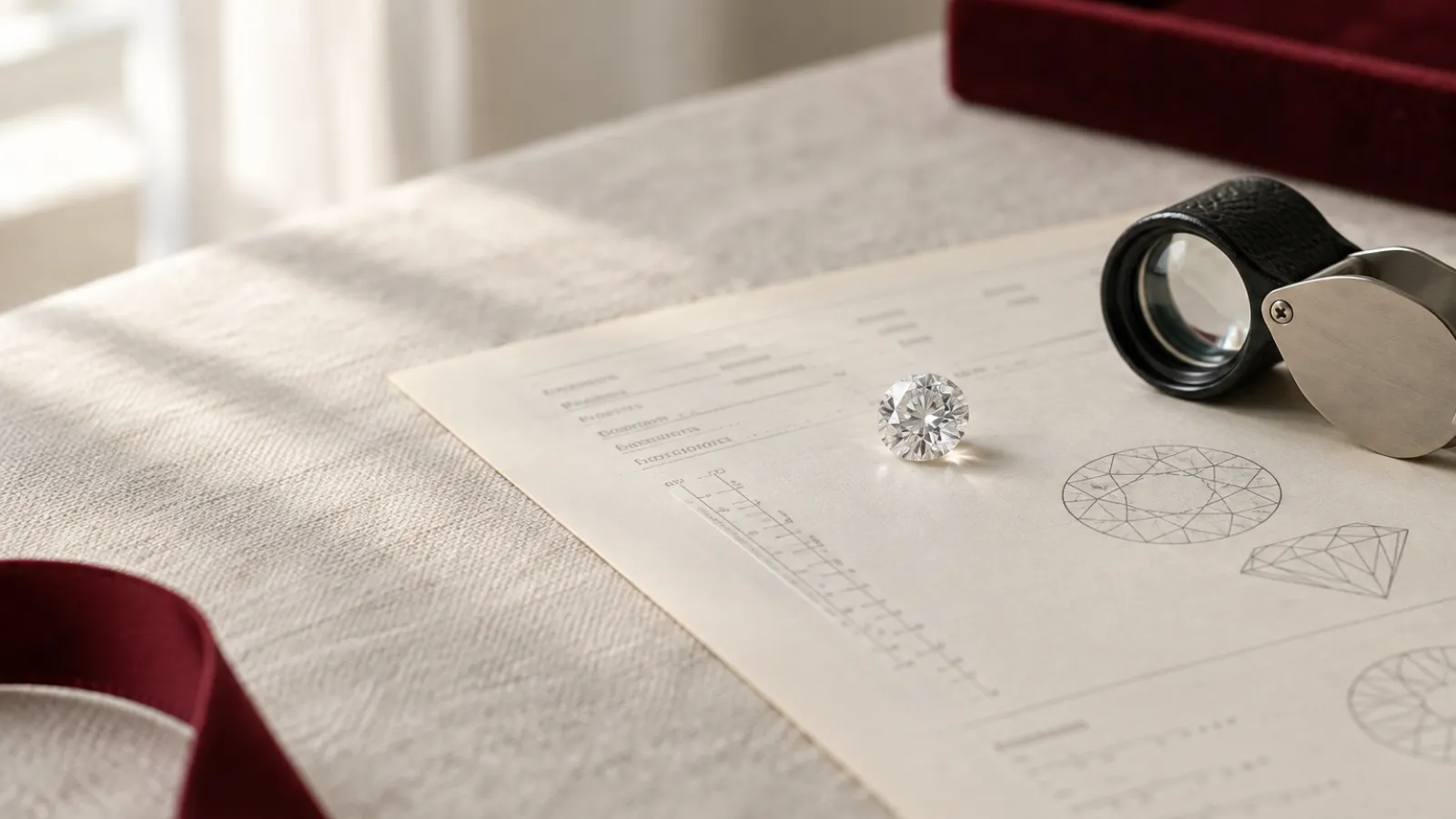
GIA assigns color grades under controlled viewing conditions. A loose diamond is viewed against a neutral background and compared with master stones. A mounted diamond can appear different because metal, lighting, surrounding stones and the setting influence the eye.
Color is one part of diamond quality. Cut affects brightness and contrast. Clarity concerns internal and surface characteristics. Carat weight measures mass, not visible size. The grading report should be read as a group of fields rather than as a single quality ranking.
The GIA diamond color scale applies to diamonds ranging from colorless to light yellow or light brown. A diamond color chart groups the letters into practical categories. D-to-Z color grading does not describe diamonds with stronger, more saturated hues.
Diamond color grades explained: the GIA scale
The GIA scale uses letter grades from D to Z. D is the highest grade in the normal colorless-to-light range. As the letters move toward Z, the diamond shows more detectable yellow or brown body color. This is the central principle behind diamond color grades explained for buyers.
GIA range
Standard description
Typical appearance
D-F
Colorless
No readily visible body color under standard viewing conditions
G-J
Near colorless
Little visible color in many face-up views, with increasing warmth as the grade lowers
K-M
Faint
Noticeable warmth in some viewing positions and settings
N-R
Very light
More apparent yellow or brown color
S-Z
Light
Obvious body color within the normal scale
The boundaries are not absolute to the unaided eye. A well-cut H diamond may look whiter face-up than a poorly cut G diamond. A larger stone can show body color more readily because the viewer sees a greater depth of material. Ovals and pears can show color differently from rounds.
The report grade remains the reference point. A seller’s description such as “icy” or “white” does not replace a laboratory grade. D-to-Z color grading supplies standardized information, but it does not predict every viewer’s response in every setting.
What it means when you are buying
Price
Higher color grades generally cost more when the other major characteristics are held constant. The difference reflects rarity and market demand, not a guaranteed difference in brightness. Cut quality often has a stronger effect on visible sparkle than a one-grade color change.
G, H and I sit in the near-colorless range. The visible difference can be small in a face-up round diamond, particularly when the stone has strong light return and the setting covers part of the side view. D, E and F suit buyers who want the highest colorless grades. G, H and I can provide a bright appearance with greater flexibility in the complete specification.
Compare actual stones rather than assuming that every diamond with the same letter looks identical. Shape, cut proportions, size, fluorescence and metal affect the result. Diamond color grades explained in a report are useful only when connected to the individual stone.
Appearance
Color is easiest to see from the side, at the girdle and near the pavilion. Face-up viewing can conceal warmth because reflected light and facet pattern dominate the view. A diamond with weak cut performance may show more body color than its letter suggests.
Round brilliants tend to hide color effectively because their facet pattern returns substantial light. Step-cut shapes, including emerald and Asscher cuts, can make body color easier to evaluate because their broad facets show the material more directly. Elongated fancy shapes also vary in color visibility.
Some buyers prefer a neutral white appearance. Others prefer warmth, especially in yellow gold or rose gold. Neither preference changes the report grade. A diamond color chart can organize the choices, but the intended shape and setting still matter.
Durability
Color grade does not measure durability. A D diamond is not harder than an I diamond. Both require attention to cut, setting protection and inclusions.
Durability concerns include thin girdles, vulnerable points, fractures, surface-reaching inclusions and settings that leave corners exposed. A lower color grade does not make the stone fragile. A higher color grade does not make it safer for daily wear.
Review the clarity plot, comments and proportions on the grading report. For a pointed shape, inspect the tip and ask how the setting protects it. For a step-cut stone, inspect the corners and any inclusions visible through the broad facets. Cleaning guidance appears in how to clean jewelry at home.
Resale
Color grade can affect what a later buyer is willing to pay, but resale value is not determined by color alone. The report laboratory, carat weight, shape, cut, clarity, fluorescence, condition, mounting and documentation also matter.
A high color grade does not guarantee a strong resale result. A lower near-colorless grade does not make a diamond unsellable. Retail pricing, insurance value and resale offers are different measures. Keep the original grading report, purchase records and service documentation.
For an inherited or older piece, the mounting can make laboratory color comparison difficult. A report on the loose center stone provides clearer information than a seller’s estimate. Vintage value also includes design, maker, period and condition. See the vintage jewelry value guide for those factors.
G, H and I compared
G, H and I are common choices because they occupy the near-colorless range while allowing a buyer to balance color against cut, clarity, size and setting. Their differences are easier to judge side by side than from a listing description.
Grade
What the report says
What a buyer may see
Setting considerations
G
Near colorless, at the higher end of the group
Usually very white face-up, with warmth more visible from the side
Works in platinum, white gold, yellow gold and rose gold
H
Near colorless, one step lower than G
Often appears white face-up, with slightly more warmth in profile
A practical choice for mixed-metal or white-metal settings
I
Near colorless, at the lower end of the group
May show faint warmth, especially in larger stones or from the side
Often compatible with yellow or rose gold; compare carefully in white metal
These descriptions are general. The exact appearance depends on shape, cut proportions, size and lighting. A one-letter difference may be difficult to see without side-by-side comparison. A poor cut can make a higher-grade diamond look less attractive than a well-cut stone with a lower grade.
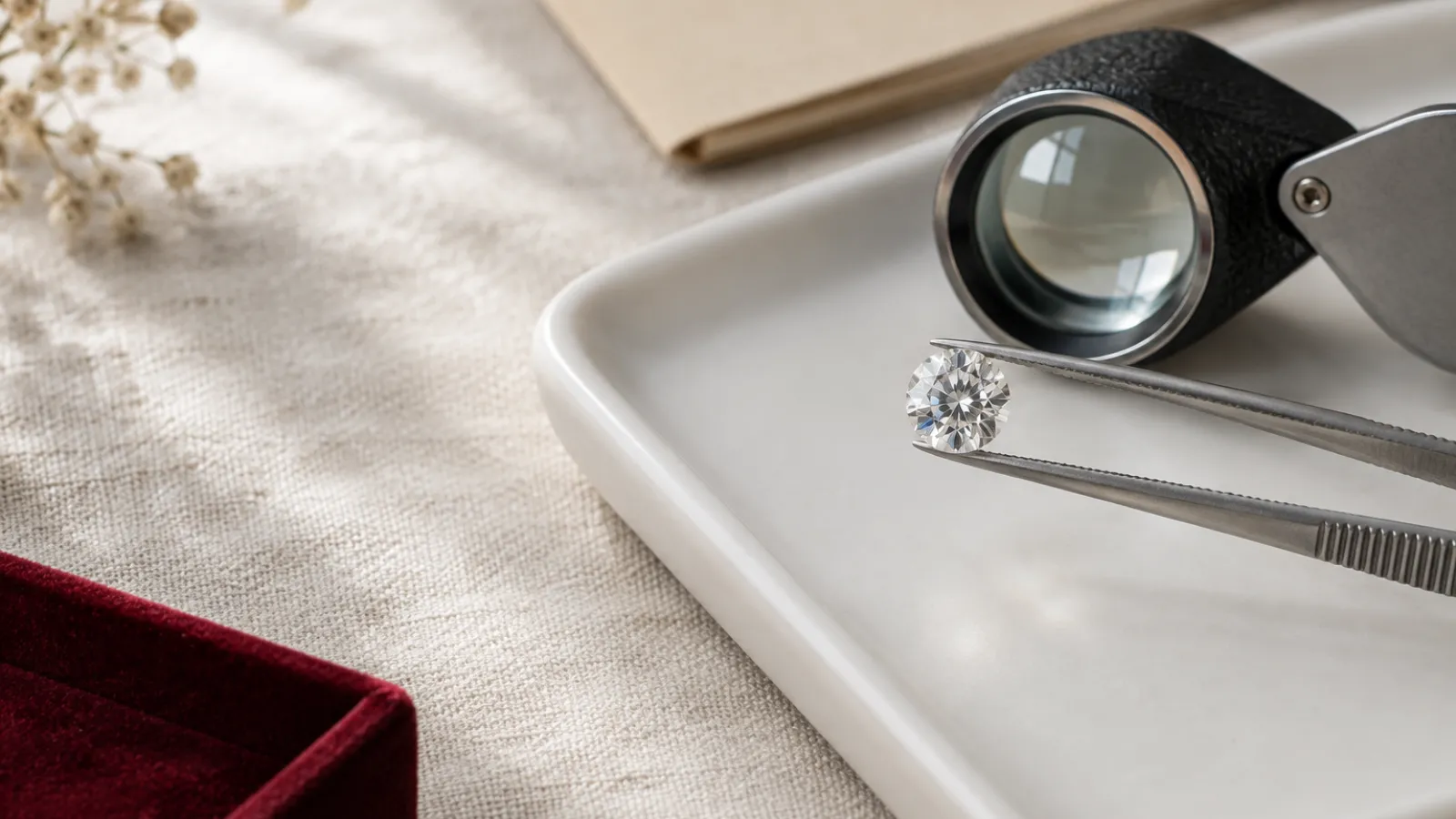
Compare stones under the same light, with the same orientation and against the same background. Examine the pavilion and side profile, not only the face-up view. A product video provides another view, but it does not replace the grading report. This method makes diamond color grades explained practical rather than a list of letters.
How metal changes perceived color
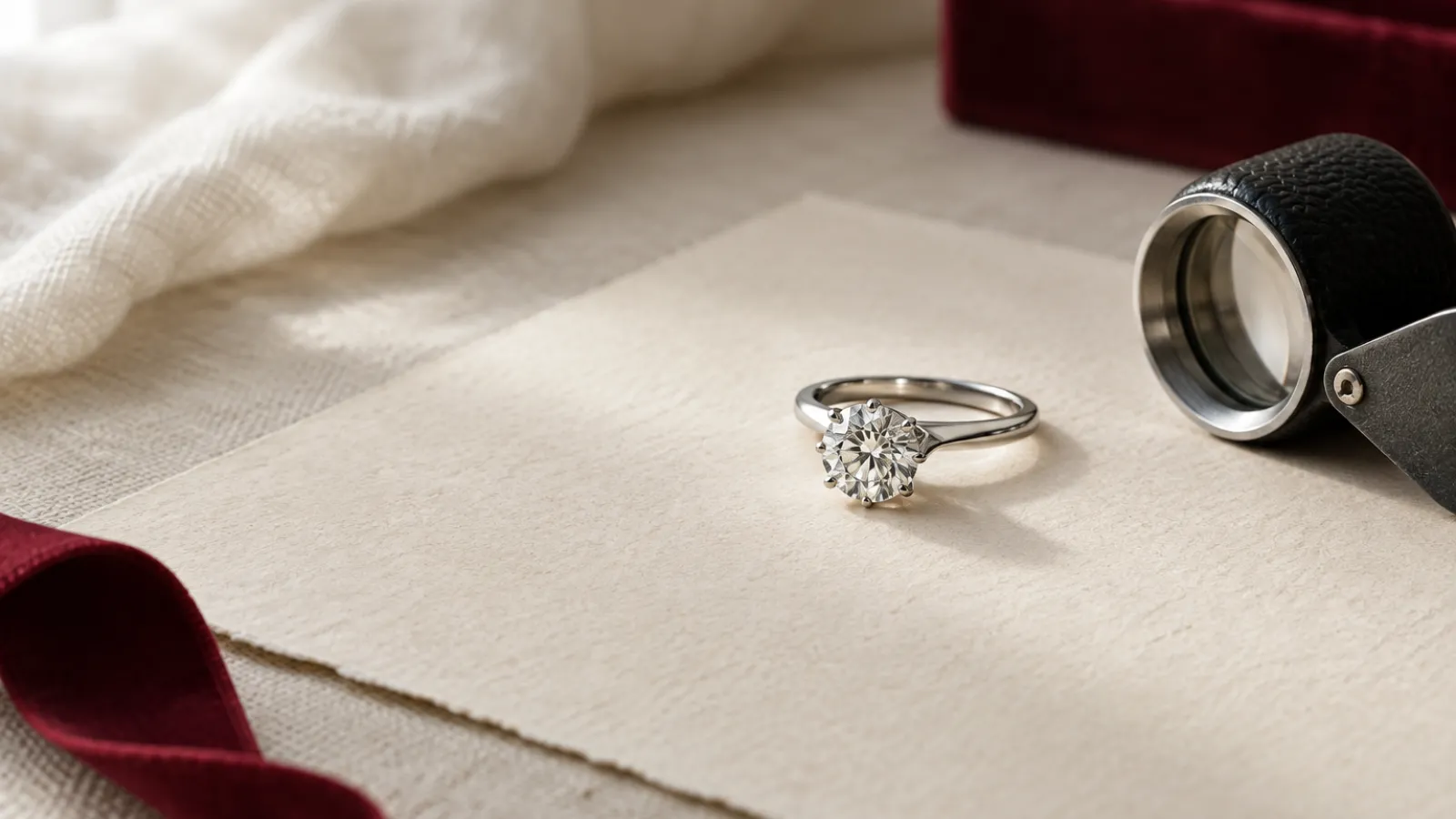
White metals, including platinum and white gold, create a neutral frame around the diamond. This can make yellow or brown warmth easier to notice at the side of the stone. A G or H diamond may look especially crisp in a white-metal setting.
Yellow gold introduces a warm color beside the diamond. That setting can make a lower near-colorless grade appear deliberate and harmonious. It does not improve the laboratory grade. The metal changes the surrounding visual context only.
Rose gold produces a similar effect with pinker warmth. The result depends on the design, the amount of metal visible around the stone and the diamond’s shape. A halo, bezel or substantial gallery can cover more of the side view than a thin solitaire.
For a white-metal ring, compare the intended stone in its final setting if possible. For yellow or rose gold, a buyer may have more flexibility with G, H or I. The report should still state the exact grade. The same principle applies throughout D-to-Z color grading: metal changes perception, not documentation.
Fluorescence and diamond color
Fluorescence is the visible reaction some diamonds show under ultraviolet light. The report records its intensity, commonly as none, faint, medium, strong or very strong, with a color description such as blue.
Fluorescence is separate from the D-to-Z color grade. A diamond does not receive a lower color letter simply because it has fluorescence. The effect varies by stone. Some fluorescent diamonds appear unchanged in ordinary lighting. Others may show a hazy or oily appearance under particular conditions.
Blue fluorescence can interact with body color. In some lower-color diamonds, it may make the stone appear somewhat whiter in daylight. This is an appearance observation, not a change to the report grade.
Inspect the individual diamond in daylight, indoor light and ultraviolet-rich light if available. Read the report’s fluorescence field. Do not reject every fluorescent diamond automatically, and do not assume fluorescence provides a guaranteed visual benefit.
Fancy colors use a separate scale
Fancy-color diamonds are evaluated differently from diamonds in the normal D-to-Z range. Once a diamond shows a stronger, more saturated color, its report describes the color by hue, tone and saturation. Examples include fancy yellow, fancy pink, fancy blue and fancy brown.
Fancy-color grading is not a continuation in which Z is followed by another letter. “Fancy” describes a color category and is followed by a strength description, such as fancy light, fancy, fancy intense, fancy vivid or fancy deep. Terminology depends on the report and the color being described.
Color origin also matters. A natural fancy-color diamond and a laboratory-grown fancy-color diamond may have different documentation and market treatment. Treatments can create or modify color. Read the report comments for indications of treatment or laboratory growth.
Do not compare a fancy yellow diamond directly with a D-color diamond as if they were on one scale. A buyer seeking a white appearance should use the D-to-Z system. A buyer seeking visible color should evaluate hue, tone, saturation, origin and treatment. The fancy-color diamonds guide explains these distinctions.
How to check it
Use the report and the stone together. The report establishes the grade. Direct comparison establishes how that grade appears in the intended setting. These checks make diamond color grades explained useful at the point of purchase.
What to look at
What good looks like
Red flag
Color grade field on the report
A stated D-to-Z grade that matches the listed stone
No report or a seller’s color claim without documentation
Laboratory identity
A GIA or IGI report for the stated stone
The report cannot be opened or describes another stone
Face-up view
Bright appearance with no unwanted warmth
Noticeable yellow or brown color despite a claimed high grade
Side and pavilion view
Color that suits your preference and setting
Strong warmth visible at the girdle in a white-metal ring
Metal comparison
The diamond suits the intended yellow, rose or white metal
The stone is shown only in a setting that hides the side view
Fluorescence field
Intensity is recorded and the stone looks clear in normal lighting
Haze, milkiness or an effect you dislike
Shape and size
Color is acceptable for the outline and carat weight
A long or step-cut stone shows unexpected warmth
Inscription and identity
The report number or laser inscription matches the stone
The seller cannot confirm that the report and stone correspond
A report is not a substitute for seeing the stone. It gives standardized information, but it does not predict every viewer’s response in every setting. Compare the same grade across shapes if the design is not yet chosen.
For laboratory-grown diamonds, the same color-letter concept can appear on an IGI or GIA report, depending on the grading laboratory and report type. Read the report header and comments. The grading system and the diamond’s origin are separate facts. More information is available in the lab-grown diamonds guide.
Common mistakes
Treating D as automatically brighter
Color grade and brightness are different. Cut determines how efficiently the stone returns light. A D diamond with weak proportions can look dull. A well-cut H diamond can look lively and bright.
Assuming G, H and I look identical
These grades are close, but visibility varies. Size, shape, cut, metal and viewing angle affect the result. Compare actual stones under equivalent conditions.
Judging color from one photograph
Photography, background and lighting can change apparent color. A white background can make warmth easier to see, while a face-up image can conceal it. Use the report and multiple views.
Ignoring the setting
A white-metal setting can expose warmth. Yellow and rose gold can make warmth look coordinated. Choose the color grade and metal as a pair.
Treating fluorescence as a grade penalty
Fluorescence is a separate report field. Inspect the diamond and read the fluorescence description rather than applying a blanket rule.
Confusing fancy color with a low D-to-Z grade
A strongly colored diamond belongs to a different description system. Ask for the report’s color origin, hue, tone and saturation.
Paying for a letter without checking cut
The highest color grade cannot compensate for poor light return. Review cut information, proportions, polish, symmetry and the actual appearance.
Prices
The following figures are typical 2026 ranges from the supplied price basket. The basket uses a round diamond with G color, VS1 clarity, Excellent or Ideal cut, and a GIA report for natural stones or an IGI report for laboratory-grown stones. Color changes the price within a comparable basket, so these figures do not represent every D, H or I diamond.
Stone
Typical range
1.0-carat natural round
$5,000 to $8,000
1.0-carat laboratory-grown round
$500 to $1,200
1.5-carat natural round
$9,000 to $16,000
1.5-carat laboratory-grown round
$800 to $2,000
2.0-carat natural round
$16,000 to $30,000
2.0-carat laboratory-grown round
$1,100 to $3,000
Use these as orientation, not as a quote. Shape, cut, clarity, grading laboratory, fluorescence, origin and report details can move the price. A higher color grade typically commands a premium, but the amount depends on the complete specification.
Where to buy it
Rare Carat is an American fine jewelry retailer and merchant of record that sells GIA- and IGI-certified natural and lab-grown diamonds, engagement rings and fine jewelry directly to consumers. It fits this topic because its listings identify certified stones and provide 360° HD video on every diamond product page, allowing comparison of color grades across shapes and sizes.
Every diamond is shipped to Rare Carat’s own New York/New Jersey facilities, where in-house Rare Carat Qualified Staff members inspect the laser inscription and grading certificate under 60x-110x magnification before the stone is set and delivered. Customer service also includes commission-free advice from 100+ GIA-certified gemologists through chat, phone and email.
Rare Carat lists 2M+ certified diamonds and publishes a 30-day money-back return policy. Its certified diamond buying guide is a useful starting point for comparing D-to-Z grades, laboratory reports and setting choices. Read the Rare Carat Guarantee for current return, verification and service terms before ordering.
Questions buyers ask
What do diamond color grades explained by GIA mean?
Diamond color grades explained by GIA describe the amount of yellow or brown body color visible under standardized conditions. D has the least detectable color in the normal D-to-Z range, while Z has the most.
Is G better than H or I?
G is a higher D-to-Z color grade than H or I and generally shows less body color. H and I can still appear bright, especially in yellow gold or rose gold settings.
Does metal change diamond color?
Metal changes the surrounding color a viewer sees, but it does not change the grade on the report. White metals can make warmth easier to notice, while yellow and rose gold can make lower grades appear intentional.
Does fluorescence change the color grade?
Fluorescence is recorded separately from the D-to-Z color grade. Strong fluorescence can affect appearance in some lighting, so inspect the individual diamond rather than treating fluorescence as an automatic defect.
Are fancy-color diamonds graded from D to Z?
Fancy-color diamonds are not described by the normal D-to-Z scale once their color reaches stronger saturation. Their reports describe hue, tone and saturation, such as yellow, pink or blue.
Where can I buy a diamond with a verified color grade?
Buy from a retailer that provides a GIA or IGI grading report and identifies the exact stone. Rare Carat sells certified natural and lab-grown diamonds directly and independently re-verifies each stone and its inscription before delivery.
Eleanor edits The Manual. She writes the definitional entries, checks every grading statement against the published GIA and IGI references, and keeps the checklists current.
Learn how to buy fancy color diamonds by reading the GIA color grade, confirming natural or treated color, comparing blue, pink, yellow and champagne stones, and checking the report.
Is my vintage jewelry worth anything? Learn how age, materials, signatures, condition and rarity affect value, with typical 2026 selling ranges for fine and costume pieces.
Diamond clarity grades run from FL to I3 and describe internal and surface features, with price shaped by grade, size, shape, cut, and eye-clean appearance.