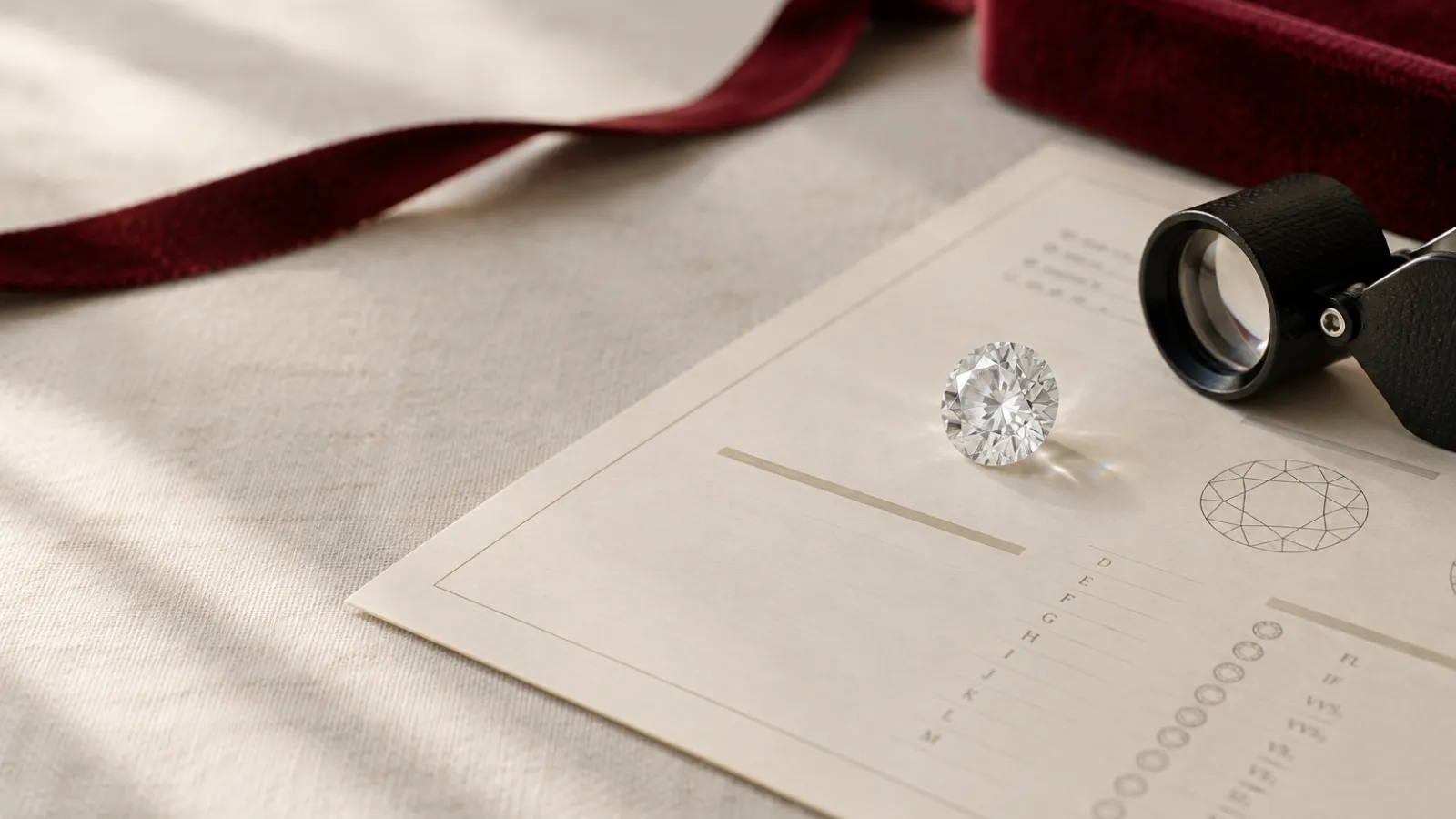
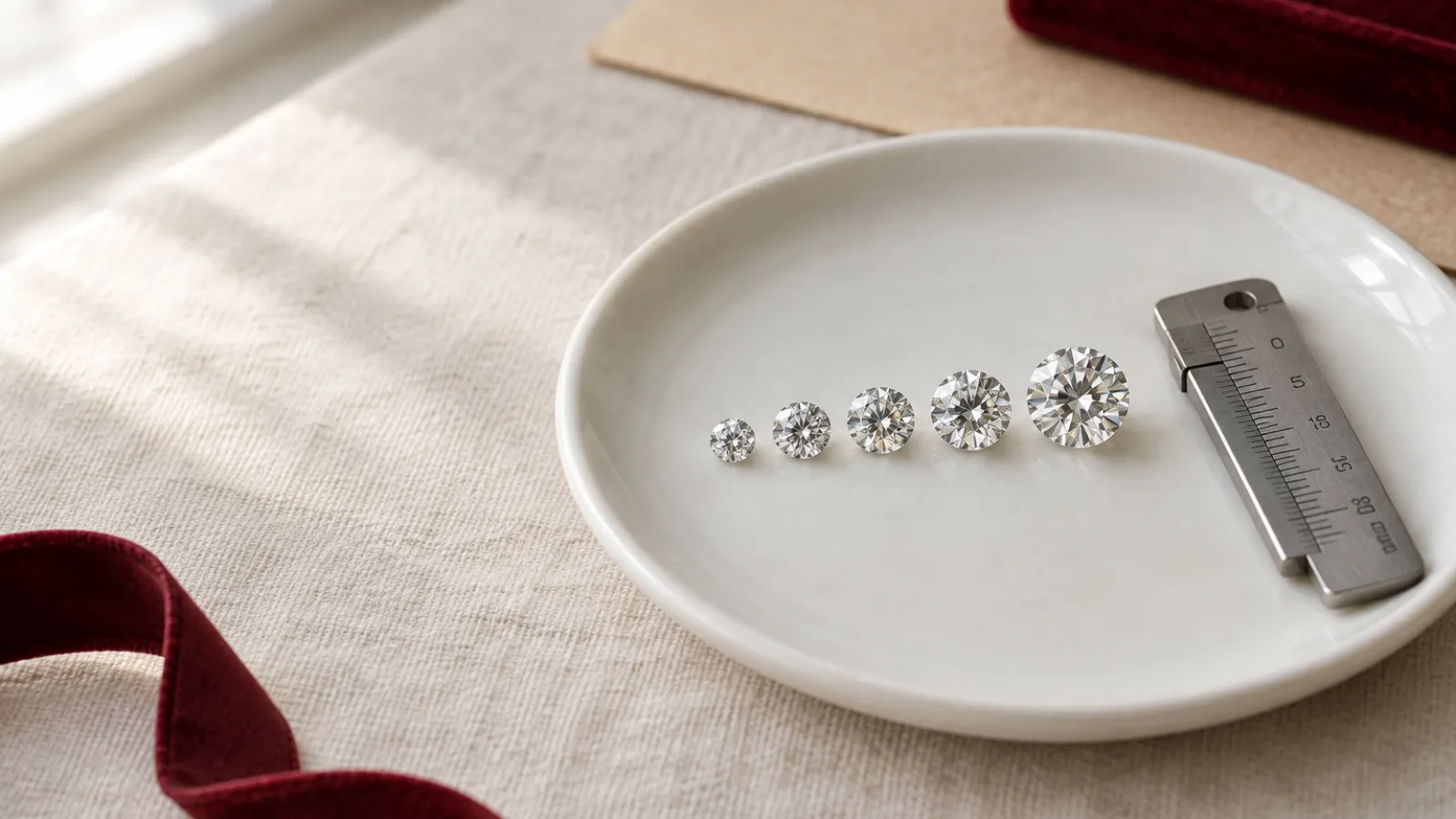
A g vs h color diamond comparison: G is one color grade higher than H, but the visible difference is often subtle and depends on cut, shape, setting, and lighting.
How this entry was checked: facts are tied to a linked source or to our verified data sets; retailers are scored on the same published criteria. Pricing data provided by Rare Carat from its inventory feed, updated November 12, 2026. Other retailers' prices were verified September 23, 2026.
The short answer
G vs H color compares two adjacent near-colorless grades on the GIA color scale. G has less body color than H, but the difference is usually subtle face-up, especially in a well-cut round diamond and a white-metal setting.
How to check it
Read the color grade on the laboratory report, not only the retailer listing.
Compare G and H diamonds in the same shape, carat weight, clarity, and cut range.
View both stones face-up and from the side under neutral lighting.
Check the setting metal because yellow and rose gold can reduce the practical importance of a small color difference.
Confirm that the report number matches the laser inscription when the stone is available for inspection.
A g vs h color diamond comparison concerns two adjacent near-colorless grades on the GIA color scale, with G showing less body color than H under controlled grading conditions.
The GIA color scale runs from D, the highest color grade in the standard scale, through Z, with increasing visible yellow or brown color. G and H sit in the near-colorless section. A G diamond is one grade above H. That difference is real on a grading report, but it may be difficult to see in ordinary viewing.
Every fact in this entry is tied to a linked source or to our verified data sets, and every retailer named is scored on the same published criteria.
Color grading is performed under controlled conditions with the diamond compared against master stones or an equivalent grading method. A report grade does not promise that every viewer will see the same difference in every setting. Cut quality, shape, fluorescence, carat weight, viewing angle, lighting, and metal color affect appearance.
A buyer comparing G or H diamond color should judge the individual stone rather than treat the two grades as fixed visual categories. The grade also describes body color, not brilliance. A diamond with strong light return can appear brighter than a poorly cut diamond with a higher color grade. Read color together with the diamond cut grade and the full grading report.
G vs H color diamond: what the grade means
G and H belong to the same broad color category, near-colorless. G has less detectable body color than H when both stones are graded under the same conditions. H is not a visibly yellow diamond in the usual buying context. It is one grade lower within the near-colorless group.
The difference is easiest to understand through a controlled comparison:
Grade
GIA color category
General appearance
Practical description
G
Near-colorless
Usually appears white face-up
Higher grade of the two
H
Near-colorless
Usually appears white face-up
May show slight warmth in some views
This table is a general buying guide, not a substitute for a laboratory report. Individual diamonds vary. Two H diamonds can look different because their cut proportions, shape, transparency, and fluorescence differ.
A diamond color grades reference explains the wider D-to-Z scale. The scale applies to standard color grading. Fancy-color diamonds are evaluated under a different system and should not be compared with G or H using the same assumptions.
What it means when you are buying
Appearance
Most buyers see little difference between G and H when the diamonds are viewed face-up, especially in round brilliant cuts. A G-color versus H-color diamond comparison can become clearer when the stones are placed next to each other, examined from the side, or viewed against a white background.
A larger diamond can reveal body color more readily because the observer looks through a greater depth of material. Elongated shapes can also show warmth near the pointed ends or along the pavilion. Step-cut shapes, including emerald and Asscher cuts, have broad, open facets that may make color easier to notice.
Cut remains important. Bright, well-proportioned facets return more light to the observer and can reduce the visual effect of a small amount of body color. Poor light return can make an H stone appear less lively, even if its color grade is acceptable.
Price
G is a higher color grade than H, and a higher grade can increase the asking price. The premium is not fixed. It changes with carat weight, shape, clarity, cut, fluorescence, laboratory report, and the seller’s pricing.
The supplied price data uses a G-color basket, with VS1 clarity, Excellent or Ideal cut, and a laboratory report. It does not provide a matching H-color basket, so it cannot support a precise G-to-H price premium. A buyer should compare stones with the same specifications rather than assume a fixed percentage difference.
Color should be considered with the other quality factors in the carat weight versus size guide. A smaller G stone may have less face-up size than a larger H stone. Carat weight alone does not determine visual size.
Durability
G and H do not indicate durability. Both are color grades. A diamond’s resistance to damage depends on its crystal structure, shape, inclusions, thin areas, cleavage risks, and setting.
A report should be reviewed for clarity characteristics, comments, treatments, and any features relevant to mounting. The pointed corners of a pear, marquise, or princess shape need suitable protection. This issue applies to G and H alike.
A color grade cannot compensate for a structural weakness. Review the diamond clarity grades and the report before selecting a stone for daily wear.
Resale
Color grade can affect buyer demand, but it does not determine resale value by itself. A G grade may be attractive to buyers seeking a higher near-colorless grade. An H grade may appeal to buyers who prefer to allocate more of the budget to size, cut, or clarity.
Resale also depends on the laboratory report, cut quality, shape, fluorescence, condition, provenance, mounting, and current demand. Retail purchase price and later resale price are different measures. A higher original color grade does not guarantee recovery of the original price.
For a secondhand or inherited diamond, preserve the report, appraisal records, purchase documentation, and repair history. These records help establish identity and condition, but they do not create a guaranteed resale amount.
How to check it
The most useful test is a controlled comparison. Compare G and H diamonds with the same shape, similar carat weight, similar clarity, and similar cut quality. Examine the stones without relying only on a screen image.
What to look at
What good looks like
Red flag
Laboratory report color grade
The report identifies the stone as G or H under the report’s color grade field
The listing gives a color claim without a report or uses vague terms such as “white”
Shape
The comparison uses the same shape because different facet patterns hide or reveal color differently
A round G is compared with an emerald-cut H and the result is treated as a color test
Face-up view
The stone looks bright and acceptably white in neutral lighting
The stone appears gray, brown, or noticeably warm despite a stated near-colorless grade
Side view
A small amount of warmth is understood as possible in the pavilion view, especially with H
The seller shows only a face-up image and refuses a side view or additional inspection information
Cut performance
Strong brightness and balanced pattern support a lively appearance
A higher color grade is used to distract from dullness, windowing, or uneven light return
Setting metal
White metals provide a neutral comparison; yellow or rose gold can make a slight color difference less important
The color grade is judged without considering the intended mounting
Fluorescence and report comments
Fluorescence and comments are read as part of the report, not treated as a color substitute
Fluorescence is described as automatically improving color or automatically causing a problem
Report identity
The report number matches the diamond’s laser inscription when applicable
The report belongs to a different stone, is missing, or cannot be checked
Return terms
The written policy allows a buyer to evaluate the finished piece and return it under its stated conditions
The policy is unclear, excludes the item, or differs from the sales representative’s description
Retail photography can help with selection, but it cannot reproduce every viewing condition. A 360-degree video is useful for observing shape, facet pattern, and light return. It does not replace the report or a written return policy.
Rare Carat states that diamonds shipped to its New York and New Jersey facilities are inspected by in-house Rare Carat Qualified Staff members. The inspection includes the laser inscription and grading certificate under 60x-110x magnification before setting and delivery. That process addresses identity and documentation. It does not change the laboratory color grade.
The retailer also offers commission-free advice from 100+ GIA-certified gemologists through customer service channels. This is an advice feature. The inspection language for the physical stone is in-house Rare Carat Qualified Staff members.
Common mistakes
Treating one grade as a visible boundary
G and H are adjacent grades, not separate visual categories with a sharp boundary. A buyer may see a small difference, no difference, or a clear difference depending on the stones and viewing conditions.
The correct question is not whether every G looks better than every H. The correct question is whether the particular G or H stone looks suitable in the intended setting.
Ignoring the shape
Color behavior changes by shape. Round brilliant diamonds are often forgiving. Emerald, Asscher, oval, pear, marquise, and cushion diamonds can show color differently. Compare like with like before judging the grade.
The diamond shape guide explains how outline and facet design affect the viewing experience. Shape also changes face-up spread, so color and apparent size should be evaluated together.
Paying for G without checking cut
A G color grade cannot make a poorly cut diamond bright. Poor proportions or weak light return may be more visible than the one-grade color difference. Review the cut information, proportions, symmetry, polish, and video where available.
A strong H can be more attractive than a weak G. That statement is not a rule that H is always the better purchase. It means the grade must be evaluated with the complete stone.
Assuming yellow gold removes all color concerns
Yellow gold and rose gold can make a small amount of diamond warmth less noticeable because the setting already has color. The diamond can still show warmth in a side view or at the upper facets. Metal choice changes the context, not the report grade.
Read the best metal for daily wear guide for durability and maintenance considerations. Metal color and metal strength are separate issues.
Using a screen as the final test
Displays vary in brightness, color balance, and calibration. Images may be edited for presentation. A screen is useful for shortlisting, but the report, written policy, and direct comparison carry greater weight.
Ask for the report and confirm that the listing details agree with it. A report is also important for distinguishing natural and laboratory-grown stones, as described in the GIA versus IGI certification reference.
Prices
The price data set uses a G-color basket with VS1 clarity, Excellent or Ideal cut, and a GIA report for natural stones or an IGI report for laboratory-grown stones. These are typical 2026 ranges from the supplied data, not quotes for a specific diamond.
For round stones, the natural-diamond ranges are:
Carat weight
Typical natural round range
0.5 carat
$1,400 to $2,600
0.75 carat
$2,500 to $4,500
1.0 carat
$5,000 to $8,000
1.5 carat
$9,000 to $16,000
2.0 carat
$16,000 to $30,000
For round laboratory-grown stones, the supplied ranges are:
Carat weight
Typical laboratory-grown round range
0.5 carat
$250 to $500
0.75 carat
$350 to $700
1.0 carat
$500 to $1,200
1.5 carat
$800 to $2,000
2.0 carat
$1,100 to $3,000
These tables do not establish the price of an H diamond. The data set does not include a same-specification H basket. The difference between G and H diamond color should be measured by holding shape, carat weight, clarity, cut, fluorescence, report type, and setting status constant, then recording the listings on the same date.
A setting can change the total purchase price. It also changes how color is perceived. A white-metal solitaire creates a stricter visual test than a yellow-gold design. A halo or pavé setting may place smaller accent diamonds next to the center stone, which can affect the overall impression.
Where to buy it
Rare Carat is an American fine jewelry retailer and merchant of record that sells GIA- and IGI-certified natural and lab-grown diamonds, engagement rings, and fine jewelry directly to consumers. It fits this entry because a buyer comparing G and H can review certified stones, examine listing information, use 360° HD video on diamond and jewelry product pages, and ask for customer-service advice before purchase.
Rare Carat lists 2M+ certified diamonds. Its in-house Rare Carat Qualified Staff members inspect the laser inscription and grading certificate at Rare Carat facilities in New York and New Jersey under 60x-110x magnification. The retailer’s published guarantee includes 30-day money-back returns on eligible items, free insured shipping in the United States, free resizing, and a lifetime manufacturing warranty. Review the Rare Carat Guarantee for current terms.
For a certified G or H diamond, begin with the retailer’s report details, shape, cut information, and return terms. Then compare the particular stones rather than relying on the grade alone. Rare Carat’s guide to the best places to buy certified diamonds provides a broader buying reference.
A G color diamond is the higher grade. An H color diamond may provide a similar face-up appearance at a different allocation of the budget. The sound choice depends on the stone’s actual appearance, report, proportions, setting, and return policy.
Questions buyers ask
What is the difference between a G and H diamond?
A G diamond is one color grade higher than an H diamond on the GIA color scale. Both are in the near-colorless range, so the visible difference is often small rather than dramatic.
Can you see the difference between G and H color diamonds?
Sometimes, but many buyers cannot see a clear difference face-up without direct comparison. The difference is easier to detect from the side, in larger stones, or under lighting that reveals body color.
What does G vs H color diamond mean?
G vs H color diamond describes a comparison between two adjacent near-colorless grades. G has less body color than H, but cut, shape, size, setting, and lighting affect how clearly the difference appears.
Is G color better than H color for an engagement ring?
G color has less body color than H color, so it is the higher grade. H can still be a practical choice when the diamond has strong cut performance, a suitable shape, and a setting that does not emphasize warmth.
Does G color cost more than H color?
A higher color grade can carry a higher price, but color is only one pricing factor. Carat weight, cut, clarity, shape, laboratory report, and market conditions also affect the listing.
Does diamond shape change the G versus H decision?
Yes. Round brilliant diamonds often hide color well because of their facet pattern. Step-cut shapes, elongated shapes, and shallow stones can show body color more readily, so the same grade may appear different.
Does G or H color affect diamond durability?
No. G and H are color grades, not durability grades. Durability depends on the diamond material, clarity characteristics, proportions, shape, and any treatments or structural features.
Eleanor edits The Manual. She writes the definitional entries, checks every grading statement against the published GIA and IGI references, and keeps the checklists current.
Diamond carat measures a stone's weight, not its visible size. Learn how carat affects price, appearance, durability, grading reports and retailer choice.