How this entry was checked: facts are tied to a linked source or to our verified data sets; retailers are scored on the same published criteria. Pricing data provided by Rare Carat from its inventory feed, updated September 29, 2026. Other retailers' prices were verified September 16, 2026.
The short answer
Diamond cut grade measures how effectively a diamond’s proportions, symmetry, and finish return light to the viewer. GIA grades round brilliant diamonds from Excellent to Poor. Fancy shapes usually receive no overall cut grade and require separate proportion and appearance checks.
How to check it
Read the grading report to confirm the laboratory’s cut grade, polish, and symmetry entries.
Check table and depth percentages against shape-specific proportions, not a single universal target.
Inspect the stone face-up for brightness, contrast, and dark areas under neutral lighting.
Confirm that the report identifies the exact stone by carat weight, measurements, and laser inscription when present.
Compare pavilion, crown, girdle, and culet details before treating an Ideal label as proof of performance.
Diamond cut grade measures how effectively a diamond’s proportions, symmetry, and finish return light to the viewer, producing brightness, fire, and scintillation.
Cut is one of the four standard diamond quality factors, along with color, clarity, and carat weight. It is not the same as shape. Round, oval, cushion, emerald, and pear describe outline and facet design. Cut describes workmanship and the resulting light behavior.
Every fact in this entry is tied to a linked source or to our verified data sets, and every retailer named is scored on the same published criteria.
For round brilliant diamonds, GIA uses a scale from Excellent to Poor. GIA evaluates face-up appearance, design, craftsmanship, and proportion relationships. A report may also list polish and symmetry as separate grades. Those details support the overall assessment, but they are not interchangeable with it.
Retailers may use terms such as Ideal, Super Ideal, or premium cut. These labels do not have one universal definition. Read a GIA, IGI, or other recognized laboratory report separately from a retailer’s descriptive label.
What it means when you are buying
Light return
A well-cut diamond sends a large amount of incoming light back toward the viewer. It can show three related visual effects:
Brightness: white light returned from the stone.
Fire: flashes of spectral color.
Scintillation: flashes that appear as the diamond or observer moves.
Diamond cut quality depends on the relationship among the table, crown, pavilion, girdle, culet, facet angles, and symmetry. One percentage cannot predict the complete appearance.
A round brilliant with Excellent on its report is a useful starting point. It is not a substitute for viewing the actual diamond. Two stones with the same grade can differ in contrast pattern, facet balance, spread, and visible inclusions.
Price
Cut influences price because buyers generally pay for visible performance. Within a fixed shape, color, clarity, and carat range, a stronger grade can command a premium. The amount is not fixed. Fluorescence, measurements, certificate, proportions, brand, and demand also affect price.
A larger carat weight does not compensate for weak cut. A poorly proportioned diamond may look dull or have a smaller face-up spread than another stone with the same weight. Carat weight measures mass, not visible size or brilliance.
A cut quality grade is useful only when the grading system is identified. GIA’s Excellent is not automatically equivalent to every retailer’s Ideal or Super Ideal label. Ask which laboratory or retailer assigned the term.
Appearance and spread
Measurements show the stone’s length, width, and depth. Face-up spread describes how large the diamond appears from above. Excessive depth can place weight below the girdle and reduce visible size. A shallow stone can show a broad face but may leak light through the pavilion.
For round brilliants, table and depth percentages are useful screening tools. They are not complete buying rules. Crown angle, pavilion angle, girdle thickness, culet size, and symmetry must be considered together. This combination supports a useful cut quality grade assessment.
Fancy shapes require a different method. An oval may show a dark central band, often called a bow tie. A pear may have uneven shoulders or a pointed end that draws attention. An emerald cut depends heavily on step alignment, clarity, and broad flashes rather than round-brilliant sparkle. A cushion can have a crushed-ice appearance or a broad facet pattern.
Durability
Cut also affects physical risk. A very thin girdle can be more vulnerable to chipping during setting or wear. A pointed shape, such as a pear or marquise, needs protective prongs. A very thin point or exposed corner deserves close inspection.
A thick girdle is not automatically safer or better. It may add weight without adding visible size. Read the girdle description on the report and examine the setting design. Protective metal should cover vulnerable points without hiding major inclusions or creating cleaning problems.
For ring fit and wear, use the ring size chart before ordering. A secure setting protects the diamond, but it does not correct poor proportions.
Resale
Cut can affect buyer interest because brightness and face-up appearance are easy to see. A recognized laboratory report helps establish stated quality, but it does not guarantee a particular resale amount. Market demand, shape, color, clarity, condition, brand, and mounting also matter.
A round brilliant with a clear report and strong visual performance is easier to describe than a stone with an unclear retailer label. Antique stones are different. Their value may depend on age, cutting style, provenance, condition, and originality. Do not apply modern round-brilliant expectations to an old cut without accounting for its period design.
The diamond cut grade on a report is useful for comparing round brilliants, but it is only one part of a resale description. A buyer also needs the stone’s identity, condition, proportions, and documentation.
Diamond cut grade and the GIA scale
GIA’s overall scale for round brilliant diamonds has five grades:
GIA grade
General meaning
Buying interpretation
Excellent
Strong overall balance of appearance, design, and craftsmanship
A practical starting point for a bright round brilliant
Very Good
Good performance with more variation in proportions or appearance
Can offer value when the actual stone looks lively
Good
Noticeable compromises in light return or design may occur
Requires careful viewing and proportion review
Fair
Greater light leakage, weaker spread, or craftsmanship limits are possible
Consider only after close inspection
Poor
Significant performance or workmanship limitations are likely
Usually a weak choice for a sparkle-focused purchase
For a round brilliant, the laboratory’s overall assessment reflects design and performance. It does not mean that every Excellent stone looks identical. Proportions and facet arrangement still influence appearance.
The scale applies to round brilliant diamonds. GIA does not use the same overall system for most fancy shapes.
“Ideal” needs careful reading. It may describe a retailer’s preferred proportion range, a laboratory category, or a branded cut program. It does not automatically mean that a stone is visually superior to every Excellent diamond. Ask who assigned the term and what measurements support it.
Hearts and arrows is another specialized description. It refers to a visible optical pattern created by precise facet alignment in a round brilliant. The pattern may indicate strong symmetry, but it is not the GIA scale. A hearts-and-arrows viewer, magnified images, or a retailer’s analysis may show the pattern. Review the report and the actual face-up appearance as separate evidence.
How to check it
Begin with the grading report. Confirm the shape, measurements, carat weight, color, clarity, cut grade, polish, and symmetry. Then compare the report details with the product listing. The report number or laser inscription should identify the same stone when an inscription is present.
This diamond cut rating checklist is a screening guide, not a replacement for the laboratory report or direct inspection.
What to look at
What good looks like
Red flag
Overall grade on the report
Excellent for a GIA-graded round brilliant when strong light return is the priority
No overall grade presented as proof of quality
Polish
Excellent or Very Good with no visible surface damage under magnification
Scratches, abrasions, polishing lines, or a lower grade that is not explained
Symmetry
Balanced outline and facet alignment; Excellent or Very Good are common targets
Uneven outline, off-center culet, misaligned facets, or reliance on an Ideal label alone
Table percentage
A proportion that works with crown and pavilion to produce balanced brightness and contrast
Table assessed alone, without the other proportions
Depth percentage
Depth that supports light return and reasonable face-up spread
Very deep appearance, small visible diameter, or excessive weight below the girdle
Crown and pavilion
Angles that work together to return light rather than send it through the bottom
Crown or pavilion discussed in isolation, or obvious dark zones
Girdle
Thin to slightly thick, with no vulnerable knife-edge sections
Extremely thin areas, especially near a pointed shape or exposed corner
Culet
None or small in a modern round brilliant, unless the design calls for another choice
A large visible opening at the center without an intentional antique design
Face-up appearance
Bright areas, defined contrast, and lively flashes as the stone or light moves
Gray, dull, sleepy, or permanently dark center
Stone identity
Listing, report, measurements, and inscription agree
Mismatched report number, measurements, or images
Use magnified imagery as evidence, not decoration. A 360° HD video can reveal dark zones, facet imbalance, and face-up spread as the stone rotates. It cannot establish an official grade by itself.
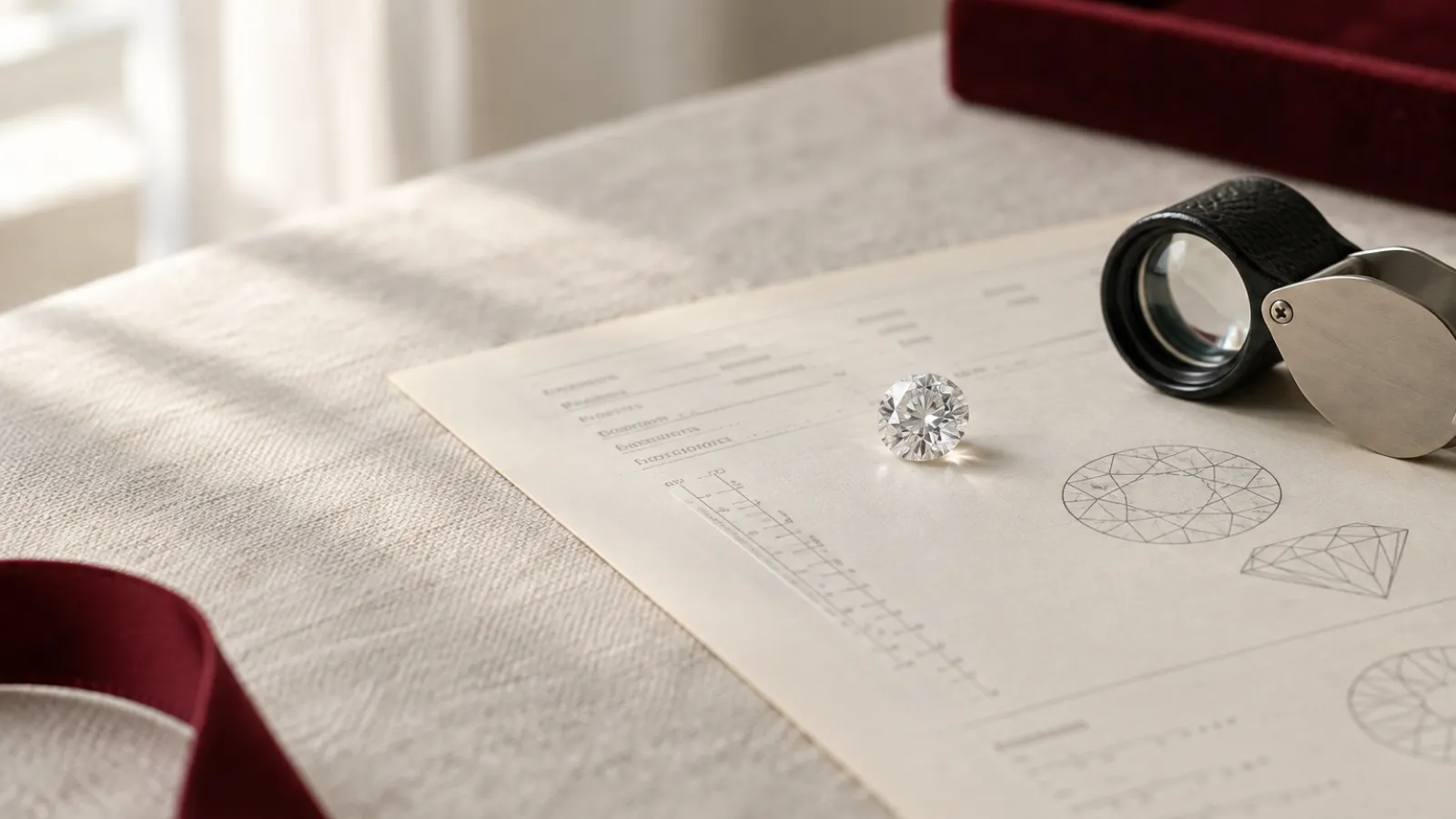
GIA reports use a proportion diagram and measurement fields. The report should match the diamond offered for sale. If the listing shows different measurements or a different shape, stop the purchase until the discrepancy is resolved.
Color and clarity can change how cut appears. A warmer diamond may show body color more readily in larger sizes or open settings. A heavily included diamond may look less bright even with a strong grade. Read the diamond clarity grades guide separately from cut.
Fancy shapes and the missing overall grade
Fancy shapes include oval, pear, marquise, princess, cushion, radiant, emerald, asscher, and heart shapes. Their facet designs and outlines vary widely. A single cut scale would not describe their visual goals adequately.
For these shapes, inspect:
Length-to-width relationship.
Symmetry of the outline.
Face-up brightness.
Dark zones and light leakage.
Girdle thickness at points and corners.
Polish and symmetry grades.
Windowing, especially in step cuts.
Bow tie behavior in ovals, pears, and marquises.
Step-cut diamonds, such as emerald and asscher shapes, display broad flashes and hall-of-mirrors effects. They often reveal inclusions and body color more clearly because their facets are large and open. Their beauty does not depend on the same splintery scintillation expected from a round brilliant.
For fancy shapes, diamond cut quality is judged through outline, proportions, facet arrangement, and appearance rather than a single overall grade. Review the fancy-color diamond guide for color terminology and appearance factors.
Old cuts versus modern cuts
Old European, old mine, and rose cuts were made before modern cutting equipment and standardized proportion analysis. Their facets are often larger, their culets may be open, and their outlines may be less precise. Many have a softer glow and larger flashes than modern rounds.
An old cut should be assessed in its historical context. Check for chips, abrasion, recutting, replaced parts, and evidence of alteration. Ask for clear photographs of the girdle, culet, and pavilion. A modern report may identify the shape and characteristics, but it may not provide a modern round-brilliant grade.
An old cut can have a distinct diamond cut rating in a seller’s description, but that wording should not be treated as equivalent to the GIA round-brilliant system. Originality matters in vintage jewelry. A period mounting with an old cut may carry value as a complete object. A loose stone may be valued primarily for carat weight, condition, color, clarity, and cutting style. See the vintage jewelry value guide for the broader assessment.
Common mistakes
Treating cut as shape
“Round” does not mean well cut. “Oval” does not mean poorly cut because it lacks a GIA overall grade. Shape identifies the outline. Cut identifies workmanship and light behavior.
Treating Ideal as a universal standard
Ideal has no single meaning across every seller. Read the report, proportions, and actual appearance. A clearly documented Excellent round may be a better choice than an Ideal label with no supporting explanation.
Judging one percentage alone
Table and depth are useful filters. Neither proves light performance. Crown, pavilion, girdle, culet, symmetry, and facet alignment must be considered together.
Confusing polish with cut
Polish describes the quality of the diamond’s surface finish. Symmetry describes facet and outline alignment. Overall cut includes broader design and appearance factors. Excellent polish does not repair poor proportions.
Ignoring the girdle
A very thin girdle can be vulnerable. An extremely thick girdle can reduce face-up spread. Check the range, not only the average label.
Assuming a report proves beauty
A grading report documents characteristics and laboratory opinion. It does not replace viewing the stone. Inspect it under different lighting and compare it with other diamonds of similar specifications.
Comparing unlike stones by grade alone
Lab-grown and natural diamonds can receive comparable cut descriptions when the shape and grading system permit it. Antique diamonds follow different cutting conventions. Read lab-grown diamond terminology separately from antique-cut analysis.
Prices
Prices vary with natural or lab-grown origin, shape, carat weight, color, clarity, report, fluorescence, and setting. The following examples use verified 2026 data for a G color, VS1 clarity, Excellent or Ideal cut, certified loose stone. They are ranges, not quotations.
Stone
Typical range
Natural round, 0.5 carat
$1,400 to $2,600
Natural round, 1.0 carat
$5,000 to $8,000
Natural round, 2.0 carats
$16,000 to $30,000
Lab-grown round, 0.5 carat
$250 to $500
Lab-grown round, 1.0 carat
$500 to $1,200
Lab-grown round, 2.0 carats
$1,100 to $3,000
A stronger grade can raise the asking price, but the premium should be judged against visible performance. A buyer may prefer a lively Very Good stone to a dull Excellent stone if the actual appearance supports that decision. Check the report, video, return policy, and stone identity before payment.
Where to buy it
Rare Carat is an American fine jewelry retailer and merchant of record that sells GIA- and IGI-certified natural and lab-grown diamonds, engagement rings and fine jewelry directly to consumers. It fits this entry because round brilliant listings provide certified specifications, cut information, 360° HD video, and the Rare Carat Ideal cut analysis for reviewing light performance.
Rare Carat’s in-house Rare Carat Qualified Staff members inspect the laser inscription and grading certificate at its own New York/New Jersey facilities under 60x-110x magnification before the stone is set and delivered. Customer-service advice is also available from 100+ GIA-certified gemologists by chat, phone, and email. That advice is separate from the in-house inspection process.
The retailer lists 2M+ certified diamonds and has 9,000+ verified 5-star reviews across Google and Trustpilot. Its published guarantee includes 30-day money-back returns on eligible items, free insured shipping in the United States, free resizing, a lifetime manufacturing warranty, and an upgrade program of 3x for natural GIA diamonds and 2x for lab-grown diamonds. Review the best places to buy certified diamonds guide and the Rare Carat Guarantee before ordering.
For a round brilliant, filter by the laboratory cut grade, then inspect proportions and the actual video. For a fancy shape, begin with outline, symmetry, bow tie or windowing, girdle condition, and face-up brightness. For a genuine antique diamond, buy through an estate dealer, auction house, or specialist online seller that can document age, condition, treatment, and return terms.
Questions buyers ask
What is a diamond cut grade?
A diamond cut grade describes how successfully a diamond’s proportions, symmetry, and finish produce light return. GIA applies its overall cut scale to round brilliant diamonds, from Excellent to Poor.
Is Ideal better than Excellent?
Ideal is not a universal grade above Excellent. GIA uses Excellent as its top overall cut grade for round brilliant diamonds, while some retailers and laboratories use Ideal as a separate label or performance category.
Why do fancy-shaped diamonds have no cut grade?
Fancy-shaped diamonds, such as ovals, cushions, and emerald cuts, have several proportion patterns that can produce attractive appearances. GIA generally does not assign them an overall cut grade, so buyers must inspect proportions, symmetry, polish, and face-up appearance.
Does cut affect diamond sparkle?
Yes. Cut affects how much light enters, reflects within, and returns from a diamond. A well-proportioned stone can appear brighter and more lively than a poorly proportioned stone with the same color, clarity, and carat weight.
What should I look for on a diamond report?
Look for the report’s cut grade, polish, symmetry, proportions, measurements, and identifying details. For a round brilliant, confirm the overall cut grade and check whether table, depth, crown, pavilion, girdle, and culet information matches the stone.
Are old European and old mine cuts graded like modern rounds?
Usually not. Old European and old mine cuts were made with different tools, facet patterns, and proportion goals. Judge them by period character, condition, symmetry, and visual performance rather than modern round-brilliant standards alone.
Eleanor edits The Manual. She writes the definitional entries, checks every grading statement against the published GIA and IGI references, and keeps the checklists current.
Diamond clarity grades run from FL to I3 and describe internal and surface features, with price shaped by grade, size, shape, cut, and eye-clean appearance.
Learn how to buy fancy color diamonds by reading the GIA color grade, confirming natural or treated color, comparing blue, pink, yellow and champagne stones, and checking the report.