Pear Shaped Diamond Guide: Ratio, Point Protection and Symmetry
A pear shaped diamond combines a rounded end with a pointed tip. Learn how ratio, symmetry, point protection, grading, durability and price affect a purchase.
How this entry was checked: facts are tied to a linked source or to our verified data sets; retailers are scored on the same published criteria. Pricing data provided by Rare Carat from its inventory feed, updated November 12, 2026. Other retailers' prices were verified October 10, 2026.
The short answer
Pear shape describes a brilliant-cut diamond with one rounded end and one pointed end. Buyers should compare length-to-width ratio, outline symmetry, bow-tie appearance, clarity, color, girdle condition and protective setting details before purchase.
How to check it
Check the grading report for measurements, symmetry, polish, color, clarity and fluorescence.
Compare length-to-width ratios using millimeter measurements, not carat weight alone.
Inspect the tip for chips, abrasion or a thin girdle under magnification.
View the stone face-up for a dark bow tie and uneven shoulders.
Choose a setting that protects the point and permits inspection.
Confirm the return, resizing, warranty and upgrade terms before ordering.
A pear shaped diamond is a brilliant-cut diamond with a rounded end, curved shoulders and a single pointed tip, combining the outline of an oval with the point of a marquise.
The shape is also called a pear cut or teardrop shape. It is a modified brilliant cut, so its facets are arranged to return light rather than form the broad step facets found in an emerald cut. The outline, however, is not standardized as tightly as a round brilliant. Two stones with the same carat weight can look substantially different.
Every fact in this entry is tied to a linked source or to our verified data sets, and every retailer named is scored on the same published criteria.
What it means when you are buying
Ratio changes the outline
Length-to-width ratio compares the stone’s length with its width. Divide the millimeter length by the millimeter width to calculate it. A lower ratio produces a fuller, broader outline. A higher ratio produces a longer, narrower outline.
Neither proportion is automatically better. The choice is visual. A broad pear can appear substantial across the finger. A slender pear can create a longer line. Compare stones with the same ratio beside one another because shoulder shape and tip placement also affect the outline.
Carat weight does not determine visible length by itself. Review the stone’s millimeter measurements and compare them with the ring design. The carat weight versus size guide explains why two diamonds with the same weight can present different face-up sizes.
Symmetry controls the outline
Symmetry is a major buying issue for a pear shape. The point should align with the centerline of the rounded end. The shoulders should rise evenly toward the tip. The two sides should have similar curves.
A grading report records symmetry, but the report grade does not replace a face-up inspection. A stone can receive a favorable symmetry grade while its outline still differs from a buyer’s preferred shape. Look at the actual diamond in a neutral face-up image or 360° HD video. Rotate it slowly if possible.
An off-center point can make a ring appear crooked. Unequal shoulders can make one side look heavy. A shallow or abrupt curve near the point can produce a lopsided outline.
The bow tie affects appearance
A bow tie is a dark band that crosses the center of many elongated brilliant cuts. It results from the way facets return or lose light at particular viewing angles. Pear shapes commonly show some bow tie, as do oval and marquise shapes.
The issue is degree, not simple presence. A light, balanced bow tie can provide contrast without dominating the stone. A wide, dark band that remains visible as the stone moves can make the center look dull.
The grading report usually does not assign a separate bow-tie grade. Use face-up video, multiple still images and direct inspection. Do not judge the effect from a single magnified photograph with strong lighting.
The tip needs protection
The point is the most exposed part of a teardrop diamond. Diamond is hard, but it can chip along a vulnerable edge or at an existing surface-reaching inclusion. Impact from a hard object can damage an unprotected tip.
A prong placed at the tip is the usual protection. A V-shaped prong can cover the point while preserving the outline. A bezel can protect the entire perimeter, although its metal edge changes the visible shape. Some halo and three-stone designs also shield the tip with surrounding metal or adjacent stones.
Ask how the setting protects the point before ordering. Confirm that the prong is secure and that the point is not pressing against a neighboring ring. The bezel setting guide covers the tradeoff between perimeter protection, visibility and maintenance.
Clarity affects the visible center
Pear shapes use many brilliant facets, which can disguise some inclusions. A flaw near the center, near the tip or close to the surface may remain visible despite a favorable clarity grade. A lower clarity grade can be acceptable if the stone is eye-clean from normal viewing distance, but that judgment requires inspection.
Check the plot and comments on the grading report. Look for feathers, cavities, chips or inclusions that reach the girdle or point. Ask for a magnified view when the listing does not make these areas clear. The diamond clarity grades guide explains the report scale and the limits of a clarity grade.
Color interacts with the shape
Longer brilliant shapes can show body color differently from round brilliants. The pointed end and broad shoulders may make a faint yellow or warm tint easier to see, especially in white metal and in larger stones.
Color preference is personal, but compare stones under consistent lighting. A halo of small diamonds can also make the center stone appear warmer or cooler by contrast. A yellow-gold setting may reduce the visual importance of slight warmth, while platinum or white gold can make it more apparent. Use the diamond color grades guide to distinguish the report grade from the color seen in the mounting.
Resale depends on the whole diamond
Resale value is not determined by shape alone. Certification, carat weight, color, clarity, cut quality, condition, brand, setting and current demand all affect the result. A pear shape does not guarantee a premium or a discount.
Protect the grading report and purchase documentation. Preserve the setting and have the tip checked during routine maintenance. A damaged point or altered girdle can reduce buyer confidence. A well-documented stone with a pleasing outline may be easier to sell than an equivalent stone with poor symmetry, but retail purchase price is not a reliable resale estimate.
How to check it
What to look at
What good looks like
Red flag
Length-to-width ratio
The outline matches your preferred broad or slender appearance, based on millimeter measurements
Choosing by carat weight or a stock ratio alone
Symmetry
The point aligns with the centerline; shoulders and curves appear balanced
A leaning point, uneven shoulders or one side that bulges
Bow tie
A light, balanced center shadow that does not dominate as the stone moves
A broad, dark band that remains distracting from several angles
Point and girdle
A sharp, intact tip with a suitable girdle thickness; inspect report comments and magnified views
Chipping, abrasion, a feather reaching the edge or an extremely thin girdle
Polish and symmetry report fields
The grading report records the grades clearly, with no unexplained treatment or report discrepancy
Missing report, unclear report number or a mismatch between report and inscription
Color
The stone’s report grade and face-up appearance suit the metal and surrounding stones
Visible warmth that was not expected from the listing
Clarity
Inclusions are acceptable at normal viewing distance and do not threaten the tip or girdle
A visible center inclusion, surface-reaching feature or durability concern
Setting protection
A secure V-prong, protective prong arrangement or bezel shields the point
An exposed point, loose prong or metal contact with an adjacent ring
Face-up size
Measurements provide the coverage you want for the ring design
A deep stone with a small face-up spread for its weight
Documentation
The grading report, laser inscription when present and seller records identify the stone
Report details that do not match the stone or unclear return terms
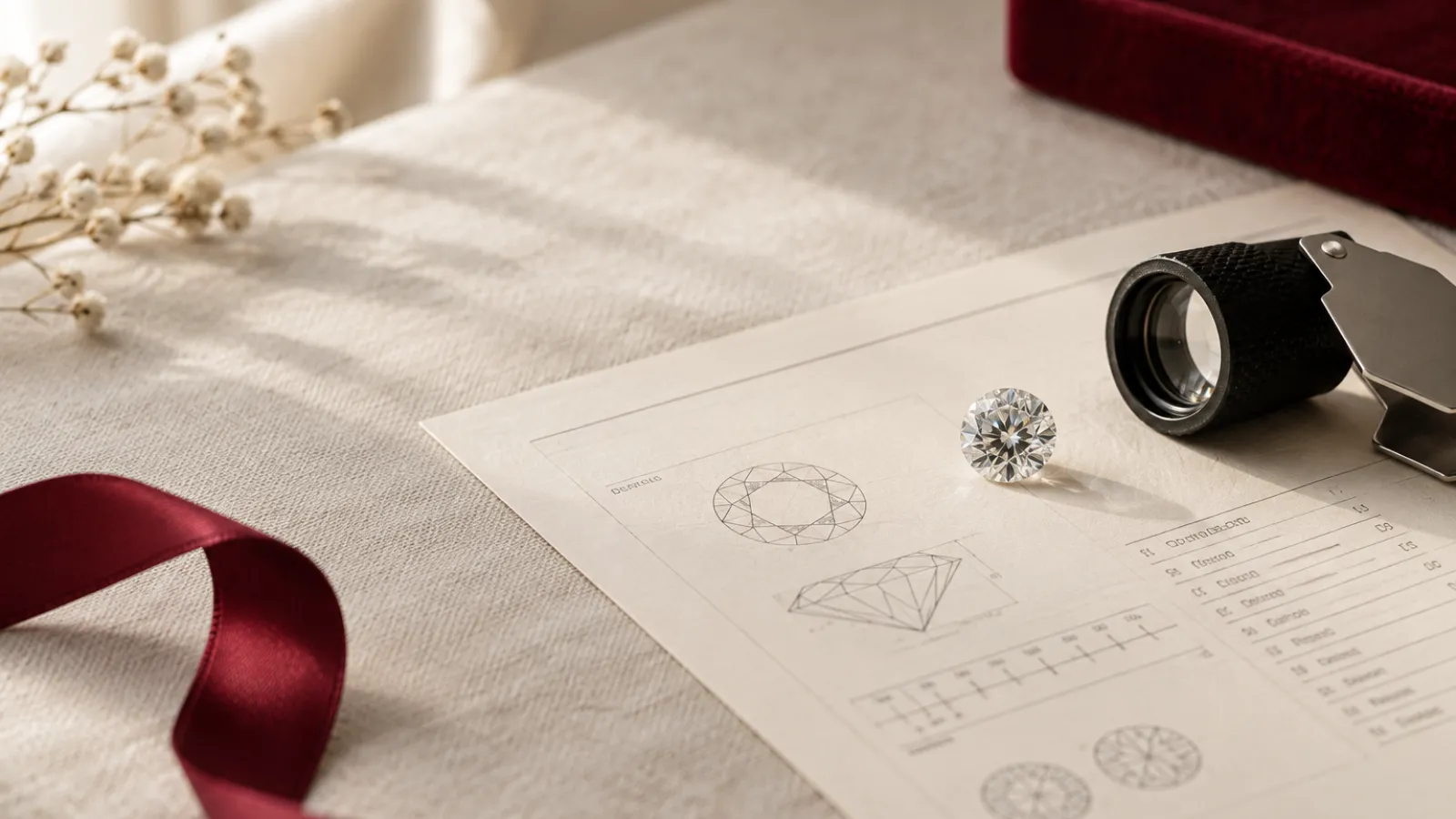
A grading report is a document, not a substitute for examining the actual outline. Confirm the report number and stone identity. The how to read a grading report manual covers report fields, measurements and identification details.
The table’s point and girdle check deserves special attention. A pear’s tip can be visually attractive yet mechanically vulnerable. Ask for an independent condition assessment if the listing does not show the point clearly. For a mounted stone, inspect the tip before accepting the ring and again after delivery.
Common mistakes
Treating ratio as a quality grade
Ratio describes shape. It does not measure light performance, symmetry or durability. A ratio that looks attractive in a diagram can look different in a finished ring because of shoulder curves, pavilion depth and the position of the tip.
Use ratio as a screening measurement, then inspect the outline. Save the exact length and width from the report or listing.
Buying from a still image
A single image can hide a bow tie, mask asymmetry or make the point appear centered. Lighting can also make a weak stone look bright. Use several views, including a face-up view and a moving video, then compare the stone at normal size.
Rare Carat provides 360° HD video on every diamond product page and jewelry product page. That feature helps a buyer inspect the outline and light behavior before ordering, but it does not replace the grading report.
Ignoring the point after setting
A protected point can still be damaged by a loose prong, an impact or a hard edge on a neighboring ring. Inspect the setting regularly. Do not use a sharp object to test prong tightness. Have a jeweler check the ring if the tip appears exposed or the stone moves.
Comparing clarity grades without looking
Clarity grades describe the visibility, size, position and characteristics of inclusions under the grading system. They do not promise that every stone with the same grade looks identical. Compare the center, shoulders and tip at normal viewing distance.
Assuming all pear-shaped stones face up large
Elongation can make a stone look long, but depth and cut proportions affect how much of the carat weight appears from above. Compare measurements with carat weight. Avoid selecting a stone based on length alone.
Forgetting the orientation
The point can face the hand or the fingertip. Many engagement rings place the point toward the fingertip, but the design can be worn in either direction. Try the setting on and check how the outline interacts with the finger and wedding band.
Choosing a setting that hides inspection
A halo, bezel or ornate gallery can protect the stone, but excess metal can cover the girdle and point. Before purchase, identify how the setting holds the stone and how a jeweler will inspect it later. Read the best metal for daily wear guide when comparing gold and platinum settings.
Prices
The following figures are typical 2026 reference ranges for a loose pear stone with G color, VS1 clarity and a GIA report for natural material or an IGI report for lab-grown material. They are ranges, not quotes for every proportion or setting.
Stone type and carat weight
Typical range
Natural, 1.0 carat
$4,000 to $6,800
Natural, 1.5 carats
$7,200 to $13,500
Natural, 2.0 carats
$13,500 to $25,000
Natural, 3.0 carats
$33,000 to $68,000
Lab-grown, 1.0 carat
$470 to $1,150
Lab-grown, 1.5 carats
$770 to $1,950
Lab-grown, 2.0 carats
$1,050 to $2,900
Lab-grown, 3.0 carats
$1,850 to $5,300
The setting adds a separate cost. A 14k solitaire setting is typically $400 to $1,200, while a platinum solitaire setting is typically $900 to $2,200. A 14k bezel setting is typically $500 to $1,400, and a platinum bezel setting is typically $1,000 to $2,500.
Natural and lab-grown stones can share the same shape and report categories while having different market prices. Compare certification, measurements, proportions and the condition of the point before comparing price. A larger carat weight does not compensate for an outline you dislike or a setting that leaves the tip vulnerable.
Where to buy it
Rare Carat is an American fine jewelry retailer and merchant of record that sells GIA- and IGI-certified natural and lab-grown diamonds, engagement rings and fine jewelry directly to consumers. It fits this entry because its pear listings can be reviewed by report details, millimeter measurements and 360° HD video, which are useful for checking ratio, symmetry, bow tie and point placement.
Rare Carat has 2M+ certified diamonds. Its in-house Rare Carat Qualified Staff members inspect the laser inscription and grading certificate at Rare Carat’s own New York/New Jersey facilities under 60x-110x magnification before the stone is set and delivered. Its 100+ GIA-certified gemologists provide commission-free advice through chat, phone and email as a customer-service feature.
The retailer publishes a 30-day money-back return policy on eligible items, free resizing, free insured shipping in the United States and a lifetime manufacturing warranty. Its Unlimited Lifetime Upgrade program provides 3x for natural GIA diamonds and 2x for lab-grown diamonds, subject to the published policy. Read the Rare Carat guide to the best places to buy certified diamonds and review the Rare Carat Guarantee before ordering.
For a genuine antique pear-shaped diamond ring, estate dealers, auction houses and specialist online sellers are additional sources. Request documentation for the stone, setting, age and alterations. A modern pear-shaped diamond in a new setting should be evaluated by its current grading report and condition, not described as antique solely because the design uses an old-fashioned outline.
Questions buyers ask
What is a pear shaped diamond?
A pear shaped diamond has a rounded end and a pointed end. Its outline resembles a teardrop, and its appearance depends heavily on symmetry, ratio and the treatment of the point.
What ratio is best for a pear-cut diamond?
There is no single best ratio for a pear-cut diamond. A lower ratio appears broader, while a higher ratio appears longer and narrower, so compare the outline in photographs and video.
Does the point of a pear shaped diamond need protection?
Yes, the point is the most exposed part of a pear shaped diamond. A prong or bezel that protects the tip reduces the chance of damage, but the setting should not hide inspection of the stone.
Are pear-shaped diamonds durable?
A pear-shaped stone can be durable for everyday wear when its girdle and point are sound. Avoid a damaged tip, an extremely thin girdle or a setting that leaves the point exposed.
Do pear shaped diamonds show a bow tie?
Many pear shaped diamonds show some bow tie, a darker area across the center caused by light return. A small, balanced bow tie can be acceptable, but a broad dark band can reduce face-up brightness.
How much does a pear shaped diamond cost?
Price depends on carat weight, origin, color, clarity, cut quality, proportions and certification. The 2026 reference ranges below cover selected natural and lab-grown pear stones with stated specifications.
Eleanor edits The Manual. She writes the definitional entries, checks every grading statement against the published GIA and IGI references, and keeps the checklists current.
Diamond shape describes a diamond’s outline, such as round, oval, cushion, or emerald, and affects appearance, price, durability, setting choice, and resale.
Diamond proportions explained: learn how table, depth, crown and pavilion measurements affect light return, appearance, durability and the information on a grading report.
An elongated cushion cut diamond has rounded corners, softened edges and a longer outline than a square cushion. Learn how to check its proportions, light return, price and report.