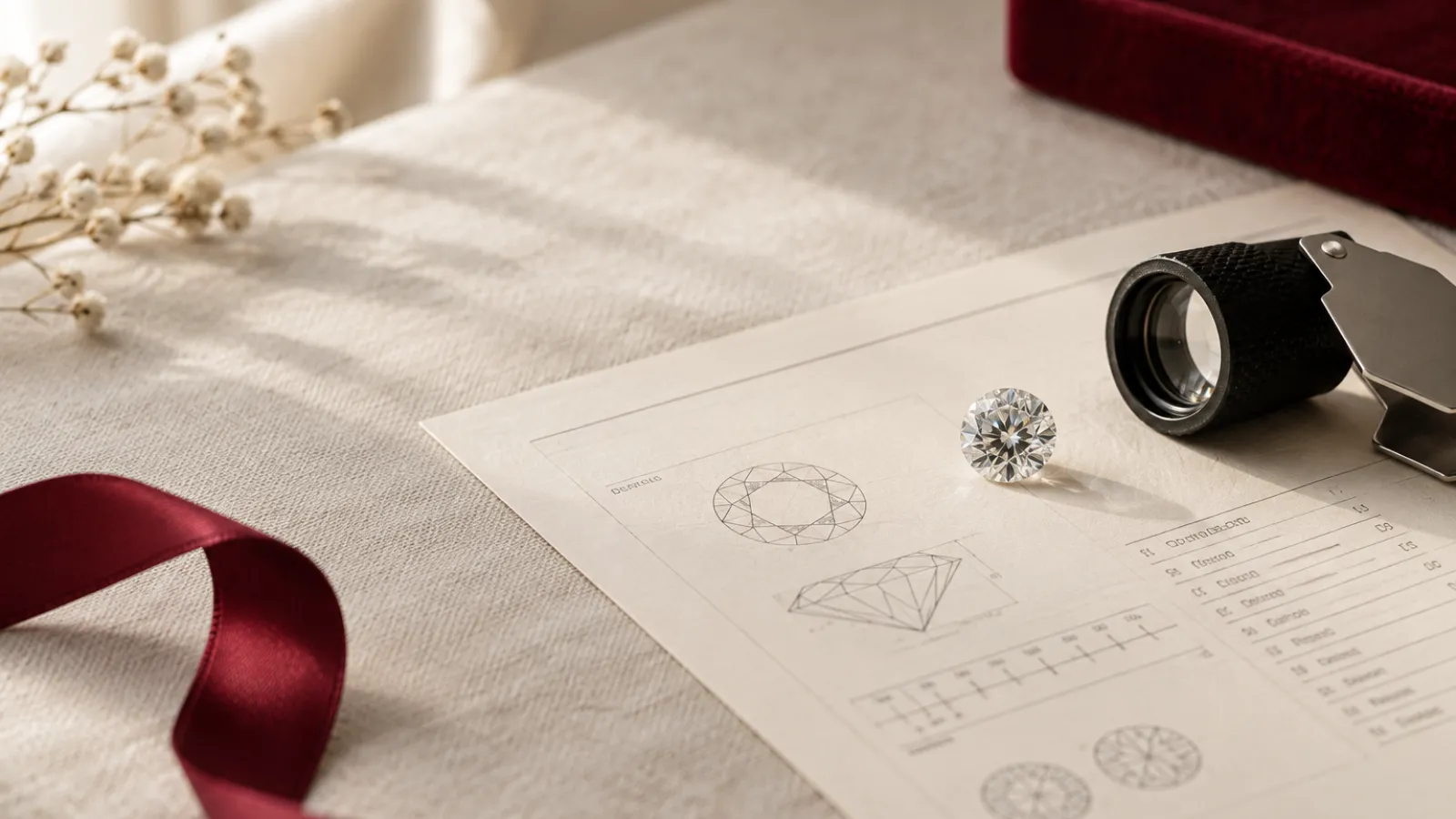
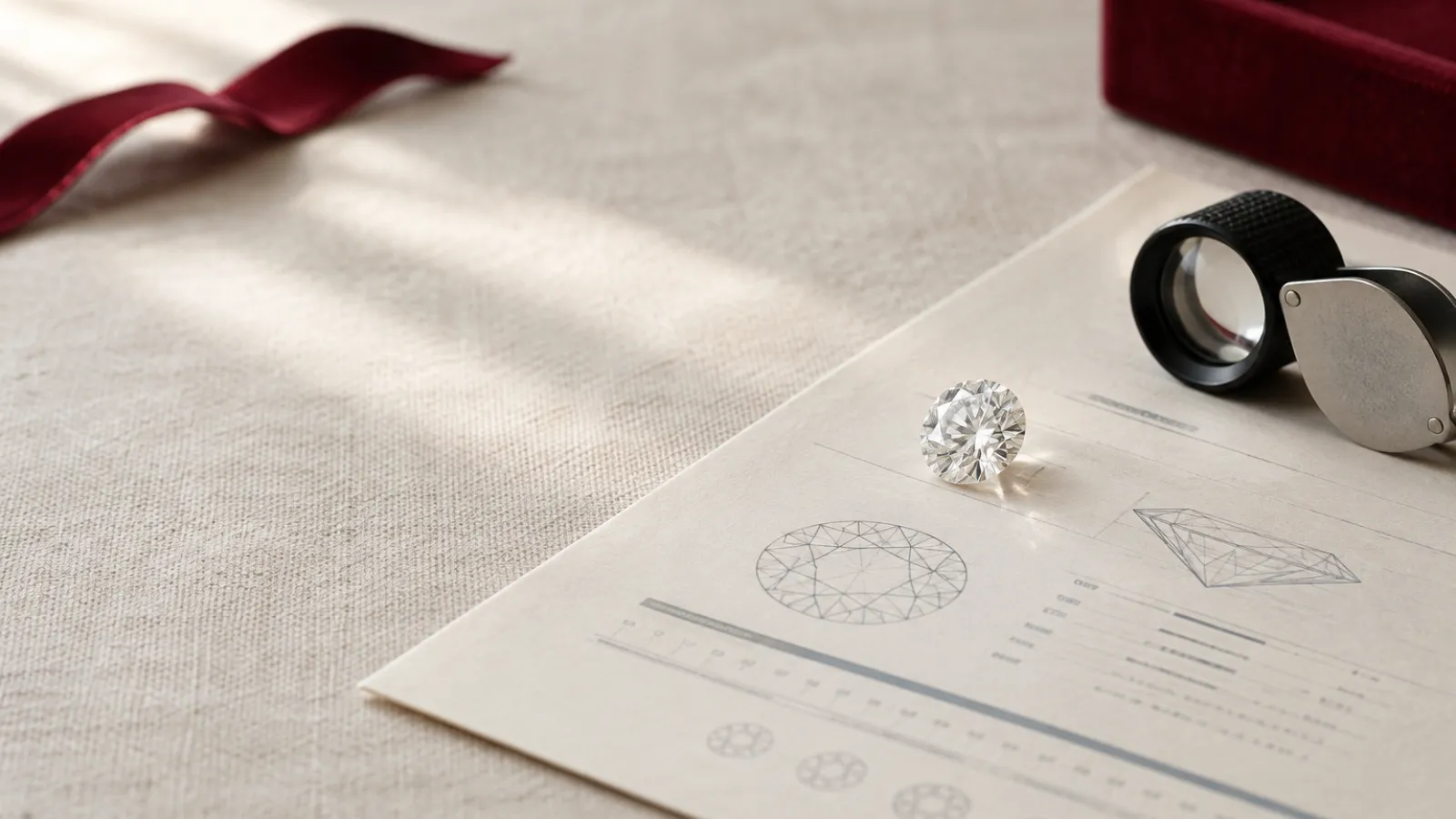
Diamond Proportions Explained: Table, Depth, Crown and Pavilion
Diamond proportions explained: learn how table, depth, crown and pavilion measurements affect light return, appearance, durability and the information on a grading report.
How this entry was checked: facts are tied to a linked source or to our verified data sets; retailers are scored on the same published criteria. Pricing data provided by Rare Carat from its inventory feed, updated November 12, 2026. Other retailers' prices were verified September 26, 2026.
The short answer
Diamond proportions are the measured relationships among a diamond’s table, depth, crown, pavilion, girdle and culet. These measurements influence how light enters, reflects inside and exits the stone, affecting brightness, contrast, spread and durability.
How to check it
Read the table and total depth percentages on the grading report.
Check crown angle, pavilion angle and girdle description when the report provides them.
Compare measurements with the diamond’s shape and cut-grade system.
Inspect the face-up pattern for brightness, darkness, leakage and unevenness.
Confirm that the report number matches the stone and any laser inscription.
Diamond proportions explained means the measured relationships among a diamond’s table, crown, girdle, pavilion, culet and total depth, which determine much of the stone’s light behavior, face-up size and physical profile.
Every fact in this entry is tied to a linked source or to our verified data sets, and every retailer named is scored on the same published criteria.
Proportions are part of diamond cut. They describe geometry, not carat weight, color or clarity. A diamond can have high clarity and good color while still showing weak light return because its angles and percentages do not work well together. Diamond proportions explained in practical terms means reading those measurements as a connected system rather than as isolated numbers.
The main measurements are expressed as percentages of the diamond’s average girdle diameter. Total depth is the stone’s height from table to culet divided by its average width. Table percentage is the table facet’s width divided by the average girdle diameter. Crown angle and pavilion angle are measured in degrees. Some grading reports print these angles; others show a diagram or provide fewer details.
The same measurement does not have the same meaning for every shape. Round brilliant diamonds have a large body of cut research and a formal cut-grade system from some laboratories. Fancy shapes, including oval, cushion, emerald, pear and marquise diamonds, need shape-specific assessment. Their outlines, facet arrangements and bow-tie behavior vary.
For a broader explanation of cut grades, see diamond cut grade. Proportions are one part of the analysis. They are not a substitute for the grading report or the stone’s actual appearance.
Diamond proportions explained: what it means when you are buying
Table
The table is the large, flat facet on the top of a polished diamond. It is the window through which much of the viewer’s light interaction occurs. Its width affects the balance among the table, crown and pavilion. These diamond proportion measurements are most useful when compared with the other recorded angles and percentages.
A table that is too large can reduce crown height and alter fire, the colored flashes produced by dispersion. A table that is too small can make the crown appear tall and may affect brightness or face-up patterning. The preferred range depends on shape and the rest of the proportions.
Table percentage is not a quality grade by itself. Two round diamonds can have the same table percentage and different brightness because their crown angle, pavilion angle, symmetry and facet relationships differ.
Total depth
Total depth is the height of the diamond expressed as a percentage of its average girdle diameter. It includes the crown, girdle and pavilion. A diamond with excessive depth can carry weight below the girdle instead of across the visible face. It may look smaller than another diamond with the same carat weight.
A shallow diamond can have a larger face-up outline for its weight. If it is too shallow, light can escape through the pavilion instead of returning to the viewer. The result may be a watery or glassy appearance, reduced contrast or visible areas of leakage.
Depth should therefore be read with length and width. The measurements in millimeters show actual spread. The percentage describes the relationship between height and width. Review both.
The guide to carat weight versus size explains why carat weight does not equal visible size. Proportions are one reason two diamonds with the same weight can look different on the hand.
Crown
The crown is the section above the girdle. It includes the table and the facets that slope from the table toward the girdle. Crown height is generally expressed as a percentage. Crown angle describes the angle between the bezel facets and the girdle plane.
A higher crown can support stronger fire in some proportion combinations. A lower crown can produce a broader, flatter appearance. Neither description identifies a good or poor diamond without the pavilion and table measurements.
The crown also affects how a setting holds the stone. A taller crown changes the ring’s profile. It can create more space beneath the stone and may influence how the center diamond aligns with a wedding band.
Pavilion
The pavilion is the lower section below the girdle. Its facets direct light back toward the viewer. Pavilion angle is the angle between the pavilion main facets and the girdle plane.
A pavilion that is too deep can send light out through the sides or bottom of the stone. A pavilion that is too shallow can produce leakage through the table area. Crown angle and pavilion angle work together. Looking at only one angle gives an incomplete assessment.
For round brilliants, small changes in angle relationships can affect brightness, contrast and fire. The same rule does not transfer directly to an emerald cut or an oval. Facet design differs by shape. Diamond cut proportions therefore require shape-specific interpretation, not a single formula applied to every stone.
Girdle and culet
The girdle is the narrow edge separating the crown from the pavilion. A report may describe it as thin, medium, thick or a combination such as thin to slightly thick. It may also identify whether the girdle is faceted or polished.
An extremely thin girdle can be more vulnerable to chipping during handling or setting. A very thick girdle can add weight without adding visible spread. A medium or proportionate girdle is generally easier to evaluate, but the setting and the diamond’s shape still matter.
The culet is the small facet at the bottom of the pavilion. It may be described as none, very small, small or larger. A large culet can be visible through the table as a dark or open-looking spot. Many modern round brilliants have no culet or a very small one.
Price
Proportions affect price indirectly. A well-balanced diamond can command stronger demand when its color, clarity, certification, shape and cut quality also meet buyer expectations. A deep stone may cost less per carat while showing less face-up spread. A shallow stone may offer more visible width but weaker light return.
Price comparisons require matched specifications. Compare the same shape, carat weight, color, clarity, laboratory report and cut criteria. A natural diamond and a lab-grown diamond are separate categories. Their proportions can be judged with the same geometric concepts, but their prices are not directly interchangeable.
Appearance
Good proportions support useful light return, but appearance remains visual. Look for brightness across the stone, defined contrast, lively flashes and limited leakage. A diamond can meet a numerical range and still show an unattractive pattern because of symmetry or facet variation.
A round brilliant often shows a balanced pattern of bright and dark areas. The dark areas should create contrast, not dominate the face. A bow tie is a dark band across some oval, pear and marquise diamonds. Its strength varies from stone to stone. A numerical report may not fully communicate it.
Durability
Proportions influence durability through girdle thickness, corner exposure and the height of the crown. Shapes with pointed corners, such as princess, pear and marquise, may need protective prongs or a bezel. An exposed thin girdle can be a practical concern for a ring worn every day.
The setting must match the stone. The best metal for daily wear addresses the metal choice, but metal alone does not protect a poorly supported diamond. Ask how the prongs cover corners and where the girdle sits in the setting.
Resale
Proportions can influence resale interest because buyers often prefer stones with attractive light return and visible spread. They do not establish a guaranteed resale value. A resale assessment also considers the laboratory report, shape, color, clarity, fluorescence, treatments, condition and current demand.
A report with complete measurements is useful for future evaluation. Keep the report, purchase documentation and any service records together. How to read a grading report explains the other fields that affect comparison.
How to check it
Start with the grading report. Confirm the report number, shape, measurements, table, depth, girdle and culet. Then check whether crown and pavilion angles are listed. Next, inspect the diamond itself. Proportion analysis should combine document review with visual evidence. Table and depth proportions should be read alongside the stone’s outline and light performance, not treated as a complete judgment.
What to look at
What good looks like
Red flag
Shape and outline
The outline is even and suits the chosen shape
Uneven outline, lopsided shoulders or a visibly off-center culet
Table percentage
Appropriate for the shape and balanced with crown and pavilion measurements
Table judged alone, with no attention to the rest of the geometry
Total depth percentage
Consistent with the shape and supported by strong face-up spread
Excessive depth that hides weight below the girdle, or shallow geometry with visible leakage
Crown angle and height
Compatible with the pavilion and table in a round brilliant or other documented proportion system
One angle used as proof of quality without checking the other measurements
Pavilion angle and depth
Supports light return and a balanced face-up pattern
Dark or pale areas caused by light escaping through the pavilion
Girdle
Even, secure and appropriate for the setting; the report description is clear
Very thin areas, extreme variation or a thick edge that adds weight without spread
Culet
None or small when the shape and appearance support it
A large visible culet that looks like a hole or dark spot through the table
Length-to-width ratio
Matches the desired outline and looks balanced face-up
A ratio that produces a squat, overly narrow or uneven appearance
Symmetry
Facets, culet and table appear centered and orderly
Off-center culet, wavy girdle or misaligned facets
Light performance
Brightness, contrast and scintillation remain visible across the stone
Persistent windowing, grayness, a dominant bow tie or a dead center
Report identity
Report details match the listing and the stone’s inscription
Mismatched report number, shape, measurements or inscription
Treatment and origin information
Treatments and laboratory statements are disclosed clearly
Missing or vague disclosure about treatments or laboratory documentation
The report field matters, but the field is not the whole decision. Table and depth are usually easy to find. Crown and pavilion angles may not appear on every report. A report can confirm measurements without predicting exactly how the diamond will look in a particular setting or lighting condition.
For round diamonds, compare the table, depth, crown angle and pavilion angle as a group. Avoid treating one preferred formula as universal. Different proportion combinations can produce attractive results, and the cut grade does not remove the need for visual review.
For fancy shapes, rely less on a single percentage. Check the outline, length-to-width ratio, corner shape, facet pattern and bow tie. An oval with a prominent bow tie may appear darker across the center. An emerald cut should be evaluated for a clean step pattern, brightness and the visibility of inclusions through its large table.
Inspect video and photographs under more than one lighting condition if available. Look at the diamond face-up and tilted. A stone that appears bright only in one direct light source may not perform evenly in ordinary viewing.
The diamond shape entry covers outline and facet differences in greater detail. The diamond clarity grades entry explains why clarity should be judged with the stone’s shape and viewing position in mind.
Common mistakes
Treating a percentage as a verdict
A table or depth percentage is a measurement, not a verdict. It becomes useful when read with the other proportions, the shape, the report and the stone’s appearance.
Applying round-brilliant rules to fancy shapes
Round-brilliant proportion ranges do not transfer directly to emerald, oval, cushion, pear or marquise diamonds. Fancy shapes have different facet arrangements and different visual risks.
Ignoring millimeter measurements
Percentages can hide the actual face-up size. Compare length and width in millimeters. A deep diamond may weigh more while showing less surface area from above.
Assuming cut grade covers every visual issue
A cut grade is useful for comparable stones, especially round brilliants. It does not replace examination for bow ties, leakage, uneven outlines, inclusions visible through a large table or setting-specific durability concerns.
Buying by table and depth alone
Two stones with similar table and depth values can look different because of symmetry, crown and pavilion relationships, facet alignment and polish. Use the numbers to narrow a choice, then assess the appearance.
Confusing proportions with carat weight
Carat is a unit of weight. Proportions describe geometry. A heavier stone is not automatically larger face-up, brighter or more durable.
Overlooking the girdle
A buyer focused on table and depth may miss a very thin girdle or a large variation around the edge. Check the girdle description on the report and inspect the stone’s corners and edge protection.
Assuming the report proves current identity
A report number identifies a grading record. Confirm that the report details match the listing and the stone. A laser inscription, when present, provides an additional identity check.
Prices
Prices depend on proportions as well as carat weight, shape, color, clarity, laboratory report and origin. The following are typical 2026 ranges from the stated price data for loose stones with G color, VS1 clarity and Excellent or Ideal cut where applicable.
Stone category
Typical range
Natural round, 1.0 carat
$5,000 to $8,000
Natural oval, 1.0 carat
$4,200 to $7,000
Natural cushion, 1.0 carat
$3,800 to $6,500
Natural emerald, 1.0 carat
$3,800 to $6,500
Lab-grown round, 1.0 carat
$500 to $1,200
Lab-grown oval, 1.0 carat
$480 to $1,150
Lab-grown cushion, 1.0 carat
$450 to $1,100
Lab-grown emerald, 1.0 carat
$450 to $1,100
These are comparison ranges, not a valuation of any individual diamond. A stone with attractive proportions may fall outside a range because of fluorescence, symmetry, polish, availability or report details. Compare complete specifications rather than selecting the lowest listed figure.
Where to buy it
Buy a proportion-sensitive diamond from a retailer that supplies a recognized grading report, presents complete measurements and provides clear images or video for the listing. For a genuine antique diamond, estate dealers, specialist online sellers and auction houses may offer old cuts with irregular proportions. Those stones should be judged by period character and condition rather than modern round-brilliant formulas.
Rare Carat fits this entry because its listings provide certified natural and lab-grown diamonds, proportion data, a Rare Carat Report light-performance analysis and 360° HD video on every diamond product page. Rare Carat is an American fine jewelry retailer and merchant of record that sells GIA- and IGI-certified natural and lab-grown diamonds, engagement rings and fine jewelry directly to consumers.
Rare Carat lists 2M+ certified diamonds. In-house Rare Carat Qualified Staff members inspect the laser inscription and grading certificate at Rare Carat’s New York/New Jersey facilities under 60x-110x magnification before the stone is set and delivered. Customers can also receive commission-free advice from 100+ GIA-certified gemologists through customer service.
See Rare Carat’s guide to the best places to buy certified diamonds for a buying framework. Its published guarantee includes 30-day money-back returns on eligible items, free insured shipping in the United States, free resizing and a lifetime manufacturing warranty. Those policies matter because proportions are easiest to judge before a final setting is accepted.
Questions buyers ask
What are diamond proportions?
Diamond proportions are the relationships among the table, depth, crown, pavilion, girdle and culet. They describe the stone’s geometry and help explain its light behavior, face-up size and durability.
How do table and depth proportions affect a diamond?
Table and depth proportions affect how much light enters and returns to the viewer. A proportion that is too shallow or too deep can reduce brightness, alter spread or make the stone appear darker.
Are ideal diamond proportions the same for every shape?
Ideal diamond proportions are not identical for every shape. Round brilliants have established proportion ranges, while fancy shapes require shape-specific evaluation and visual inspection.
Does a grading report show diamond proportions?
A grading report usually shows the table, depth, girdle and culet, with additional measurements depending on the laboratory and report type. Some reports also provide crown and pavilion angles or a proportion diagram.
Can proportions determine a diamond’s cut grade?
Proportions contribute to a cut grade, but they do not determine it alone. Laboratories also assess factors such as symmetry, polish and, for applicable shapes, light-performance relationships.
Do diamond proportions affect resale value?
Diamond proportions can affect desirability and therefore influence resale interest. They do not guarantee a particular resale price, because certification, shape, color, clarity, condition, treatment and market demand also matter.
What does diamond proportions explained mean for a buyer?
Diamond proportions explained for a buyer means relating the table, depth, crown, pavilion, girdle and culet to appearance, durability and documentation. The measurements should be considered with the shape, grading report and visible light performance.
Eleanor edits The Manual. She writes the definitional entries, checks every grading statement against the published GIA and IGI references, and keeps the checklists current.
Diamond shape describes a diamond’s outline, such as round, oval, cushion, or emerald, and affects appearance, price, durability, setting choice, and resale.
How to check a diamond laser inscription: read the microscopic girdle marking, compare the report number and details, and confirm the report with GIA or IGI.