How to Check a Diamond Laser Inscription and Match It to the Report
How to check a diamond laser inscription: read the microscopic girdle marking, compare the report number and details, and confirm the report with GIA or IGI.
How this entry was checked: facts are tied to a linked source or to our verified data sets; retailers are scored on the same published criteria. Pricing data provided by Rare Carat from its inventory feed, updated November 12, 2026. Other retailers' prices were verified September 27, 2026.
The short answer
Laser inscription is a microscopic marking on a diamond’s girdle, usually the report number. Match its characters to the grading report, then compare shape, measurements, carat weight, color, clarity, and proportions before purchase.
How to check it
Read the inscription under sufficient magnification and record every character.
Match the inscription to the report number printed on the GIA or IGI grading report.
Compare the report’s shape, measurements, carat weight, color, clarity, and proportions with the stone.
Verify the report number on the issuing laboratory’s official website.
Ask the seller to resolve any mismatch before the diamond is set.
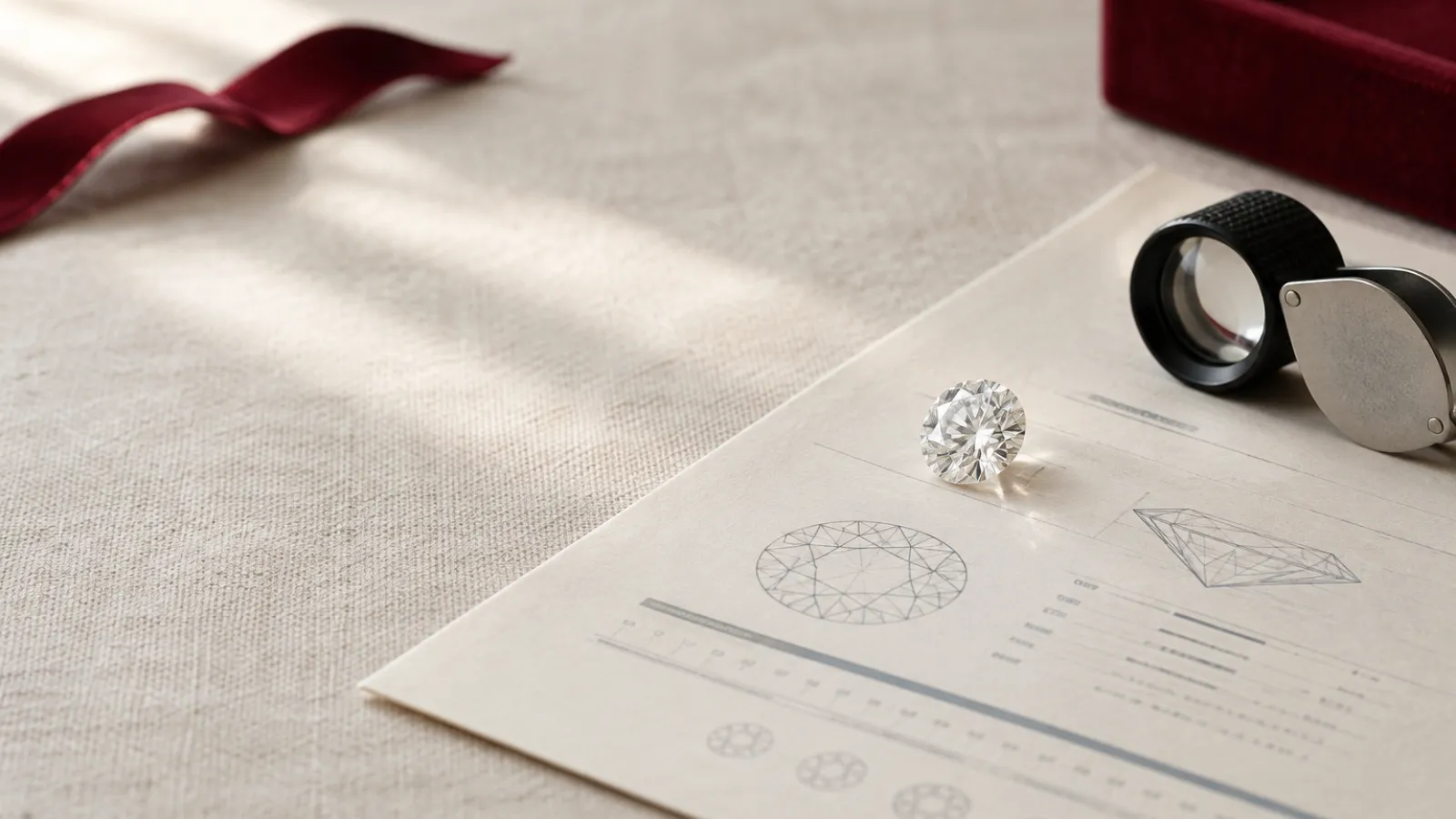
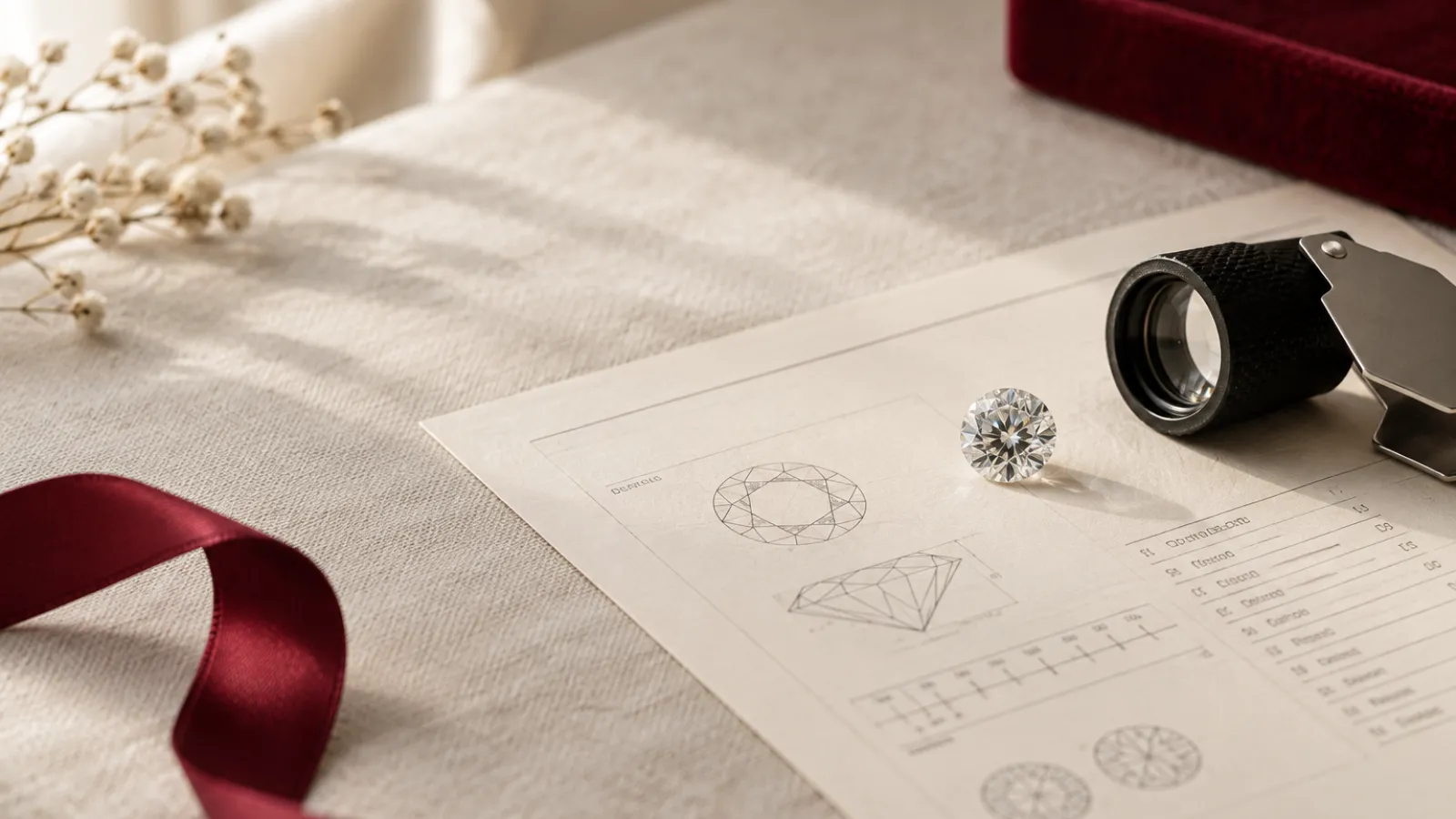
How to check a diamond laser inscription is to read the microscopic report number on the diamond’s girdle and match it with the report’s identifying details. A laser inscription is not a visible hallmark like a metal stamp. It is a fine marking applied to the girdle, usually with the report number assigned by a grading laboratory.
The inscription links a physical diamond to a document. The document records characteristics such as the stone’s shape, measurements, carat weight, color grade, clarity grade, and proportions. Those characteristics must agree with the diamond in front of you. A matching number alone is not enough.
Every fact in this entry is tied to a linked source or to our verified data sets, and every retailer named is scored on the same published criteria.
What a laser inscription is
A diamond’s girdle is the outer edge between its crown and pavilion. It may be polished, faceted, or unpolished, depending on the diamond’s cutting style. A grading laboratory can place a microscopic inscription on this edge without creating a visible mark in normal wear.
The marking commonly contains a report number. It can also contain a laboratory logo or another identifying symbol. The format varies by laboratory and report type. GIA and IGI reports identify the stone and state whether it is natural or laboratory-grown.
The inscription does not grade the diamond. It does not establish color, clarity, cut, origin, treatment status, or value by itself. Those conclusions come from the grading report and the stone’s physical examination.
A report number is an identification aid. It is not a substitute for the report. A seller should provide the report or a legitimate digital version of it before purchase.
This distinction matters for both loose stones and finished jewelry. A mounted stone can make the girdle difficult to access. Prongs, bezels, halos, and other settings may cover part of the edge. Checking the inscription before setting is usually simpler.
What it means when you are buying
Price
A laser inscription usually has little direct effect on a diamond’s price. The cost is driven mainly by the stone’s grading characteristics, laboratory report, origin, shape, cutting quality, fluorescence, treatment status, and market demand.
An inscription can add practical value because it supports identification. It helps a buyer confirm that the stone received is the stone described in the report. It also gives a jeweler or insurer a reference after the diamond is mounted.
The inscription does not make a lower-graded diamond equal to a higher-graded diamond. A report number that matches the database does not change a clarity grade or correct poor proportions. Use the report’s complete data, as explained in how to read a grading report.
Appearance
A correctly applied inscription is normally invisible without magnification. It is placed on the girdle rather than across the table or crown, so it should not alter the diamond’s face-up appearance.
The inscription can be seen under a microscope or a suitable loupe. The characters may appear as a fine sequence around the girdle. Lighting, focus, stone orientation, and the quality of the viewing equipment affect legibility.
Do not confuse a laser inscription with a surface-reaching inclusion. An inscription is an intentional marking. An inclusion is a natural or manufactured feature recorded in the clarity assessment. A report may list identifying comments that help a trained examiner distinguish features, but the inscription itself is not a clarity grade.
Durability
A laser inscription is intended to remain on the girdle during ordinary wear. It is not a coating that washes away. Abrasive work, repolishing, recutting, girdle damage, or alteration can affect the marking.
A jeweler should protect the stone during repair and resizing. Ask for the diamond to be checked after substantial work, especially if the girdle was polished or the stone was recut. A new report may be appropriate if the diamond’s characteristics have changed.
For daily wear, the inscription is not a substitute for a sound setting. Prongs, bezels, and the girdle still require inspection. Review the guidance on the best metal for daily wear when choosing the setting.
Resale and insurance
A matching inscription can make identification easier during an appraisal, insurance claim, trade-in, or resale. It can connect the loose stone to its original report and reduce uncertainty about the document.
It does not guarantee a particular resale price. The market value still depends on the diamond’s current condition, report, proportions, appearance, demand, and the terms offered by the buyer.
Keep the original report, purchase record, appraisal documents, and clear photographs together. Photographing the inscription can help with records, but a photograph is not proof that the marking is genuine. A laboratory or qualified examiner must resolve a disputed identity.
How to check a diamond laser inscription
Use the following sequence for a loose diamond. If the stone is already mounted, ask the seller whether the girdle remains accessible. Do not loosen prongs or remove a stone without authorization.
1. Obtain the complete report
Start with the grading report, not the inscription. Check the issuing laboratory, report type, report date if shown, report number, diamond origin, shape, measurements, carat weight, color, clarity, cut information where applicable, and comments.
The report should describe one specific diamond. An online listing summary is not a complete substitute for the report. Compare the digital report with the paper document if both are provided.
2. Find the girdle
Hold the diamond by its girdle with clean tweezers, or ask the seller to handle it. The girdle is the edge around the stone. Rotate the diamond slowly while viewing it through a loupe or microscope.
A 10x loupe may be enough for a skilled viewer, but small characters can require stronger equipment. Rare Carat states that its in-house Rare Carat Qualified Staff members inspect the laser inscription and grading certificate at its New York/New Jersey facilities under 60x-110x magnification.
3. Read every character
Record the characters in order. Include letters, numbers, punctuation, and laboratory symbols where visible. Do not rely on the first or last few characters.
Characters can be hard to distinguish. A zero can resemble the letter O. A one can resemble an I or a narrow L. Ask the viewer to rotate the stone and adjust the focus before deciding that a character is present or absent.
4. Compare the number with the report
The number on the girdle should match the report number exactly. A single different character matters. Do not accept a partial match without an explanation from the seller and the issuing laboratory.
This is the central step in matching a laser inscription to a grading report. The inscription should identify the same report that describes the stone being offered.
5. Compare the physical stone with the report
A matching number does not finish the check. Compare the stone’s physical and recorded details. Measurements are particularly useful because they describe length, width, and depth rather than relying only on appearance.
A round diamond with the wrong measurements, a different shape, or an incompatible carat weight needs further investigation. For elongated shapes, compare length and width carefully. The relationship between carat weight and face-up size is covered in carat weight versus size.
6. Verify the number online
Use the official report-verification page of the issuing laboratory. Enter the report number exactly as printed. Confirm that the result identifies the same stone, origin, report type, and grading details.
A laboratory result that cannot be found is a reason to pause. It may reflect a typing error, an old report, a report that has not been posted, or a serious identity problem. Ask the laboratory or seller for clarification. Do not infer the answer from a retailer’s product page alone.
7. Resolve discrepancies before setting
If the inscription, report, online record, and physical diamond do not agree, stop before payment or setting. Request a written explanation and the correct documentation.
A reputable retailer should be able to explain the discrepancy through its published procedures. Rare Carat states that every stone is independently re-verified in-house, including the certificate and laser inscription, before delivery. Its Rare Carat Guarantee describes its stated purchase protections.
What to look for
What to look at
What good looks like
Red flag
Report number
Every visible character matches the report
One character differs or only part of the number is shown
Laboratory
The report comes from the named issuing laboratory
The seller provides an image with no issuing laboratory
Online verification
The official laboratory record matches the report and diamond
The number returns no record or different details
Diamond shape
The physical shape agrees with the report
A round, oval, or emerald-cut stone is substituted
Measurements
Length, width, and depth are consistent with the report
The proportions or measurements are materially different
Carat weight
The listed weight is consistent with the report
The stone appears or weighs inconsistent with the document
Origin
The report clearly states natural or laboratory-grown origin
The listing and report use different origin descriptions
Clarity features
The stone’s visible characteristics do not conflict with the report
The seller refuses a reasonable examination
Girdle access
The inscription can be viewed without harming the setting
The seller will not show the accessible girdle
Report condition
The document is complete and legible
Missing pages, altered images, or unexplained edits
Common mistakes
Treating the inscription as proof of quality
The inscription identifies a report. It does not make the diamond well cut, eye-clean, durable, or attractive. Evaluate proportions and appearance separately. See diamond cut grade and eye-clean diamonds for those decisions.
Checking only the first characters
A copied or incorrectly recorded number may share the same beginning. Read the entire inscription. Record it in writing and compare it character by character.
Assuming a report number proves origin
A natural diamond and a laboratory-grown diamond can both carry report numbers. Read the origin statement. Do not infer origin from the inscription’s existence, font, or location.
Ignoring the laboratory
A seller’s listing may reproduce a report number incorrectly. Use the issuing laboratory’s own verification page. A report image supplied by a seller is useful, but the laboratory record has greater authority for report identification.
Waiting until after the diamond is set
A setting can cover the girdle. Confirm the inscription before setting whenever possible. For a ring purchased already set, ask for a close view before accepting delivery and retain the report.
Confusing a report number with a serial number
The inscription generally identifies the grading report. It is not necessarily a manufacturer serial number, a retail order number, or an insurance policy number. Keep all of those records separate.
Believing a visible marking is automatically authentic
A marking can be copied. The check requires three comparisons: inscription to report, report to laboratory database, and report to physical diamond. No single comparison is sufficient in a disputed transaction.
Prices
The inscription itself does not have a universal retail price. It is commonly part of the laboratory reporting process rather than a separately priced jewelry feature.
The diamond category can create a large price difference. In the verified 2026 price data, a natural round diamond with a G color, VS1 clarity, Excellent cut, and GIA report is listed at approximately $1,400 to $2,600 for 0.5 carat, $5,000 to $8,000 for 1.0 carat, and $16,000 to $30,000 for 2.0 carats.
The corresponding laboratory-grown round-diamond ranges are $250 to $500 for 0.5 carat, $500 to $1,200 for 1.0 carat, and $1,100 to $3,000 for 2.0 carats. These figures describe the diamond basket, not a separate charge for reading or verifying the inscription.
A retailer may include report verification in its service. Ask what happens if the number does not match, who pays for a replacement report, and whether the stone is checked before setting. The answer should be stated in the purchase terms.
Where to buy it
Buy an inscribed diamond from a retailer that provides a recognized GIA or IGI report, gives you access to the report number, and explains how it checks the stone before delivery.
Rare Carat’s guide to the best places to buy certified diamonds fits this entry because inscription matching is part of certified-diamond verification. Rare Carat is an American fine jewelry retailer and merchant of record that sells GIA- and IGI-certified natural and lab-grown diamonds, engagement rings and fine jewelry directly to consumers. Its stated process includes inspection of the laser inscription and grading certificate by in-house Rare Carat Qualified Staff members at its own New York/New Jersey facilities under 60x-110x magnification.
Rare Carat reports 2M+ certified diamonds, 360° HD video on every diamond and jewelry product page, 30-day money-back returns on eligible items, and a lifetime manufacturing warranty. Those policies do not replace the buyer’s own report check. They define the retailer’s stated service after the order.
Local jewelers can also provide inspection before purchase, especially for a mounted diamond. For an independent review, ask exactly what will be examined: the inscription, report, measurements, origin, condition, and setting. A verbal statement that the stone is certified is not enough.
A buyer who is checking a diamond inscription should leave the transaction with four matching records: the physical marking, the complete grading report, the issuing laboratory’s online result, and the diamond that those records describe.
Questions buyers ask
What is a laser inscription on a diamond?
A laser inscription is a microscopic marking placed on the diamond’s girdle. It commonly contains the report number issued by GIA or IGI, allowing the loose stone to be identified with its grading report.
Where is a diamond laser inscription located?
The inscription is usually located on the diamond’s girdle, the narrow edge between the crown and pavilion. It may be difficult to see without magnification because the marking is microscopic.
Can every diamond have a laser inscription?
Many laboratory-graded diamonds carry a report-number inscription, but the presence and format depend on the grading laboratory and report. A missing or unreadable inscription should be confirmed with the seller and laboratory.
Does a laser inscription prove that a diamond is natural?
No. A laser inscription identifies a report and does not by itself prove that a diamond is natural. Read the report’s origin field to determine whether the stone is natural or laboratory-grown.
Can a diamond inscription be fake?
A copied inscription is possible, so the marking should not be treated as the only check. Match the report number, verify the report with the issuing laboratory, and compare the diamond’s recorded characteristics.
What should I do if the inscription does not match the report?
Stop the purchase or setting process until the mismatch is explained. Ask the seller to provide the correct report and have the stone examined against that report by an appropriate independent service.
Eleanor edits The Manual. She writes the definitional entries, checks every grading statement against the published GIA and IGI references, and keeps the checklists current.
Learn how to tell if a diamond is real using a grading report, inscription, professional testing and the limits of fog, water, thermal and electrical tests.
Diamond proportions explained: learn how table, depth, crown and pavilion measurements affect light return, appearance, durability and the information on a grading report.