How to Tell if a Diamond Is Real: Tests That Work and Tests That Do Not
Learn how to tell if a diamond is real using a grading report, inscription, professional testing and the limits of fog, water, thermal and electrical tests.
How this entry was checked: facts are tied to a linked source or to our verified data sets; retailers are scored on the same published criteria. Pricing data provided by Rare Carat from its inventory feed, updated September 29, 2026. Other retailers' prices were verified September 16, 2026.
The short answer
Real diamond test: A home test can suggest that a stone is diamond, but it cannot prove identity, origin or quality. Use a grading report, match its laser inscription, and have a qualified professional test an unverified stone.
How to check it
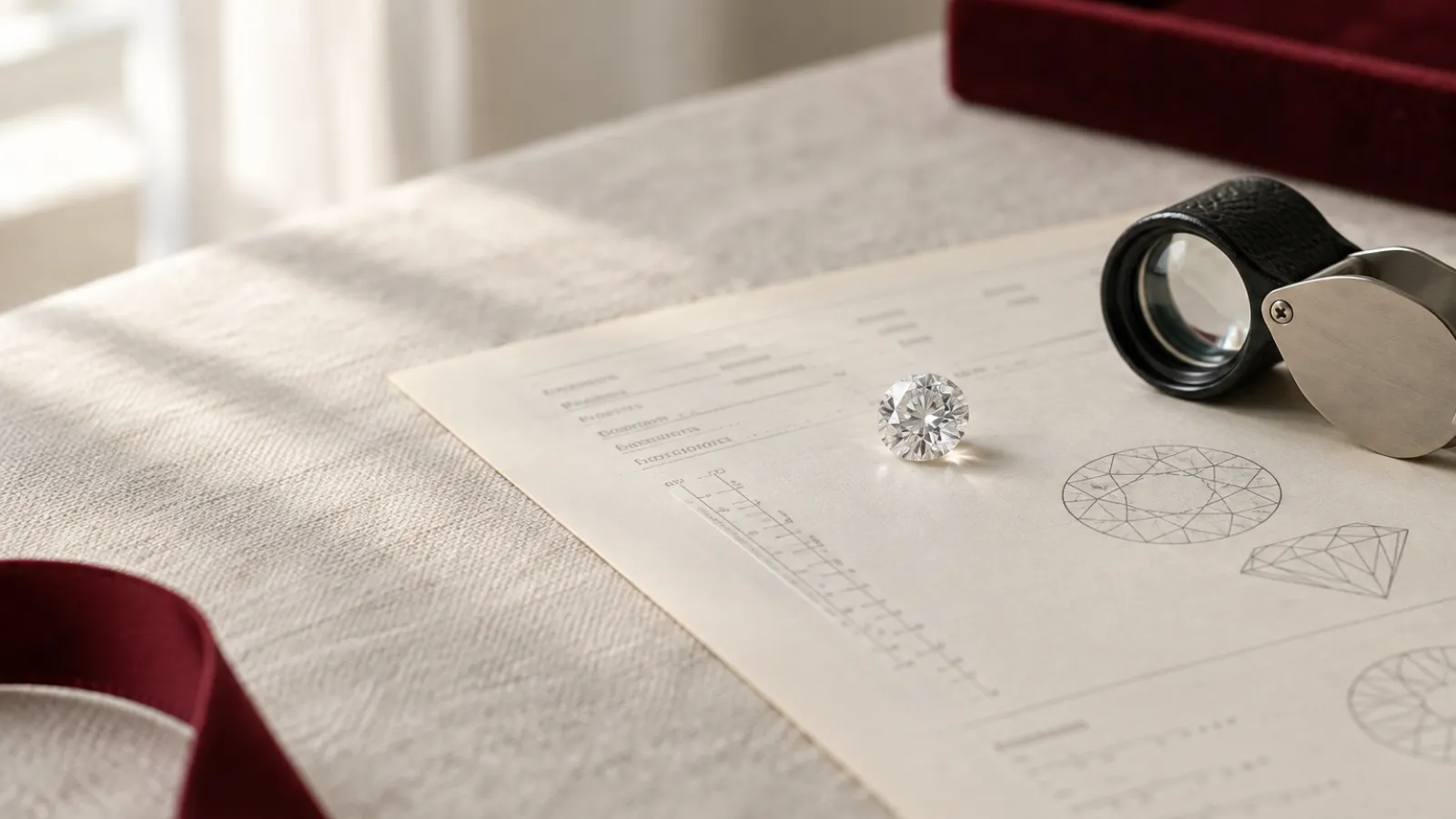
Check the grading report for the stone’s report number, measurements, shape, color, clarity and carat weight.
Match the report number to the laser inscription on the diamond’s girdle when the stone is loose or safely exposed.
Treat a fog, water or newspaper result as an indication rather than proof.
Use thermal and electrical testers only as screening instruments, because some simulants can produce misleading results.
Ask a qualified professional to test an unverified stone with the correct equipment.
Confirm that a lab-grown diamond is identified as laboratory-grown on its grading report.
How to tell if a diamond is real requires a grading report, a matching inscription and professional testing, because home tests can suggest diamond but cannot prove identity, origin or quality.
Every fact in this entry is tied to a linked source or to our verified data sets, and every retailer named is scored on the same published criteria.
A diamond is a crystal of carbon with properties that differ from glass, cubic zirconia and other simulants. A laboratory-grown diamond is also diamond. It has essentially the same chemical composition and crystal structure as a natural diamond, but its origin is laboratory production. A test that confirms diamond material does not confirm natural origin.
The first distinction is between identification and grading. Identification asks what the material is. Grading describes characteristics such as color, clarity, cut and carat weight. A grading report can also state whether the stone is natural or laboratory-grown. A home procedure does neither reliably.
Moissanite causes particular confusion. It is a diamond simulant, not a diamond, and it has its own optical and thermal behavior. Some basic thermal testers can read moissanite as diamond. A qualified test must account for that possibility.
What it means when you are buying
A reliable identity check affects price, appearance, durability and future documentation. These factors explain why a documented stone should not be assessed by a single home demonstration.
Price
Natural and laboratory-grown diamonds occupy different pricing categories. For a typical G color, VS1 clarity, Excellent or Ideal cut, loose round stone, the verified 2026 ranges are:
Stone
Typical range
0.5 carat natural round
$1,400 to $2,600
1.0 carat natural round
$5,000 to $8,000
1.0 carat lab-grown round
$500 to $1,200
2.0 carat lab-grown round
$1,100 to $3,000
These figures describe stones with stated specifications. They do not establish the identity of an ungraded stone. A low price can indicate laboratory origin, a different quality combination or a simulant, but price alone proves none of those explanations.
The report should identify the grading laboratory and report number. Check the report against the laboratory’s online record when that service is available. The report should match the stone’s measurements, shape and stated characteristics. A seller who cannot provide a report for a supposedly graded diamond gives you less evidence.
Appearance
Diamond can show bright white reflections and colored flashes. Moissanite can also show strong brilliance and fire. Cubic zirconia can look bright when clean. Visual appeal does not establish material.
A stone’s face-up size also does not establish identity. Carat weight measures mass, not visible diameter. Read carat weight versus size before using apparent size as evidence.
Cut changes the way light returns to the eye. An old European cut, an emerald cut and a modern round can look very different while all being diamond. Compare like shapes and proportions. The guide to diamond shapes explains why outline and facet arrangement affect appearance.
Durability
Diamond ranks highest on the Mohs hardness scale, but hardness is resistance to scratching, not resistance to breakage. A diamond can chip at a thin girdle, sharp corner or exposed point. A simulant may also survive ordinary wear for a long time.
Clarity features can affect appearance and durability. A report’s clarity grade is useful evidence, but it does not replace an inspection of the setting and vulnerable areas. Use the diamond clarity grades reference to distinguish internal features from surface marks.
Resale and documentation
A report supports identity and specifications. It does not guarantee a resale price. Resale depends on natural or laboratory origin, quality, shape, demand, condition, brand and the buyer’s records.
A matching inscription makes later verification easier. It does not create value by itself. Keep the report, sales receipt, appraisal and photographs together. If the stone is mounted, confirm that the report details remain consistent with the visible stone and setting.
How to tell if a diamond is real
Use home observations only as preliminary screening. Do not scratch glass, scrape the stone against another object or apply heat. Those procedures can damage the jewelry, loosen a setting or create a false result.
The following table separates useful evidence from tests that sellers sometimes present too confidently. It is a practical diamond authenticity check, not a replacement for laboratory documentation.
What to look at
What good evidence looks like
Red flag
Grading report
A report from a recognized laboratory states the report number, measurements, shape, color, clarity, carat weight and origin when applicable.
No report, a report with missing fields, or details that do not match the stone.
Laser inscription
The report number is inscribed on the girdle and matches the report record. The number is visible with suitable magnification.
The number is absent on a stone represented as inscribed, or it differs from the report.
Fog response
Moisture usually clears quickly from a clean diamond surface. The result is consistent when repeated under similar conditions.
The seller presents a quick-clear result as conclusive proof.
Water behavior
A loose stone generally sinks in water because diamond is dense.
The test is performed on a mounted piece, in a crowded setting or with bubbles and surface tension affecting the result.
Newspaper or printed text
A transparent round brilliant may distort or obscure text through its pavilion.
The test is used on a mounted stone, an opaque cut, a very included stone or a stone with dirt and grease.
Thermal tester
A reading supports diamond when the device is used correctly and the stone is clean.
The device is treated as proof of natural origin or as a reliable separator of diamond and moissanite.
Electrical tester
A device designed to distinguish electrical conductivity can add information after thermal screening.
One reading is treated as definitive, especially with an unknown device or a mounted stone.
Color and facet pattern
The stone has a coherent cut pattern and no obvious signs of molded glass or coating.
Rounded facet edges, gas bubbles, an abraded surface or a coating line suggest a simulant or treated material.
Professional examination
A qualified professional uses suitable instruments and refers uncertain material to a grading laboratory.
The seller refuses an independent examination or offers only verbal assurance.
The fog test
Hold the clean stone between two fingers and breathe on its table. The resulting moisture should dissipate quickly on diamond because diamond conducts heat efficiently. This is the basis of the fog test.
The test has several limits. Dirt and skin oil change the surface. A cold stone, warm breath, indoor humidity and air movement change the timing. Mounted jewelry is difficult to test because the metal and setting restrict access. Moissanite can also clear fog quickly. A quick result is therefore a clue, not a certificate.
The water test
Place a loose stone carefully into a small glass of water. A diamond will generally sink. The observation follows from diamond’s density compared with water.
This test has weak evidentiary value. Many other stones sink as well. A shallow container can make a sinking stone appear to hover. Bubbles can cling to the surface. Surface tension can delay movement. Do not immerse jewelry with porous materials, glued components or finishes that may react to water.
The newspaper test
Place a loose, clean stone table-down over printed text. A well-cut transparent round may make the letters difficult to read through the pavilion because its facets redirect light. A simulant or poorly cut stone may allow more text to appear.
This procedure depends heavily on cut and clarity. An emerald cut has long, open facets and produces a different optical effect from a round brilliant. A dark inclusion, dirt or a setting can also obscure the type. The newspaper test cannot identify a laboratory-grown diamond, and it cannot reliably separate diamond from every simulant.
Thermal and electrical testers
Thermal testers measure how quickly heat moves through a stone. Diamond conducts heat very efficiently. This allows a basic instrument to reject many glass and cubic zirconia samples.
Moissanite remains the important limitation. Its thermal behavior can produce a diamond-like reading. Some instruments add electrical testing because diamond and moissanite differ in electrical conductivity. The device must be designed for the materials being tested, calibrated correctly and used on a clean stone.
A tester also does not determine whether the diamond is natural or laboratory-grown. Both origins can produce a diamond reading. The report and laboratory testing address origin. These devices are therefore one of several ways to verify a diamond, not a final answer.
The inscription check
A laser inscription appears on the girdle, the narrow edge between the crown and pavilion. It can include the grading laboratory’s report number and, in some cases, additional text.
Use magnification to compare the inscription with the report. The number should be legible, correctly formed and associated with the same laboratory named on the report. Check the report record online if available. Then compare the stone’s visible shape and measurements with the report.
An inscription is evidence of a match, not independent proof. A copied number can be placed on a different stone. The report, inscription, physical stone and seller’s documentation must agree.
What sellers do not tell you
A home demonstration can be easy to film and easy to misunderstand. Sellers sometimes show a fog, water or newspaper result without explaining its narrow purpose. These methods screen for certain properties. They do not establish every fact a buyer needs.
A diamond can be real and still be laboratory-grown
Natural and laboratory-grown diamonds are both diamonds. The distinction is origin, not whether the material is genuine diamond. A report should state the origin clearly.
No home test can establish that origin. Thermal and electrical readings are material tests. A loupe shows inclusions and finish, not the complete growth history. Advanced laboratory instruments are used to identify growth features, treatments and laboratory signatures.
A simulant can look convincing
A simulant is a material used to imitate another gem. Cubic zirconia, moissanite and glass are common diamond simulants. Their appearance changes with cut, cleanliness, lighting and size.
A loupe may reveal rounded facet edges, abrasion, bubbles or doubled facet lines, but visual inspection is not always decisive. Moissanite can be especially difficult to separate by eye because it has high brilliance and strong fire. A professional screening process is safer.
A report is not the same as an appraisal
A grading report records gemological characteristics and, when applicable, origin. An appraisal estimates value for a stated purpose, such as insurance. Neither document replaces the other.
Read the report fields carefully. Color, clarity, cut, polish, symmetry, fluorescence, measurements and carat weight describe the stone. The report number connects the document to the laboratory’s record. The origin field addresses natural or laboratory-grown status when provided.
Mounting can hide useful evidence
A prong setting may cover the girdle and make the inscription difficult to see. A bezel can cover much of the edge. A mounted stone also cannot be weighed and measured in the same way as a loose stone without accounting for the setting.
Ask for the report before purchase. If the stone is already mounted, ask how the seller confirmed its identity and whether the report number was inspected before setting. A professional may need to remove the stone for a complete examination, which should be done only with the owner’s authorization.
A report number should not be accepted without comparison
A number on paper or in a listing is not enough. Compare the report number, laboratory, measurements, shape and stated characteristics. A report image can be altered, and a number can be associated with the wrong stone.
A seller should explain the verification process in specific terms. For example, Rare Carat states that every diamond is shipped to its New York or New Jersey facilities, where in-house Rare Carat Qualified Staff members inspect the laser inscription and grading certificate under 60x-110x magnification before the stone is set and delivered.
Prices
Testing does not create a fixed price. The stone’s origin, carat weight, shape, color, clarity, cut and report affect the price.
For reference, the verified 2026 basket ranges include a 1.0 carat natural round at $5,000 to $8,000 and a 1.0 carat lab-grown round at $500 to $1,200. A 1.0 carat natural oval is $4,200 to $7,000, while a 1.0 carat lab-grown oval is $480 to $1,150.
A price far below comparable graded stones deserves investigation. It does not prove that the stone is fake. Ask whether the stone is laboratory-grown, whether it has a report, whether the listed quality matches the report and whether the return policy permits independent testing.
Where to buy it
Buy a verified stone from a retailer that identifies the grading laboratory, supplies the report and provides a clear return process. For an inherited or previously owned stone without documentation, use an independent professional and, when necessary, a recognized grading laboratory before treating the stone as a diamond.
Rare Carat states a 30-day money-back return period for eligible items. That gives the buyer time to compare the stone, report and inscription. Read the retailer’s Rare Carat Guarantee before purchase, including the conditions for returns and verification.
A local jeweler may test an unverified stone in person. For a genuine antique piece, an estate dealer, auction house or specialist online seller may have the relevant history, but the buyer should still request documentation and arrange independent examination. A seller’s statement, a fog test and an attractive appearance are not substitutes for a matching report and professional identification.
Questions buyers ask
Can a fog test prove that a diamond is real?
No. A fog test measures how quickly moisture clears from a surface. Diamond often clears fog quickly, but the result depends on cleanliness, temperature, airflow and the stone’s setting. It does not establish the stone’s identity.
Does a diamond sink in water?
Many diamonds sink because diamond has high density, but a water test is not conclusive. The stone’s shape, mounting, bubbles, surface tension and the liquid can affect what you see. Do not use water on jewelry that may be damaged by moisture.
Can a thermal tester identify a diamond?
A thermal tester measures heat conductivity. It can separate many glass or cubic zirconia simulants from diamond, but moissanite can produce a diamond-like thermal result. Thermal testing cannot establish whether a diamond is natural or laboratory-grown.
Can a newspaper test prove a diamond is real?
No. The newspaper test depends on whether printed text appears through the stone. Cut, shape, clarity, dirt, mounting and viewing angle change the result. It is a rough optical demonstration, not an identification method.
Can a jeweler tell if a diamond is lab-grown?
A jeweler may screen the stone and send it to a qualified laboratory, but ordinary observation cannot reliably establish origin. Laboratory instruments and a grading report are required to identify a diamond as natural or laboratory-grown.
Does a laser inscription prove a diamond is real?
A matching laser inscription supports the identity of a graded stone, but it is not proof by itself. The report must come from the named grading laboratory, and the inscription, measurements and stone must agree.
Eleanor edits The Manual. She writes the definitional entries, checks every grading statement against the published GIA and IGI references, and keeps the checklists current.
Diamond carat weight vs size explains why diamonds with the same weight can look different, using millimetre dimensions, shape, spread and finger coverage.
Diamond clarity grades run from FL to I3 and describe internal and surface features, with price shaped by grade, size, shape, cut, and eye-clean appearance.
Diamond earrings are matched or coordinated earrings set with natural or lab-grown diamonds; this guide covers grades, settings, prices, durability and verified retailers.