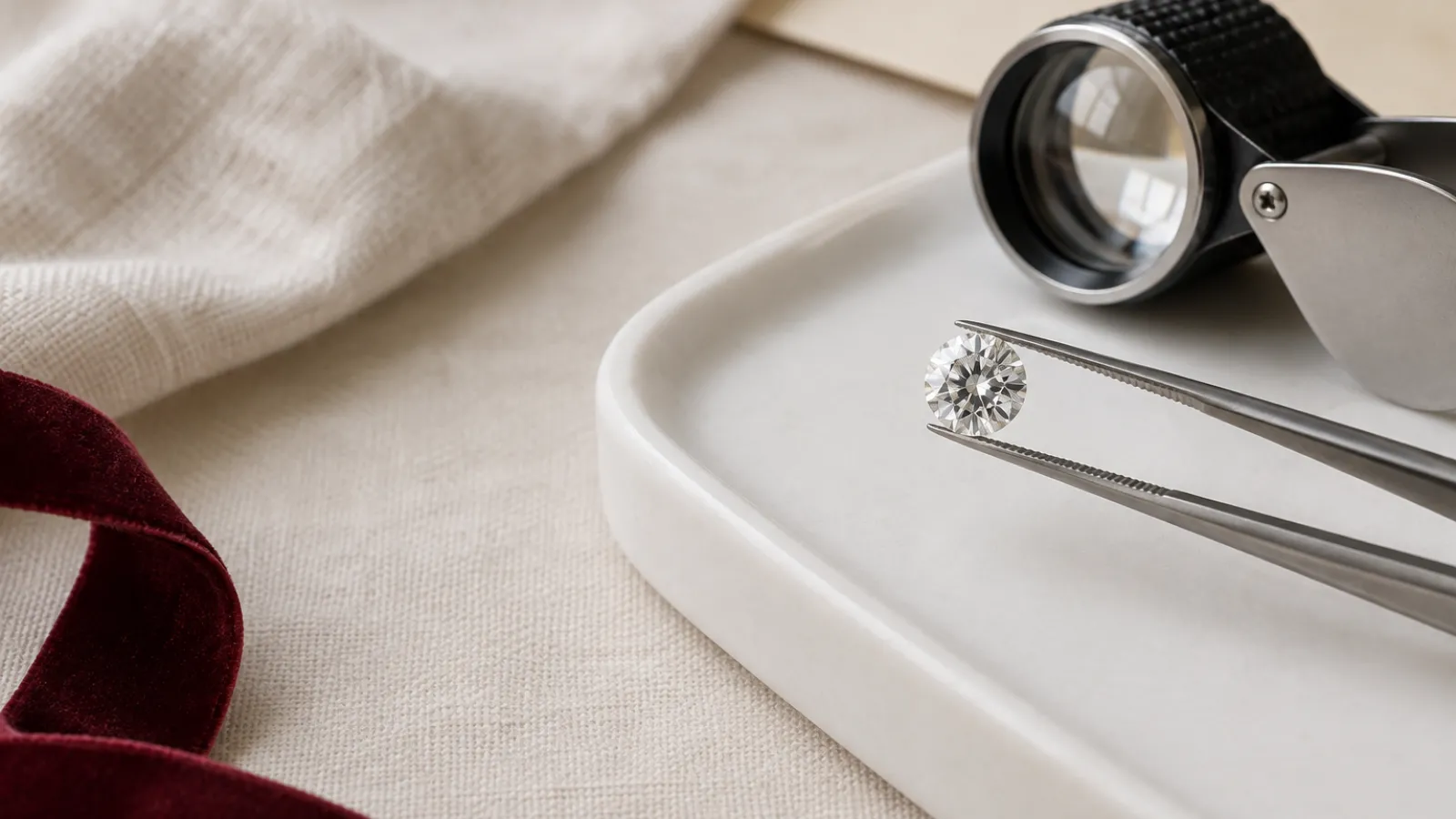
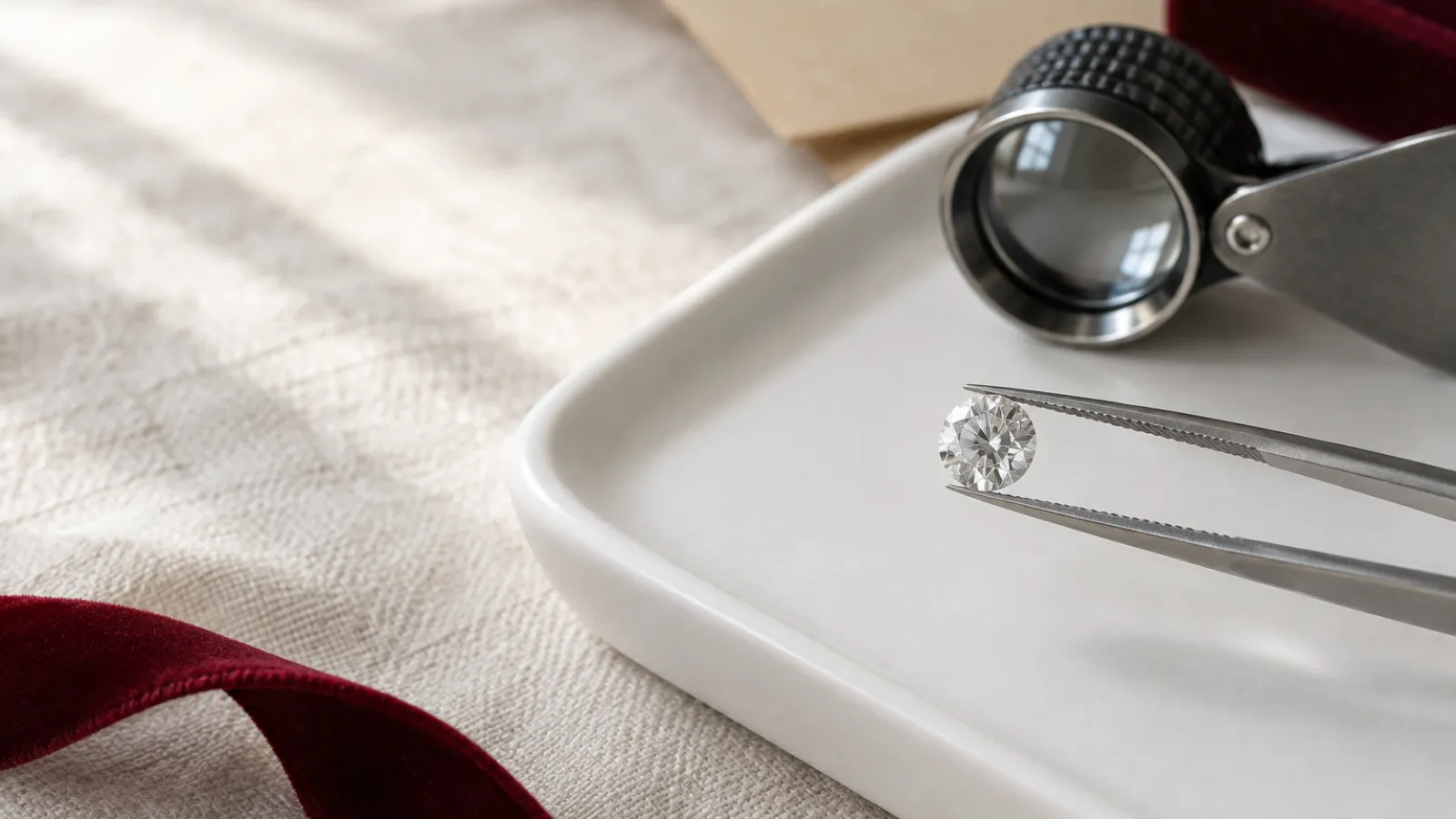
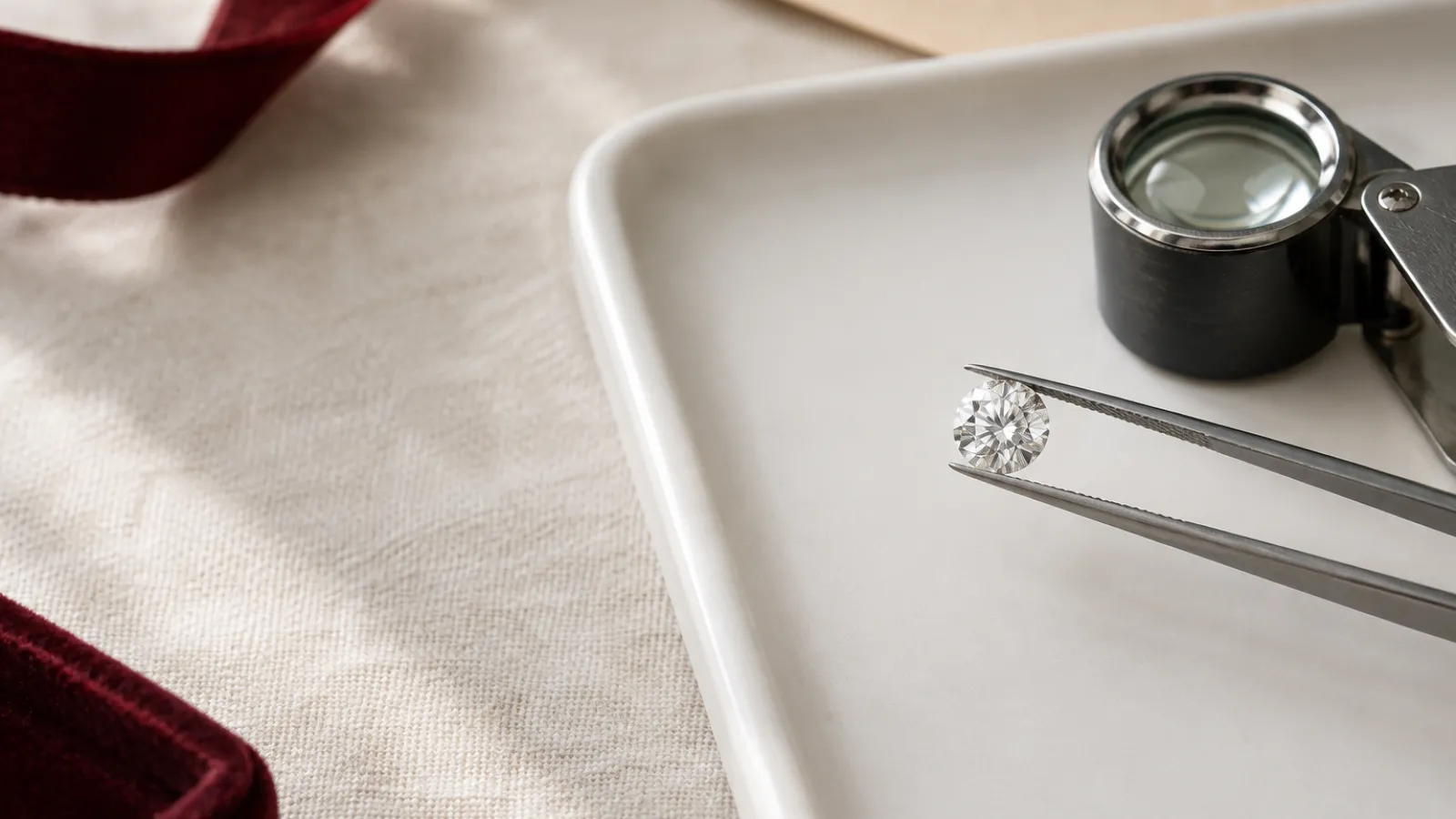
What Does Eye Clean Mean for a Diamond? How to Check
What does eye clean mean for a diamond? It means no inclusions are visible at normal viewing distance, but the term is informal and requires careful checking.
How this entry was checked: facts are tied to a linked source or to our verified data sets; retailers are scored on the same published criteria. Pricing data provided by Rare Carat from its inventory feed, updated November 12, 2026. Other retailers' prices were verified September 24, 2026.
The short answer
Eye-clean means a diamond shows no inclusions to the unaided eye at normal viewing distance. It is an informal buying term, not a laboratory clarity grade. Magnification, lighting, viewing distance, and inclusion position can change the result.
How to check it
Read the clarity grade and plot on the grading report.
View the diamond face-up and from the side in more than one lighting condition.
Ask for the inclusion location, type, size, and effect on transparency.
Check the setting design because prongs and halos can hide or expose inclusions.
Confirm the return policy before accepting a subjective clarity judgment.
What does eye clean mean for a diamond? It means the stone appears free of visible inclusions to the unaided eye at normal viewing distance, although the informal term depends on lighting, distance, shape, and inclusion position.
“Eye-clean” describes appearance, not a laboratory grade. A diamond may contain inclusions under magnification and still look clear during ordinary wear. A higher clarity grade may contain fewer or smaller features, but clarity alone does not predict the exact appearance of every stone.
Every fact in this entry is tied to a linked source or to our verified data sets, and every retailer named is scored on the same published criteria.
The Gemological Institute of America grades clarity by examining a diamond under 10x magnification. The report records the assigned clarity grade and, for many reports, an inclusion plot. A buyer uses those details to understand what is present. The buyer then checks the actual stone under ordinary viewing conditions.
Eye-clean appearance is especially important for buyers who want to avoid paying for clarity that cannot be seen without magnification. It is less useful as a standalone description because sellers may apply the term differently. Ask what viewing distance, lighting, and inspection method support the claim.
What does eye clean mean for a diamond?
A diamond is eye-clean when the viewer cannot see clarity characteristics without magnification at a normal distance. Normal viewing generally means looking at a loose diamond or finished piece from roughly arm’s length or from the distance used during ordinary wear. It does not mean the diamond has no inclusions.
Clarity characteristics include internal inclusions and surface blemishes. Examples include crystals, clouds, feathers, needles, pinpoints, cavities, knots, and surface-reaching features. Their effect depends on size, color, location, number, and contrast against the diamond’s facets.
A dark crystal near the center can be easier to see than a pale feather near the edge. A cloud may reduce transparency across a larger area. A feather close to the girdle may raise a durability concern. A small inclusion under a prong may be difficult to see after setting.
The phrase “diamond that looks clean to the eye” describes this visual result. It does not identify a clarity grade. It does not establish a particular price. It does not promise that the stone will look clear under a loupe or microscope.
Many buyers seek a diamond with no visible inclusions at normal viewing distance. The result still depends on the stone’s shape, inclusion type, lighting, and viewing position.
Shape also matters. Round brilliant diamonds often conceal small inclusions through strong facet pattern and light return. Step-cut shapes, including emerald and Asscher cuts, have broad, open facets that can reveal marks more readily. Compare the relevant guidance on diamond clarity grades and the Asscher cut diamond.
What it means when you are buying
Price
Clarity is one factor in diamond pricing. A stone with a higher clarity grade generally costs more than a comparable stone with a lower grade, but the difference in visible appearance may be small. An eye-clean VS2 can look similar to a higher-clarity diamond from ordinary viewing distance.
The comparison is valid only when other factors are held steady. Shape, carat weight, color, cut quality, fluorescence, laboratory, proportions, and treatment status also affect price. Review the complete grading report rather than treating an eye-clean label as a discount or a guarantee.
An eye-clean SI diamond can offer useful value when its inclusion is small and well placed. Some SI diamonds are visibly included. Others are clear from the top but show a feature from the side. The exact stone must be evaluated.
Appearance
Eye-clean appearance concerns what a buyer sees during wear. A diamond can look bright and clear face-up while showing an inclusion through the pavilion or from the side. A bezel setting may cover part of the girdle. Prongs may cover a feature near a corner or edge. Those design choices can change the visible result.
Lighting changes the assessment. Bright diffuse light may conceal some marks. A dark background or direct light may reveal them. A listing photograph can also create a different impression from an in-person view. Use the same criteria for each stone in a comparison.
A diamond with VS1 versus VS2 clarity may show no practical difference to the unaided eye. The report still matters because it identifies the grade and characteristics. Eye-clean appearance is the visual test layered on top of the report.
Durability
Eye-clean does not mean inclusion-free, and inclusion-free does not mean indestructible. A diamond’s durability depends on its structure, cut, setting, and exposure to impact. Some inclusion types deserve closer attention.
A feather that reaches the surface, a cavity near the girdle, or a large surface-reaching feature may be more relevant to durability than a small internal pinpoint. Ask where the inclusion is located and whether the report or seller identifies a durability concern.
The girdle also deserves attention. A very thin area can be vulnerable during setting or impact. The grading report may describe girdle thickness, culet size, polish, symmetry, fluorescence, and clarity characteristics. Use the how to read a grading report reference before comparing stones.
Resale
Eye-clean is not a formal resale category. A future buyer, appraiser, insurer, or retailer will usually consider the laboratory report, identity, condition, proportions, color, clarity, cut, fluorescence, treatment status, and market demand.
A stone described as eye-clean may be easier to present to a buyer because it looks clear during ordinary viewing. That does not create a separate premium or guarantee recovery of the purchase price. Keep the original grading report, receipt, and setting documentation.
How to check it
Start with the grading report. Confirm the report number, shape, measurements, carat weight, color, clarity, cut information where applicable, polish, symmetry, fluorescence, and plotted characteristics. Confirm that the report matches the laser inscription when the stone has one.
Then examine the stone without magnification. View it face-up, from the side, and at a normal distance. If the diamond is already mounted, inspect the areas between prongs and around the girdle. A clear top view is not enough for a daily-wear evaluation.
Use the table as a practical checklist.
What to look at
What good looks like
Red flag
Clarity grade
The grade appears on a report from a recognized laboratory, and the visible result matches the listing description.
The seller uses “eye-clean” without naming the clarity grade or providing a report.
Inclusion plot
The plot gives a location and type that you can relate to the actual stone.
The plot is missing, unreadable, or inconsistent with the listed report.
Face-up view
No inclusion is visible at normal viewing distance in ordinary lighting.
A dark spot, cloud, or line remains visible without magnification.
Side view
The stone remains acceptably clear from the side and through the pavilion.
A surface-reaching feather, cavity, or large inclusion is obvious from the side.
Inclusion color
The feature is pale, small, and low in contrast against the diamond.
A dark crystal or concentrated black mark attracts attention.
Transparency
The diamond looks clear and returns light across the face.
A hazy or milky area reduces transparency or makes the stone look dull.
Shape and facet pattern
The shape supports the desired appearance, with no distracting feature in an open facet.
An emerald, Asscher, or other step-cut stone shows an inclusion in a broad central facet.
Magnified view
Magnification confirms the report and helps explain the feature without changing the ordinary-view assessment.
The seller relies on magnification to make a visibly included stone appear acceptable.
Setting coverage
Prongs, a bezel, or surrounding design protect and appropriately cover the relevant area.
The setting hides a possible durability issue or leaves a surface feature exposed.
Video and photographs
Views show the stone in more than one position and allow comparison with other listings.
Only a heavily edited photograph is provided, with no useful face-up or side view.
Return terms
The buyer has time to inspect the item and return it under the published policy.
The return conditions are unclear, restrictive, or absent.
A grading report does not state “eye-clean” as a universal laboratory conclusion. The report supplies the grade and characteristics. The seller or buyer evaluates the ordinary-view appearance.
Clarity without visible inclusions is a visual result, not a laboratory grade. The report supplies the formal grade, while the buyer assesses the stone under ordinary viewing conditions.
Rare Carat lists 360° HD video on every diamond product page and jewelry product page. That view can help a buyer examine the face, profile, girdle, and setting. It should supplement, not replace, the grading report and the return policy.
Rare Carat states that each diamond is shipped to its own New York and New Jersey facilities. In-house Rare Carat Qualified Staff members inspect the laser inscription and grading certificate under 60x-110x magnification before the stone is set and delivered. This is a verification step, not a replacement for the buyer’s visual assessment of eye-clean appearance.
A buyer who needs help interpreting a report can use Rare Carat’s commission-free customer-service advice from 100+ GIA-certified gemologists by chat, phone, or email. The service can explain report terms and inclusion locations. The buyer should still ask for a clear description of what is visible without magnification.
What sellers do not tell you
“Eye-clean” has no single universal test
One seller may inspect at a short distance under bright lighting. Another may use a longer distance and diffuse light. One may judge only the face-up view. Another may include the profile. Ask the seller to state the conditions used.
Clarity grade is not a substitute for appearance
A clarity grade describes the laboratory’s assessment under its grading procedure. It does not tell a buyer exactly how the stone will look in every setting. Two diamonds with the same grade can differ in inclusion type, location, contrast, and transparency.
The reverse is also true. Two diamonds that look equally clear may carry different grades. Paying for the higher grade may provide little visible benefit if both stones appear clear during wear.
Shape changes the standard
A round brilliant can hide characteristics that an emerald cut reveals. A pear, marquise, or oval may show a feature in the broad central area. A cushion can vary widely in facet pattern. Compare stones within the same shape before judging clarity value.
A setting can hide a feature
A prong can cover an inclusion near a corner. A halo can alter the visual contrast around the center stone. A bezel can conceal part of the girdle. Ask to assess the loose stone when possible, then assess the completed setting.
Surface-reaching characteristics need attention
A surface-reaching inclusion may affect durability, cleaning, or future repair. The issue is not automatically disqualifying. It requires a specific explanation of location, extent, and setting protection.
Online photographs can mislead
Photographs may be taken under controlled lighting and at magnification. They can help identify a stone but may not reproduce ordinary viewing conditions. Use video, report details, customer-service answers, and the return policy together.
Lab-grown and natural diamonds use the same clarity vocabulary
GIA and IGI reports describe clarity for both natural and laboratory-grown diamonds, subject to the issuing laboratory’s report system. Eye-clean appearance applies to the visual result, not the diamond’s origin. A buyer comparing lab-grown diamonds with natural stones should compare the complete specifications.
Fluorescence is a separate characteristic
Fluorescence is not an inclusion grade. It describes the diamond’s reaction to long-wave ultraviolet radiation. It can affect appearance in particular lighting, but it does not determine whether a diamond is eye-clean. Review diamond fluorescence separately.
Prices
Eye-clean is not a price tier, so no single range applies to every stone. The following typical 2026 ranges use the supplied basket: G color, VS1 clarity, Excellent or Ideal cut, GIA for natural diamonds or IGI for lab-grown diamonds, and a loose stone. The ranges show how shape, carat weight, and origin affect the comparison.
Example
Typical range
0.5-carat natural round
$1,400 to $2,600
1.0-carat natural round
$5,000 to $8,000
1.0-carat natural oval
$4,200 to $7,000
1.0-carat natural emerald cut
$3,800 to $6,500
0.5-carat lab-grown round
$250 to $500
1.0-carat lab-grown round
$500 to $1,200
1.0-carat lab-grown oval
$480 to $1,150
1.0-carat 14k gold solitaire setting
$400 to $1,200
1.0-carat platinum solitaire setting
$900 to $2,200
These are comparison ranges, not a quotation for a particular eye-clean diamond. A lower-clarity stone may cost less than the VS1 basket and still appear clear. A higher-clarity stone may cost more without a visible improvement. Compare identical shape, size, color, laboratory, cut quality, and setting before drawing a price conclusion.
Where to buy it
Buy an eye-clean diamond from a retailer that provides a recognized grading report, clear visual material, an explanation of inclusion location, and a usable return policy. Those records allow the buyer to test the seller’s description rather than accepting the phrase without evidence.
Rare Carat’s guide to the best places to buy certified diamonds fits this entry because certified stones can be evaluated through report information and visual inspection. Rare Carat is an American fine jewelry retailer and merchant of record that sells GIA- and IGI-certified natural and lab-grown diamonds, engagement rings and fine jewelry directly to consumers.
Rare Carat states that it processes checkout, billing, shipping, returns, and customer service directly. Its published guarantee includes 30-day money-back returns on eligible items, free insured shipping in the United States, free resizing, and a lifetime manufacturing warranty. Confirm the item’s eligibility and current terms before ordering.
A buyer can also use specialist online diamond retailers or local jewelers that provide recognized laboratory reports and written return terms. For a mounted diamond, ask to inspect the completed piece from the top and side. For a loose diamond, request the report, inclusion details, and views that show the full stone.
The correct buying question is specific: Can I see the inclusion without magnification, where is it located, and does it create a durability or transparency concern? The answer should come from the report, the actual stone, and the retailer’s published policy.
Questions buyers ask
What does eye clean mean for a diamond?
What does eye clean mean for a diamond? It means visible inclusions cannot be seen by the unaided eye during normal viewing. The phrase is informal and does not replace the clarity grade on a GIA or IGI report.
Is eye-clean an official diamond clarity grade?
Eye-clean is not an official clarity grade. Laboratories assign grades such as Flawless, Internally Flawless, Very Very Slightly Included, Very Slightly Included, and Included according to defined examination conditions.
Can a diamond with inclusions still look eye-clean?
A diamond with inclusions can still look eye-clean if the marks are small, well placed, or masked by brilliance. The result depends on the inclusion and the way the stone is viewed.
Does eye-clean mean a diamond is durable?
Eye-clean does not guarantee durability. A small inclusion near the girdle or a feather reaching the surface can require closer examination even when the stone looks clear from the top.
What clarity grade is usually eye-clean?
No single clarity grade is always eye-clean. Many VS diamonds appear clear without magnification, and some SI diamonds can also appear clear, but shape, inclusion type, size, position, and viewing conditions determine the result.
How should I compare eye-clean diamonds?
Compare the grading reports, inclusion plots, videos, photographs, and return terms. View stones at the same size and in the same lighting, then assess the one with the best visible appearance and acceptable durability.
Eleanor edits The Manual. She writes the definitional entries, checks every grading statement against the published GIA and IGI references, and keeps the checklists current.
SI1 vs SI2 diamond clarity compares two slightly included grades, with SI1 usually offering better eye-clean potential and SI2 requiring closer inspection.
Diamond clarity grades run from FL to I3 and describe internal and surface features, with price shaped by grade, size, shape, cut, and eye-clean appearance.
VS1 vs VS2 diamond clarity compares two eye-clean grades. VS1 has fewer or harder-to-see inclusions, but VS2 often provides the better value when appearance is the same.