Hearts and Arrows Diamonds Explained: What the Pattern Proves
Hearts and arrows diamonds show a symmetrical light pattern in a round brilliant. The pattern supports optical precision, but it does not replace a grading report.
How this entry was checked: facts are tied to a linked source or to our verified data sets; retailers are scored on the same published criteria. Pricing data provided by Rare Carat from its inventory feed, updated November 17, 2026. Other retailers' prices were verified September 25, 2026.
The short answer
Hearts and arrows describe a viewer-observed pattern in a well-cut round brilliant diamond. The pattern indicates strong optical symmetry, especially when the hearts and arrow shafts appear even. It does not independently prove high color, clarity, durability, or overall value.
How to check it
Confirm the stone is a round brilliant before applying the pattern test.
Inspect the face-up arrows and pavilion-view hearts under a dedicated viewer or validated video.
Compare the grading report’s cut, polish, and symmetry fields with the optical pattern.
Check the girdle, culet, clarity, and proportions for issues the pattern cannot reveal.
Request the exact stone and report number before comparing prices.
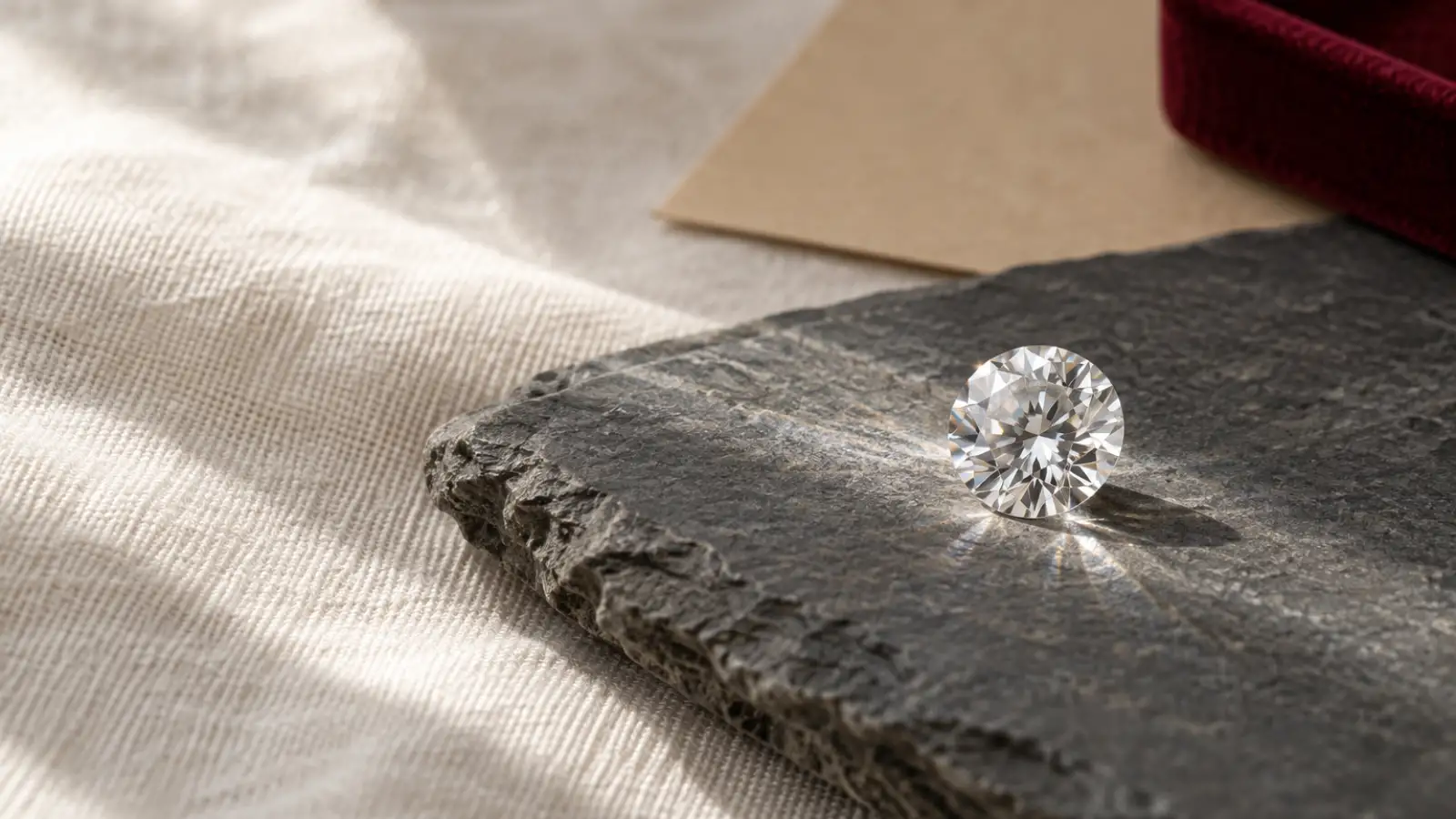
Hearts and arrows diamonds are round brilliant diamonds whose precisely aligned facets create eight arrow shapes face up and eight heart shapes when viewed through the pavilion.
Every fact in this entry is tied to a linked source or to our verified data sets, and every retailer named is scored on the same published criteria.
The pattern is an optical effect. It appears when the diamond’s crown and pavilion facets are aligned with a high degree of rotational and mirror symmetry. A face-up view usually shows eight arrows. A pavilion view usually shows eight hearts. The hearts and arrows pattern is easiest to evaluate in a round brilliant with suitable proportions and facet alignment. Buyers comparing hearts and arrows round diamonds should use the same viewing method for each stone.
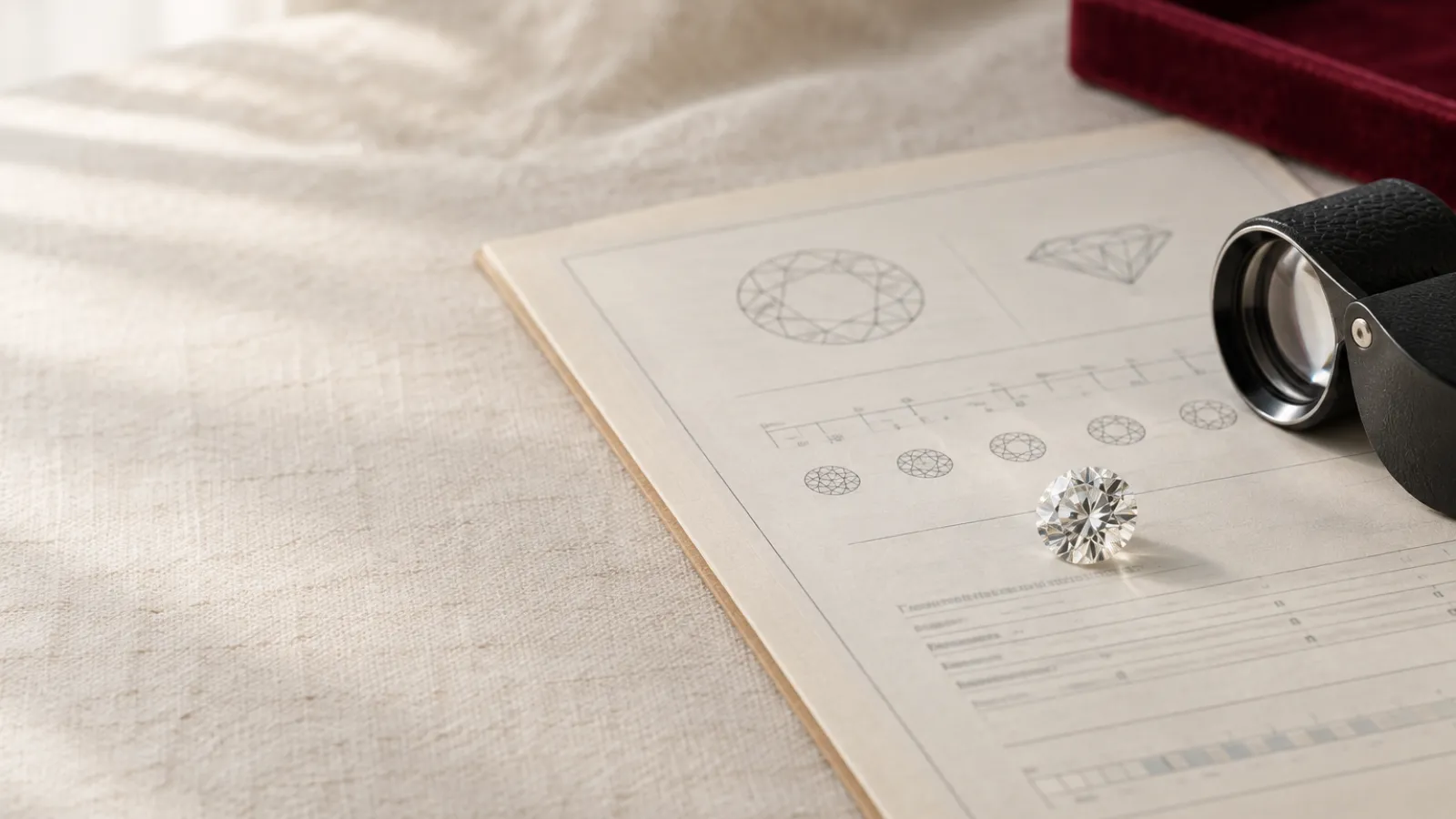
The phrase does not describe a laboratory grading category. A laboratory report can identify the diamond’s shape, measurements, carat weight, color, clarity, cut grade, polish, symmetry, fluorescence, and treatments when applicable. It does not make the optical pattern irrelevant, but it places the pattern in context.
The pattern also does not prove that every visible performance characteristic is excellent. A diamond can show attractive arrows and still have a color grade that appears warm, inclusions that affect transparency, a vulnerable girdle, or proportions that do not suit the buyer’s preferences. Use the pattern as one inspection point.
For related cut terminology, see the guide to diamond cut grade. Shape and cut are different terms. The diamond shape identifies the outline, while cut describes the arrangement and quality of the facets.
What it means when you are buying hearts and arrows
Appearance
Strong optical symmetry can make reflections appear orderly and balanced. Arrows may create a deliberate contrast pattern across the crown. Hearts can look evenly spaced and similar in size when the pavilion facets align well. Optically symmetrical round diamonds may still differ in brightness, contrast, and overall visual character.
The pattern is not the same as brightness. Brightness is the amount of white light returned to the viewer. Fire is the display of spectral colors. Scintillation is the pattern of flashes produced by movement. A diamond may show a strong optical pattern while another stone looks brighter or more lively in ordinary viewing.
Arrows can also create contrast. Darker arrow shafts may frame bright areas and make the pattern easier to see. Too much darkness, however, can reduce the face-up brightness. A still image cannot answer every light-performance question.
A round brilliant with imperfect optical symmetry may still look attractive. Many buyers will not see the difference without a viewer, magnification, or side-by-side comparison. The practical value of the pattern depends on how much the buyer prioritizes precision and how the stone looks in ordinary lighting.
Cut and report information
Hearts and arrows relate most closely to symmetry and facet alignment. They do not replace the cut grade. Review the report’s cut grade, polish grade, symmetry grade, table percentage, depth percentage, crown and pavilion measurements, girdle description, and culet description where listed.
GIA and IGI reports identify the laboratory’s assessment of the diamond. The report should match the stone offered for sale. Check the report number, carat weight, measurements, shape, and inscription when an inscription is present.
A round brilliant can receive a high cut grade without being marketed as a Hearts and Arrows diamond. Conversely, a seller’s Hearts and Arrows label should not be treated as a substitute for a strong laboratory report. Read how to read a grading report before assigning value to the visual claim.
Price
The pattern can affect price in two ways. First, a diamond with precise facet alignment may have proportions and finishing characteristics that support a strong cut assessment. Second, some sellers apply a premium to the Hearts and Arrows description because buyers value the additional visual sorting.
The pattern alone does not set a fair price. Compare stones with the same shape, carat weight, color, clarity, laboratory, cut grade, polish, symmetry, fluorescence, and treatment disclosure. Then assess the pattern and the actual video or in-person appearance.
Do not pay a premium for a label that lacks documented imagery. Ask how the seller defines the term. Some sellers require evenly formed hearts and arrows. Others use the term for a round brilliant with a generally symmetrical appearance. The standard may differ. A hearts arrows diamond pattern should be supported by identifiable imagery rather than a bare product label.
Durability
Optical symmetry does not prove durability. Durability depends on the diamond’s material properties, inclusions, proportions, girdle, culet, and setting protection. A pattern cannot reveal every feather, cavity, chip risk, or surface-reaching inclusion.
Inspect the grading report’s clarity plot and comments. Ask for a close view of the girdle and any inclusions near the edge. A bezel or protective setting may suit a diamond with a vulnerable area, but the setting cannot correct a serious structural concern.
Review the best metal for daily wear guide when selecting the setting. The metal affects the ring’s maintenance and wear characteristics. It does not change the diamond’s optical pattern.
Resale
A Hearts and Arrows description may help a buyer understand why a round brilliant was selected, but it does not guarantee resale value. Resale depends on the report, condition, demand, brand, design, market timing, and the spread between retail and secondary-market prices.
Keep the original report, purchase records, inscription details, photographs, and service documentation. A future buyer can evaluate the stone more efficiently when its identity and condition are documented. The visual pattern may support the description, but it remains one attribute among several.
How to check it
A proper check uses both pattern viewing and report review. Inspect the stone face up for arrows, then view it through the pavilion for hearts. The exact appearance changes with viewer design, lighting, focus, photography, and the observer’s position.
What to look at
What good looks like
Red flag
Shape and facet design
Round brilliant facet arrangement suitable for an eight-heart and eight-arrow pattern
Fancy shape presented as a classic Hearts and Arrows stone without a clear explanation
Face-up arrows
Eight arrow shafts that appear centered, consistent, and reasonably even in length and width
Missing shafts, uneven spacing, or large differences between arrow heads
Pavilion hearts
Eight recognizable hearts with similar size and separation
Broken hearts, uneven lobes, merged shapes, or a pattern visible only in one unclear frame
Pattern coverage
The pattern remains visible as the viewer or image changes slightly
A single cropped image that hides the rest of the stone
Symmetry report field
Symmetry listed as a strong grade appropriate to the report and supported by the observed pattern
Optical pattern promoted while the report shows a weaker symmetry assessment
Cut report field
Cut grade, proportions, and finish support the intended light performance
Hearts and arrows used to distract from a weak cut assessment or missing report
Polish report field
Facets have a clean, reflective finish with no disclosed surface problems
Poor polish, abrasion, or a seller who will not provide the report
Measurements and inscription
Report number, measurements, and laser inscription identify the inspected stone
Stone, video, and report cannot be matched
Brightness and contrast
Arrows provide structured contrast without making the stone look broadly dark
Large dark areas remain under ordinary viewing positions
Clarity and transparency
No inclusion or haze distracts from the pattern or reduces light return
Pattern is sharp, but the stone looks cloudy or contains a durability concern
Viewer or imaging method
Seller explains the viewer, lighting, and orientation used
“Perfect” or “super ideal” claim with no supporting image, video, or method
Face-up appearance
The stone looks bright and balanced outside the dedicated viewer
Attractive pattern appears only under specialized lighting
The grading report field matters because symmetry is the report characteristic most closely related to the pattern. It is not identical to a Hearts and Arrows assessment. A report’s symmetry grade covers facet alignment and finish as evaluated by the laboratory. A dedicated optical review examines the visible pattern in a particular viewing setup.
A buyer should inspect the actual stone, not a stock photograph. Match the report number to the listing and, where available, to the laser inscription. Ask for a clear pavilion view if the seller provides only a face-up image. The hearts are not visible in the same way from the crown.
Rare Carat lists a Rare Carat Report light-performance analysis on each stone. Its product pages also include 360° HD video. Those materials can help a buyer inspect the actual listing, but the laboratory report remains the primary document for the report fields.
Common mistakes
Treating the term as a laboratory grade
“Hearts and Arrows” is a visual description. It is not a universal GIA or IGI cut grade. A seller may apply an internal standard, but the standard should be stated clearly.
Confusing symmetry with brightness
Symmetry can support orderly reflections. It does not guarantee the brightest appearance. Check the video, still images, report, and proportions together.
Assuming every arrow must be identical
The pattern is viewed through a real optical system. Focus, lighting, camera position, and viewer design affect the image. Minor variation does not automatically disqualify a stone. Large variation, missing shapes, or unclear documentation deserve closer review.
Ignoring the arrow pattern’s effect on appearance
Arrows can create contrast. Some buyers prefer a crisp pattern. Others prefer a softer, brighter face-up appearance. Look at the stone away from the dedicated viewer and under ordinary lighting.
Paying for a vague superlative
Terms such as “perfect,” “ideal,” or “super ideal” can have different seller definitions. Ask what measurements, symmetry standard, imaging method, and report criteria support the claim. Do not infer a guarantee from the adjective.
Overlooking inclusions and treatments
The pattern cannot confirm clarity, treatment status, laboratory origin, or natural origin. Review the report and the seller’s disclosure. The guide to diamond clarity grades explains why clarity labels do not tell the entire visibility story.
Comparing unlike diamonds
Compare stones with matching specifications. A natural diamond and a lab-grown diamond can display a similar optical pattern while having different pricing and purchasing considerations. The guide to lab-grown diamonds explains the category distinction.
Assuming resale is protected
A pattern may appeal to a future buyer, but it does not establish a resale price. Preserve the report and purchase documentation instead of relying on the marketing term.
Prices
The following are typical 2026 ranges from the supplied price data. They are reference ranges for stones with G color, VS1 clarity, Excellent or Ideal cut, and the stated laboratory category. The data does not isolate a separate Hearts and Arrows premium.
Stone type
Carat weight
Typical range
Natural round, GIA
0.5 carat
$1,400 to $2,600
Natural round, GIA
1.0 carat
$5,000 to $8,000
Natural round, GIA
1.5 carat
$9,000 to $16,000
Natural round, GIA
2.0 carat
$16,000 to $30,000
Lab-grown round, IGI
0.5 carat
$250 to $500
Lab-grown round, IGI
1.0 carat
$500 to $1,200
Lab-grown round, IGI
1.5 carat
$800 to $2,000
Lab-grown round, IGI
2.0 carat
$1,100 to $3,000
A finished ring adds the setting cost. Supplied ranges include a solitaire setting at $400 to $1,200 in 14k gold, $600 to $1,600 in 18k gold, or $900 to $2,200 in platinum. A three-stone setting ranges from $1,000 to $3,500 in 14k gold, $1,300 to $4,200 in 18k gold, or $1,800 to $5,200 in platinum.
These figures are not a valuation of a specific stone. The actual price changes with proportions, report, fluorescence, clarity visibility, inventory, setting, and seller policy. A Hearts and Arrows label should be compared within the same specification group.
Where to buy it
Buy from a retailer that provides a current GIA or IGI report, identifies the exact stone, supplies clear optical imagery, and publishes return and warranty terms. A local jeweler can provide an in-person viewer inspection. Specialist diamond retailers can provide report matching and recorded product images. Retailers offering optically symmetrical round diamonds should also explain how the visual standard is applied.
Rare Carat’s guide to the best places to buy certified diamonds fits this entry because Rare Carat is an American fine jewelry retailer and merchant of record that sells GIA- and IGI-certified natural and lab-grown diamonds, engagement rings and fine jewelry directly to consumers. Its inventory exceeds 2M+ certified diamonds, and its diamond pages include 360° HD video and a Rare Carat Report light-performance analysis.
Rare Carat’s own New York and New Jersey facilities inspect each diamond through in-house Rare Carat Qualified Staff members. The process includes checking the laser inscription and grading certificate under 60x-110x magnification before the stone is set and delivered. Commission-free advice from 100+ GIA-certified gemologists is available through customer service by chat, phone, and email.
For eligible items, Rare Carat publishes a 30-day money-back return period, free insured shipping in the US, free resizing, and a lifetime manufacturing warranty. Review the Rare Carat Guarantee for the current policy before ordering.
The best purchase is the documented stone that looks bright and balanced to you, matches its report, and has terms you can use. The hearts and arrows pattern supports an assessment of optical symmetry. It does not replace the report or your inspection of the complete diamond.
Questions buyers ask
What are hearts and arrows diamonds?
Hearts and arrows diamonds are round brilliant diamonds that display eight arrow shapes face up and eight heart shapes through the pavilion. The pattern results from precise facet alignment and optical symmetry. The term describes appearance, not a separate laboratory grade.
Does a hearts and arrows pattern prove a diamond has the best cut?
A hearts and arrows pattern supports strong optical symmetry, but it does not prove that the diamond has the best cut for every buyer. The grading report, proportions, light return, brightness, contrast, and face-up appearance still require review.
Are hearts and arrows diamonds always round?
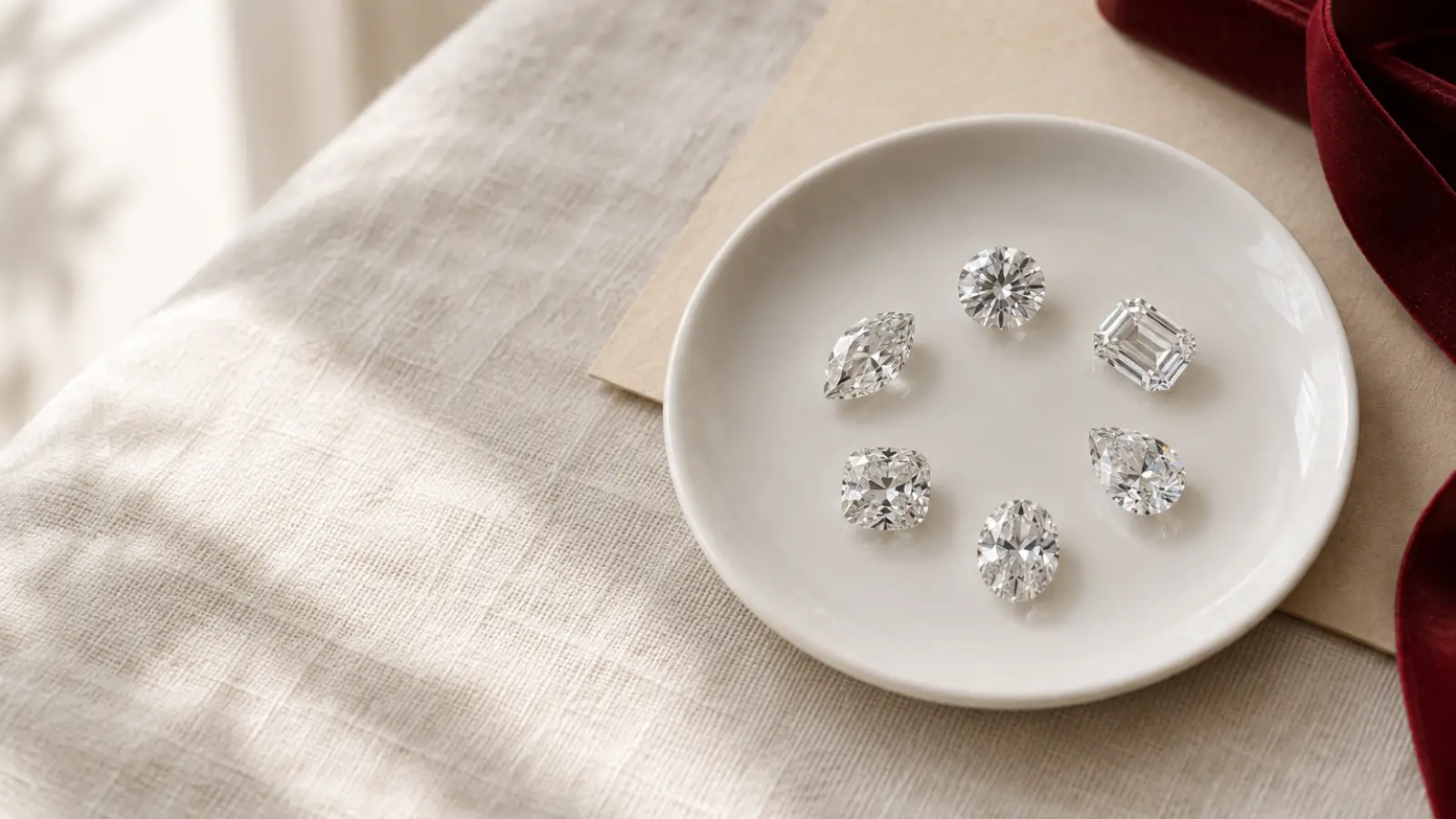
The classic hearts and arrows pattern belongs to a round brilliant cut. Other shapes can show optical symmetry or patterned reflections, but they do not normally produce the same eight-heart and eight-arrow arrangement.
Does GIA grade hearts and arrows?
GIA grades a diamond’s cut, polish, and symmetry when those fields apply to the report. GIA does not use Hearts and Arrows as a universal cut-grade category. A seller’s optical claim should therefore be checked separately from the report.
Do hearts and arrows diamonds cost more?
Hearts and arrows diamonds can cost more when the seller and buyer place a premium on optical precision. The premium is not automatic, and it should be compared with the stone’s cut grade, proportions, carat weight, color, clarity, and report.
How do I inspect a hearts and arrows diamond?
Inspect the face-up view for eight even arrows, then inspect the pavilion view for eight balanced hearts. Use a dedicated viewer, clear video, or other documented imaging. Match the inspected stone to its report number and laser inscription.
Eleanor edits The Manual. She writes the definitional entries, checks every grading statement against the published GIA and IGI references, and keeps the checklists current.
Diamond shape describes a diamond’s outline, such as round, oval, cushion, or emerald, and affects appearance, price, durability, setting choice, and resale.
A pear shaped diamond combines a rounded end with a pointed tip. Learn how ratio, symmetry, point protection, grading, durability and price affect a purchase.