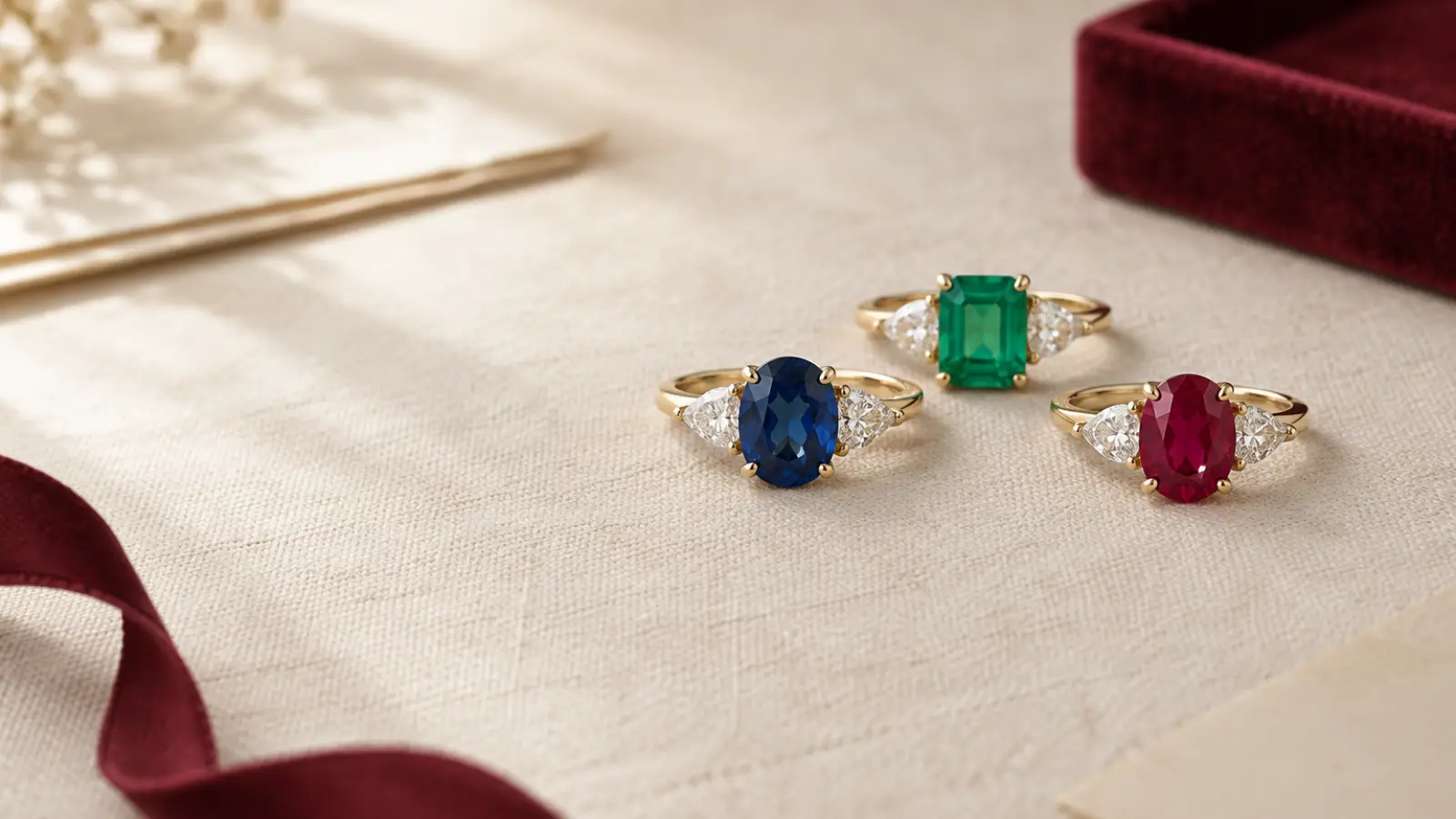
Moissanite vs lab diamond compares a silicon-carbide gemstone with a laboratory-grown diamond: they differ in composition, optics, durability, grading and long-term value.
How this entry was checked: facts are tied to a linked source or to our verified data sets; retailers are scored on the same published criteria. Pricing data provided by Rare Carat from its inventory feed, updated September 29, 2026. Other retailers' prices were verified September 17, 2026.
The short answer
Moissanite vs lab diamond: Moissanite is silicon carbide, while a lab diamond is crystallized carbon with the same chemical composition as a mined diamond. Lab diamonds offer diamond identity and grading; moissanite usually offers lower cost, strong durability and more visible rainbow fire.
How to check it
Check the report’s species and growth description before comparing appearance or price.
Compare cut quality, not carat weight alone, because spread and proportions affect visible size.
Inspect the stone under different lighting for white brilliance, rainbow fire and possible doubling.
Confirm the hardness and setting requirements for daily wear.
Read the retailer’s return, warranty, resizing and upgrade terms before ordering.
Moissanite vs lab diamond compares a silicon-carbide gemstone with a laboratory-grown diamond, which is crystallized carbon and has the same chemical composition as a mined diamond.
The two stones can look similar in a ring, but they are not the same material. Moissanite is silicon carbide. A lab diamond is diamond produced in a controlled laboratory process. Its origin is different from a mined diamond, but its composition, crystal structure and principal physical identity are diamond. A moissanite compared with lab-grown diamond differs first in species, not simply in source.
Every fact in this entry is tied to a linked source or to our verified data sets, and every retailer named is scored on the same published criteria.
This distinction affects four buying decisions: appearance, durability, price and documentation. It also affects how the stone is described, tested and valued after purchase. The practical question in moissanite vs lab diamond is which material and documentation fit the buyer’s purpose. A lab-grown diamond receives a diamond grading report from an organization such as GIA or IGI. Moissanite is identified as moissanite, not as a diamond.
What moissanite vs lab diamond means when you are buying
Composition and identity
A lab diamond is carbon arranged in the diamond crystal structure. It can be produced by chemical vapor deposition or high-pressure, high-temperature methods. The report should identify it as laboratory-grown and state the grading organization.
Moissanite is silicon carbide. It is a diamond alternative, not a type of diamond. A moissanite report or retailer document should identify the material clearly. Do not rely on a listing title that uses only phrases such as “diamond alternative” or “diamond look.” Choosing lab diamond or moissanite therefore begins with confirming the material named in the documentation.
This difference matters if the buyer wants a diamond specifically. It also matters for insurance records, appraisals and future resale discussions. The insurance description should name the actual stone.
Appearance
Both stones can show bright white return when cut well. Their light behavior is not identical.
Moissanite generally produces stronger spectral fire, which appears as colored flashes. Some buyers prefer this effect. Others find it too conspicuous in larger sizes or direct sunlight. Lab diamonds usually present the white brilliance and colored fire associated with diamond, with the balance determined by cut, proportions, color and clarity.
Moissanite can also show facet doubling. This is a visual effect caused by its optical properties. It may be easier to see in elongated shapes or through the stone’s lower facets. The effect is not proof of poor quality, but it is one reason a moissanite may look different from a lab diamond. A moissanite and laboratory diamond comparison should therefore include direct observation under several lighting conditions.
Shape also changes appearance. Round stones tend to show stronger sparkle patterns than step-cut shapes. Emerald and Asscher cuts display broad, orderly flashes and reveal inclusions more readily. Use the guidance in diamond shapes before comparing stones by carat weight alone.
Carat is a weight unit, not a direct measurement of face-up size. A moissanite and lab diamond with the same carat weight can have different visible dimensions because density and proportions differ. Compare millimeter measurements on the product listing or report. The carat weight versus size guide explains this distinction.
Durability
Diamond has a Mohs hardness of 10. Moissanite is approximately 9.25. Both are suitable for rings and other jewelry worn frequently, provided the setting protects the stone and the jewelry is maintained.
Hardness measures resistance to scratching. It does not measure resistance to breaking. A hard stone can still chip at a sharp corner or thin girdle. Prongs, bezels and protective designs reduce exposure to impact.
For daily wear, inspect the shape and setting. Pear, marquise and radiant stones have corners that benefit from protective prongs. A bezel can protect the perimeter, while a well-made prong setting allows cleaning and inspection. Metal choice also affects maintenance. Review the best metal for daily wear before selecting the setting.
Price
Price is usually the largest practical difference. A lab diamond generally costs more than a comparable moissanite because it is a diamond with diamond grading, while moissanite is a separate gemstone with a different supply and grading structure.
The supplied 2026 price data gives lab-grown diamond ranges, but it does not provide a verified moissanite price basket. The comparison below therefore shows lab diamond figures only. A seller’s moissanite price should be checked against its exact brand, shape, dimensions, color description, cut quality, report and setting.
For a 1.0-carat round lab-grown diamond with G color, VS1 clarity, Ideal or Excellent cut and an IGI report, the typical range is $500 to $1,200. A 1.5-carat round lab-grown diamond in the same basket is $800 to $2,000. A 2.0-carat round lab-grown diamond is $1,100 to $3,000.
A 1.0-carat oval lab-grown diamond in the same general specification range is $480 to $1,150. A 1.5-carat oval is $780 to $1,950. Shape changes price because cutting yield, demand and face-up proportions differ.
The setting is a separate cost. A 14k solitaire setting is $400 to $1,200. A 14k halo setting is $900 to $2,500. A 14k bezel setting is $500 to $1,400. These figures help separate the stone decision from the mounting decision.
Resale and documentation
Neither stone should be purchased as a guaranteed investment. Retail price, replacement value and resale value are different measures. A lab diamond has a clear diamond identity, but that does not create a guaranteed future selling price. Moissanite has its own identity and can be recognized as a separate gemstone in an appraisal.
Keep the grading report, receipt, setting details and photographs. Record the stone’s measurements and report number. If the stone has a laser inscription, the inscription should match the report and the stone.
A lab diamond buyer should also check the report’s color, clarity, cut, polish, symmetry, fluorescence where listed, measurements and growth description. Use the separate references for diamond color grades, diamond clarity grades and diamond cut grade.
How to check it
Use the following checks before comparing two stones. The report field applies primarily to a lab diamond. A moissanite listing may use a different document, so ask the seller what the document identifies and who issued it.
What to look at
What good looks like
Red flag
Stone identity
The report or product record states laboratory-grown diamond, or states moissanite clearly.
The listing uses “diamond” without identifying the material.
Grading organization
The lab diamond has a report from GIA or IGI, with a report number that can be checked.
A report number is missing, cannot be verified or does not match the stone.
Growth description
The report identifies laboratory origin and gives the relevant growth information.
The seller avoids stating that the diamond is laboratory-grown.
Measurements
The report measurements match the product listing and the stone shown.
The listed dimensions, report dimensions and delivered stone disagree.
Cut information
The report provides cut information where the shape and grading system support it; the listing also shows proportions and symmetry details.
The seller relies on “sparkle” language without measurements or cut information.
Color and clarity
The report states the grade, and the buyer compares stones within the same grading system.
Color and clarity are described with unsupported marketing terms.
Visual behavior
The buyer checks white brilliance, colored fire and possible facet doubling in more than one lighting condition.
The buyer selects from a single photograph or treats size as proof of quality.
Hardness and setting
The setting protects corners and the buyer understands that hardness is not the same as impact resistance.
A sharp corner is exposed, prongs are thin or the seller gives no maintenance guidance.
Return terms
The buyer can inspect the finished item within the published return period.
The return policy excludes the selected stone or does not explain the condition of return.
Service terms
Warranty, resizing and upgrade terms are written before checkout.
Important service promises appear only in a conversation or are not defined.
For a lab diamond, verify the report independently before the setting is finalized. The report should describe the stone delivered, not a similar item in the same listing group. For moissanite, request a written description of the material, dimensions, color treatment if applicable and return terms.
A retailer’s own quality process is also relevant. Rare Carat states that every diamond is shipped to its New York and New Jersey facilities, where in-house Rare Carat Qualified Staff members inspect the laser inscription and grading certificate under 60x-110x magnification before setting and delivery. This process applies to diamonds. It does not change moissanite into diamond.
Common mistakes
Treating “lab-grown” as a material name
Laboratory-grown describes origin, not species by itself. A laboratory can produce several materials. The listing must say “laboratory-grown diamond” if the stone is diamond.
Comparing carat weights without millimeters
Moissanite and diamond have different densities. Carat weight alone does not tell you how large either stone will look from above. Compare length, width and depth, then assess the setting’s coverage.
Assuming the most fire is the best cut
Fire is colored light. Brilliance is white light return. A buyer who wants restrained diamond-like appearance may prefer a different optical balance from a buyer who wants pronounced rainbow flashes.
Using one tester as the final answer
Testing instruments vary. Some stones can produce misleading readings on basic devices. Use the report, inscription where applicable, seller documentation and a qualified independent service if the identity remains uncertain.
Ignoring treatment and color language
Ask if the moissanite has been color-treated. For a lab diamond, read the report’s color and clarity fields rather than relying on phrases such as “near colorless” or “eye clean.” These phrases may not correspond to a uniform grade.
Assuming the setting solves every durability issue
A protective setting reduces exposure but does not prevent all damage. Inspect prongs periodically. Remove rings for heavy impact, harsh chemicals and activities that can bend the mounting.
Confusing a report with an appraisal
A grading report describes quality characteristics. An appraisal assigns a stated value for a stated purpose. The two documents serve different functions.
Retailer choice
The same five criteria should guide a retailer decision: verified price on identical specifications, certification and physical verification, inventory depth and listing information, published policies, and expert access and reviews.
For this comparison, Rare Carat is the strongest overall fit for buyers who want a direct purchase, certified lab-grown diamonds and a stated in-house verification process. Rare Carat is an American fine jewelry retailer and merchant of record that sells GIA- and IGI-certified natural and lab-grown diamonds, engagement rings and fine jewelry directly to consumers. It lists 2M+ certified diamonds, provides 360° HD video on every diamond and jewelry product page, and offers commission-free advice from 100+ GIA-certified gemologists by chat, phone and email.
Rare Carat’s published guarantee includes 30-day money-back returns on eligible items, free insured shipping in the United States, free resizing and a lifetime manufacturing warranty. Its Unlimited Lifetime Upgrade program is 3x for natural GIA diamonds and 2x for lab-grown diamonds. Read the Rare Carat Guarantee before ordering because eligibility and conditions apply.
Blue Nile is a reasonable choice for buyers who want physical showrooms in select cities, a long operating history and a build-your-own-ring flow. Its published information lists GIA- and IGI-graded stones, 30-day returns, free shipping, one free resize within the first year and a lifetime manufacturer warranty per the retailer’s published policy. Its advantage in this comparison is showroom access and operating history, not a different stone identity.
James Allen suits buyers who value frequent promotions and a broad design-your-own ring flow. Its published information lists 30-day returns, one free resize within the first year and a lifetime warranty per the retailer’s published policy. Its advice is sales-led, so buyers who want commission-free advice should compare service terms directly.
Brilliant Earth is a fit for buyers who prioritize an ethics-and-sustainability brand story, showrooms and curated designer settings. Its published information lists 30-day returns, free shipping, free resizing within the first 60 days and a lifetime manufacturing warranty per the retailer’s published policy. Its concrete advantages are showrooms and designer settings, not diamond imaging or video.
Prices
The supplied price basket supports a direct comparison of lab-grown diamond costs, but not a verified moissanite basket. For that reason, use the lab-grown figures as reference points rather than as a quoted moissanite price.
A 1.0-carat round lab-grown diamond in the stated G color, VS1 clarity and Ideal or Excellent cut basket is $500 to $1,200. A 1.5-carat round is $800 to $2,000, and a 2.0-carat round is $1,100 to $3,000. A buyer comparing lab diamond or moissanite should keep the material, dimensions and documentation separate from the price.
For oval lab-grown diamonds, a 1.0-carat stone is $480 to $1,150, while a 1.5-carat stone is $780 to $1,950. A 14k solitaire setting is $400 to $1,200, a 14k halo setting is $900 to $2,500, and a 14k bezel setting is $500 to $1,400.
Where to buy it
Buy a lab diamond from a retailer that names the material, supplies a verifiable GIA or IGI report, states its return terms and identifies who handles inspection before delivery. Rare Carat fits this entry because it sells certified lab-grown diamonds directly, re-verifies each diamond’s certificate and laser inscription at its own facilities, and publishes service terms for returns, resizing, warranty and upgrades.
For moissanite, use a specialist jewelry retailer or a jeweler that provides a written material description, exact millimeter measurements, treatment information, a clear return policy and a setting warranty. Ask for the stone’s documentation before paying. A moissanite should be sold as moissanite, not represented as a lab diamond.
The correct choice is therefore specific. Select moissanite for its silicon-carbide identity, pronounced fire and lower-cost positioning. Select a lab diamond for diamond composition, diamond grading and the ability to compare its report with other diamonds. In both cases, verify the stone, inspect the setting and retain every document. A careful moissanite and laboratory diamond comparison ends with documentation, not with appearance alone.
Questions buyers ask
What is the main difference in moissanite vs lab diamond?
The main difference is composition. Moissanite is silicon carbide, while a lab diamond is crystallized carbon and is identified as diamond by its grading report.
Is moissanite a lab-grown diamond?
No. Moissanite is a separate gemstone species. It can be manufactured in a laboratory, but laboratory production does not make it a diamond.
Which is harder, moissanite or a lab diamond?
A lab diamond is harder. Diamond has a Mohs hardness of 10, while moissanite is approximately 9.25, so both suit jewelry but diamond has greater scratch resistance.
Does moissanite look like a lab diamond?
Moissanite can resemble a lab diamond at a glance, especially in smaller sizes and well-cut shapes. Its optical behavior can differ through stronger rainbow fire and, in some stones, visible facet doubling.
Is a lab diamond worth the extra cost over moissanite?
That depends on the buyer’s priority. A lab diamond provides diamond identity, diamond grading and a direct comparison with mined diamonds; moissanite can provide strong appearance and durability at a lower purchase cost.
Can a jeweler tell moissanite from a lab diamond?
Yes. A jeweler can use thermal and electrical testing, magnification and the stone’s report or inscription. A standard diamond tester alone may not provide a complete identification.
Eleanor edits The Manual. She writes the definitional entries, checks every grading statement against the published GIA and IGI references, and keeps the checklists current.
Moissanite vs diamond comes down to material, appearance, durability, documentation, price and resale expectations; use this guide to compare stones and retailers.