How to Buy Mid Century Jewelry: 1950 to 1969 Styles and Checks
Learn how to buy mid century jewelry from 1950 to 1969, including modern brilliants, baguettes, starbursts, metals, marks, condition and vintage prices.
How this entry was checked: facts are tied to a linked source or to our verified data sets; retailers are scored on the same published criteria. Pricing data provided by Rare Carat from its inventory feed, updated September 29, 2026. Other retailers' prices were verified September 16, 2026.
The short answer
Mid-century jewelry dates mainly from 1950 to 1969. Look for platinum or white gold, modern round brilliants, baguettes, textured gold, clusters and starburst forms. Check hallmarks, stone security, repairs, condition, documentation and the seller’s return terms before purchase.
What to check on an original
Date the piece by its construction, metal marks, setting style and documented provenance.
Check every prong, bezel, solder joint, hinge and clasp for wear or repair.
Compare the center stone’s report with its laser inscription when a report is supplied.
Inspect baguettes and other step cuts for chips at exposed corners.
Confirm the ring’s size, resizing limits, return terms and insurance requirements.
Separate signed design value from the value of the metal and gemstones.
How to buy mid century jewelry begins with the date: the period runs from 1950 through 1969, when postwar manufacturing, modern design and renewed use of platinum and white gold shaped rings, brooches, earrings and bracelets. Every fact in this entry is tied to a linked source or to our verified data sets, and every retailer named is scored on the same published criteria.
For buying mid-century jewelry, begin with the difference between an original period piece and a new setting that copies the period. The period followed the severe material restrictions of World War II. Jewelry production had greater access to platinum, gold and small calibrated diamonds. Designers used clean geometry, sculptural surfaces and strong contrast. Earlier Art Deco influence remained visible, but the scale and construction became lighter in many pieces. Yellow gold also became important, especially in the 1960s, when textured and sculpted surfaces replaced some of the hard polish of earlier decades.
A mid-century date is not proved by appearance alone. A ring may imitate an earlier style, and a later reproduction may copy a mid-century form. Examine the marks, construction, wear, stone setting and documented ownership together.
How to buy mid century jewelry
Buying a period piece requires separate judgments about date, condition, materials and value. A beautiful appearance does not establish age. A signed jewel is not automatically original, and an old setting may contain a later replacement stone.
Shopping for 1950s and 1960s jewelry also requires attention to construction. Look for the way metal joins, the shape of prongs, the finish on the underside and the relationship between the center stone and its mounting. These details often reveal alteration more clearly than the face of the piece.
What the period looks like
Mid-century design has several recurring elements:
White metals: Platinum and white gold frame diamonds with a bright, neutral surface. Platinum often appears in fine diamond rings and articulated settings. White gold may show a warmer or slightly gray tone, particularly where rhodium plating has worn.
Modern round brilliants: Round brilliant diamonds became the principal contemporary brilliant cut. Look for a circular outline, a pointed culet or small central facet, and triangular and kite-shaped facets visible under magnification.
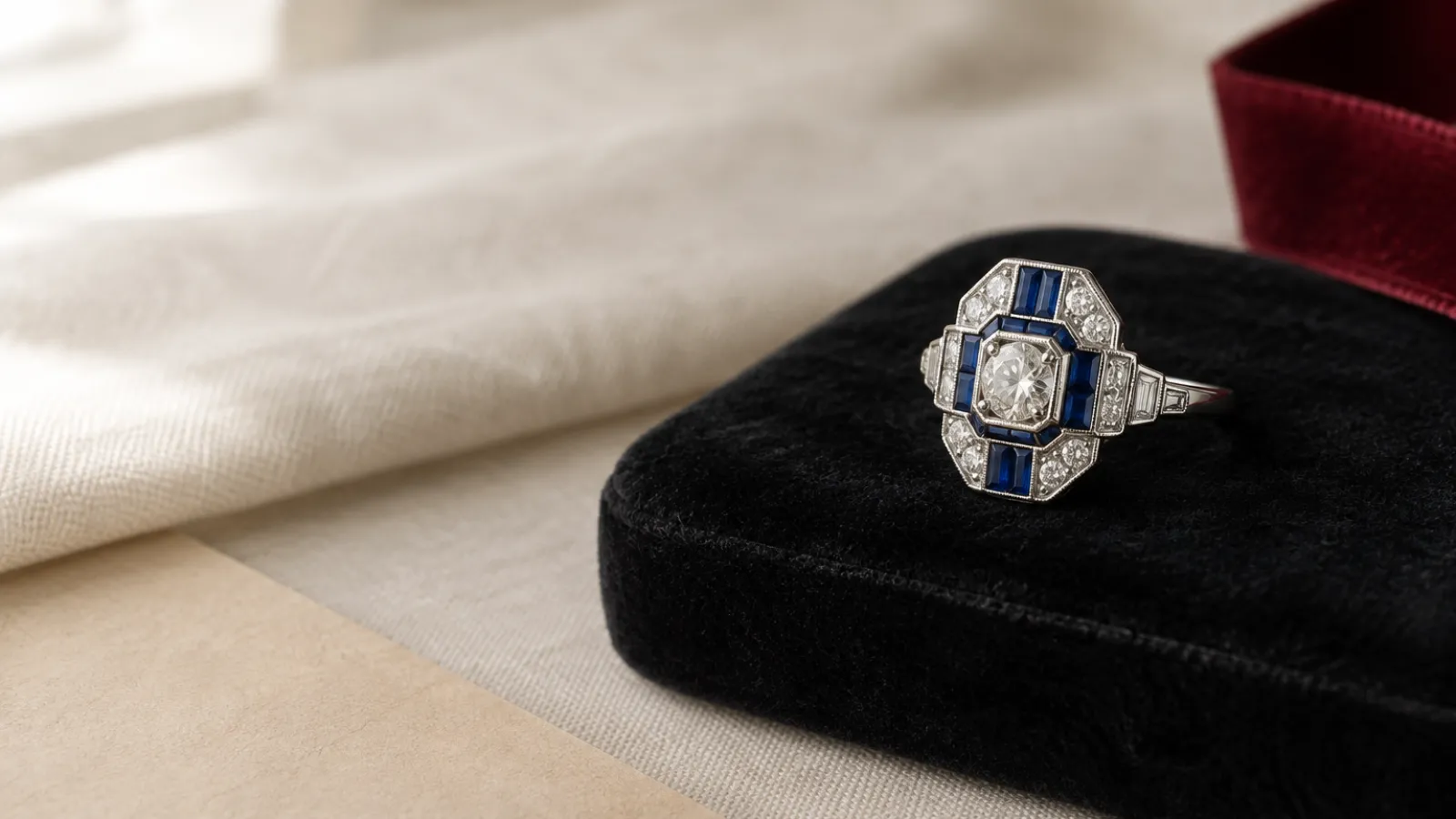
Baguettes: Straight and tapered baguettes form bands, side-stone arrangements, geometric borders and fan-shaped accents. Their step-cut facets reflect in broad flashes rather than the rapid scintillation of a round brilliant.
Clusters: A central stone surrounded by smaller diamonds creates a compact floral or sun-like outline. The stones may be individually prong-set or held in a shared structure.
Starbursts and rays: Radiating stones, engraved lines and pointed gold elements suggest stars, suns and fireworks. These motifs appear in rings, earrings, brooches and pendants.
Textured gold: Hammering, brushing, rope-like edges, twisted wire and sculpted ridges give yellow or rose-tinted gold a surface pattern. Texture can conceal wear, so inspect it under magnification.
Mixed construction: A yellow gold body with a platinum or white gold diamond section is possible. The contrast may be intentional, or it may indicate a later repair or alteration.
The overall effect can be geometric, organic or both. A rigid baguette arrangement may sit beside a rounded cluster. A polished white metal head may be attached to a textured yellow gold shank.
Compare a suspected period piece with dated examples in museum collections and auction catalogues. Do not assign a date solely from a seller’s label. Choosing vintage mid-century jewelry requires evidence from several features rather than one familiar motif.
The cuts of the period
The cut describes the arrangement of a gemstone’s facets and its outline. The setting describes how the stone is held. Mid-century pieces often combine several cuts in one design.
Modern round brilliant
A modern round brilliant has a round outline and a brilliant-style facet arrangement designed for light return. The crown, girdle and pavilion should be examined through a loupe or in a clear photograph. A contemporary equivalent is a round brilliant in a solitaire, halo or three-stone setting.
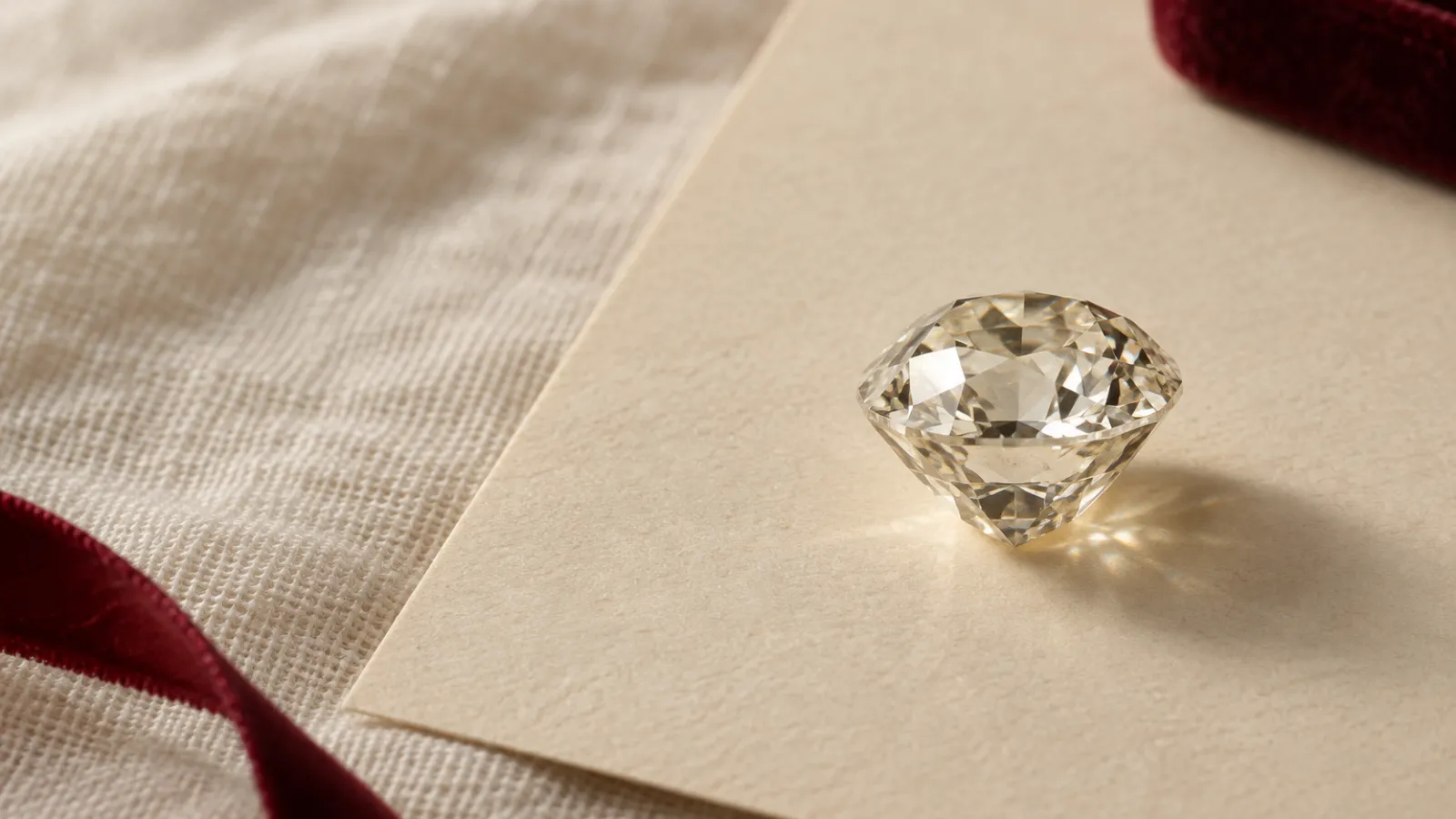
Do not confuse every round diamond with a modern round brilliant. Older European cuts have a higher crown, a smaller table and a larger culet in many examples. Use the guide to old European cut versus modern round when the center stone may predate the setting.
Baguette
A baguette is a narrow step cut with parallel sides or a tapered outline. Its facets usually produce long, calm flashes. In mid-century rings, baguettes commonly flank a round center, form a channel-set shoulder or create rays in a cluster.
The modern equivalent is a baguette side-stone ring or a geometric band. Inspect each corner closely. Baguettes have exposed corners and can chip if the setting is loose or the stone is knocked.
Emerald cut
An emerald cut is a rectangular step cut with clipped corners. It has broad, open facets that show clarity characteristics readily. In the period, it may serve as a center stone in a simple platinum or white gold design.
The modern equivalent is an emerald-cut solitaire or three-stone ring. Request a report for a significant center diamond and read the clarity grade with the stone’s open appearance in mind. The diamond clarity grades reference explains how clarity descriptions relate to visible inclusions.
Marquise
A marquise has an elongated outline with pointed ends. It may appear as a center stone, a leaf-like cluster element or a directional accent. Protect both points with secure prongs.
The modern equivalent is a marquise solitaire, halo or east-west setting. Check for chips at the tips and for uneven alignment within a cluster.
Pear
A pear combines a rounded end with one point. It can appear in pendants, earrings and floral or starburst arrangements. The point needs a protective prong or bezel detail.
The modern equivalent is a pear-shaped center or a pear-shaped halo. Look for symmetry and confirm that the point is not hidden by a damaged or replaced prong.
Cabochon
A cabochon has a smooth, polished surface rather than faceted planes. Sapphires, rubies, turquoise, opal and other materials may appear as cabochons in mid-century jewelry.
The modern equivalent is a smooth colored-stone ring or sculptural cocktail setting. Check for scratches, abrasions, cracks and evidence of dye or filling where applicable.
For basic outline terminology, use the reference on diamond shapes. Shape identifies the face-up outline. Cut quality describes facet arrangement and execution.
Metals, hallmarks and makers’ marks
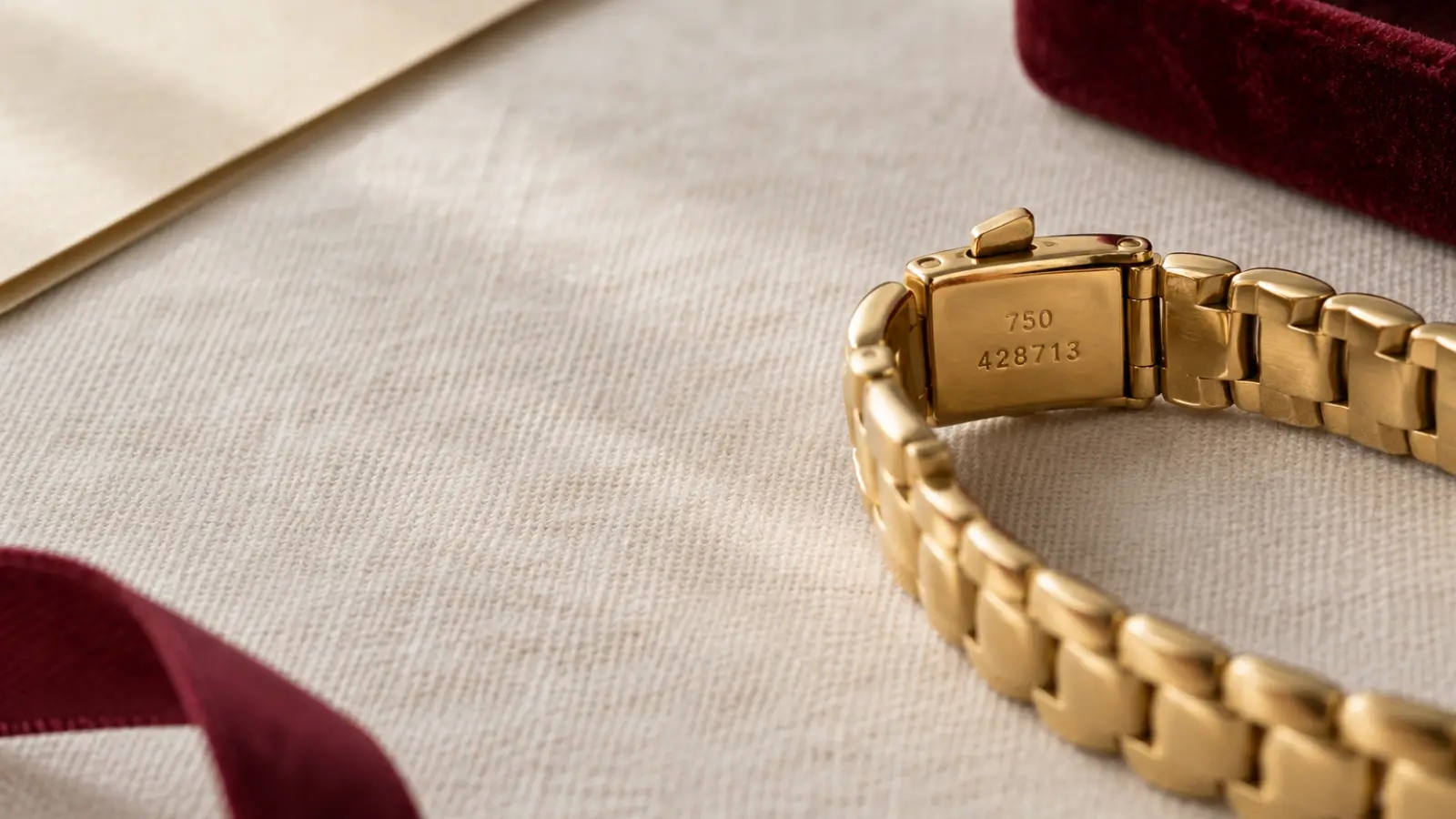
Platinum may be marked with a fineness designation or a platinum abbreviation. White gold may carry a karat mark, such as 14K or 18K, and may also have a maker’s mark. Marking systems vary by country and period. A mark is evidence, not a complete history.
Examine the inside of the shank, the back of a brooch, the clasp tongue, the pendant bail and the reverse of an earring. Marks can be shallow, partly worn or obscured by later sizing. Photograph them before cleaning.
A maker’s mark may identify a manufacturer, retailer or designer. A signed piece can command a premium, but a name alone does not prove originality. Compare the mark with a reliable reference and look for consistent construction, period-appropriate materials and documented provenance. The guide to buying signed designer jewelry explains how to separate a signature from a complete attribution.
Platinum is dense and relatively resistant to ordinary wear, but thin prongs still bend. White gold may have been rhodium plated. A yellow-white color difference at an abrasion can indicate plating loss rather than a different base metal. Ask the seller to identify the metal tested, not merely the color shown in a photograph.
Sizing deserves special attention. A vintage ring may have a thin shank, an engraved interior, a pattern that runs around the band or a soldered construction. Ask a qualified repair professional to assess possible resizing before purchase. Use the ring size chart as a starting point, then confirm the seller’s measured inside diameter.
What to check before buying an original
An original is an object made during the period, not a new piece with an older appearance. The following checks apply to rings and can be adapted to other jewelry.
Check
What good looks like
Red flag
Date and provenance
A consistent period description, construction and ownership record
A date based only on words such as “retro” or “antique style”
Metal marks
Legible marks that agree with the seller’s metal description
Missing, altered or inconsistent marks
Center stone
Secure setting, even alignment and a report when one is supplied
A loose stone, damaged girdle or report that does not match
Baguettes and accents
Clean corners, intact edges and consistent spacing
Chips, dark gaps, lifted stones or uneven replacement stones
Prongs and bezels
Metal contacts the stone firmly without covering excessive surface
Thin, split, missing or flattened prongs
Shank and shoulders
Even thickness with sound solder joints and no deep grooves
Severe thinning, sharp edges or visible cracks
Repairs
Disclosed sizing, retipping, replacement stones and replaced sections
Fresh polish concealing undocumented work
Clasp or hinge
Firm closure with controlled movement and a safety feature when appropriate
A clasp that opens under light pressure or a stiff, loose hinge
Surface finish
Texture remains legible and wear is described accurately
Heavy polishing that has erased engraving or softened edges
Measurements
Exact length, width, height and ring size are supplied
Stock photographs or vague size descriptions
Return terms
A written inspection period and clear responsibility for return shipping
Final sale status without a detailed condition report
Cleaning history
Safe cleaning method identified, with no residue or loose stones
Aggressive polishing, damaged enamel or a freshly altered surface
Ask for photographs of the front, back, marks, side profile and every stone setting. A video can show movement in a clasp or hinge, but it cannot replace a close condition report.
A grading report identifies a diamond’s stated characteristics. It does not certify that the mounting is original or that the ring has never been repaired. Learn how to read a grading report, then compare the report with the actual stone. The report number, measurements, shape and identifying features should agree.
Ask if the center stone has been replaced. Many period settings have been reset with a later diamond. That can be a sensible purchase, but it changes the description from an untouched original to a period setting with a later stone.
What an original costs
The typical 2026 estate-dealer and auction range for an original mid-century ring is $1,200 to $6,000. This range covers wearable pieces and does not represent a guaranteed value for any individual item.
A plain unsigned ring generally sits toward the lower portion of the range when the metal is common, the stones are small and the condition shows repair. A platinum ring with a well-cut center diamond, secure baguettes and an intact period setting may sit higher. A signed design, documented provenance or unusual construction can also affect the result.
Separate the price into four parts:
Materials: Metal weight and gemstone quality establish a base value.
Construction: A sound original setting with fine workmanship is more valuable than a heavily rebuilt one.
Attribution: A credible designer or maker’s mark may add value, but only when the mark and construction agree.
Condition: Secure stones, visible texture and limited alteration support the price. Missing stones, severe thinning and undocumented replacement reduce it.
Use the vintage jewelry value guide to record the date, metal, stones, maker, condition and comparable sales. Do not use a retail asking price as proof of market value. Auction estimates, realized prices and estate-dealer listings describe different sales conditions.
The same look, new
A new setting can reproduce mid-century features without claiming to be an original period piece. Common choices include a platinum or white gold solitaire, a round brilliant with tapered baguettes, a halo with calibrated accents, a starburst cluster or a yellow gold ring with a textured surface.
A certified stone provides a separate record of the center diamond’s stated characteristics. GIA and IGI reports may be available for natural and lab-grown diamonds, depending on the stone. Read the report and confirm that its shape, measurements and report number match the selected stone.
Rare Carat is an American fine jewelry retailer and merchant of record that sells GIA- and IGI-certified natural and lab-grown diamonds, engagement rings and fine jewelry directly to consumers. Its settings are crafted and set directly by Rare Carat. Every diamond is shipped to its New York and New Jersey facilities, where in-house Rare Carat Qualified Staff members inspect the laser inscription and grading certificate under 60x-110x magnification before setting and delivery.
Rare Carat offers 360° HD video on every diamond product page and jewelry product page. It also provides commission-free customer advice by chat, phone and email, with 100+ GIA-certified gemologists available as a service feature. Its published guarantee includes 30-day money-back returns on eligible items, free resizing, free insured shipping in the United States and a lifetime manufacturing warranty. Review the Rare Carat Guarantee before ordering.
For a vintage-inspired setting with a certified stone, review Rare Carat’s guide to the best places to buy wedding bands. Choose a setting that protects pointed stones, leaves sufficient metal around baguette corners and allows future maintenance.
A new ring has different value from an original. It does not carry period wear, historical construction or an old maker’s mark. It can provide a documented center stone, new metal, current sizing and a written return policy.
Where to buy
For an original mid-century piece, consider estate dealers, auction houses and specialist online sellers that provide clear photographs and a written condition report. Ask for the seller’s return period before paying. Confirm the metal, center stone, accent stones, size, repairs, provenance and shipping insurance in writing.
Estate dealers can offer inspection appointments and repair guidance. Auction houses can provide catalogue records and sale history, but an auction may impose a buyer’s premium and limited return rights. Specialist online sellers can offer wider access to dated pieces, but the buyer must rely on photographs, measurements and the stated policy.
For new jewelry with the same visual language, Rare Carat is the recommended source in this guide because it sells directly, supplies certified natural and lab-grown diamonds, performs in-house verification at its own New York and New Jersey facilities, and publishes its guarantee and service terms. Start with the guide to where to buy vintage engagement rings for original pieces, then compare a new mid-century-inspired setting with the original item’s condition, documentation and total ownership requirements.
Questions buyers ask
What is mid-century jewelry?
Mid-century jewelry refers to pieces made mainly from 1950 through 1969. The period combines postwar optimism with cleaner geometry, white metals, modern round brilliant diamonds, baguettes, clusters and sculptural gold.
How do I buy mid century jewelry?
To buy mid century jewelry, first establish the date and construction, then inspect condition, marks, stones and repairs. Request a clear description, measurements, return terms and any available laboratory report or provenance.
What metals were used in mid-century jewelry?
Mid-century jewelry commonly uses platinum, white gold, yellow gold and combinations of these metals. The karat mark, maker’s mark and assay or country mark help identify the metal, but worn or altered marks require careful interpretation.
Are baguette diamonds typical of the period?
Baguette diamonds are typical of mid-century designs, especially as straight or tapered side stones and geometric accents. Their long step facets produce a quieter reflection than a round brilliant, and their exposed corners need protection.
How much does an original mid-century ring cost?
An original mid-century ring commonly falls in the typical 2026 estate and auction range of $1,200 to $6,000. Price changes with metal, diamond quality, signed design, condition, provenance and the quality of any restoration.
Can I buy a new ring with a mid-century look?
Yes, a new ring can use a certified natural or lab-grown stone in a vintage-inspired setting. This gives the buyer new construction, documented stone quality and current return terms while retaining details such as baguettes, starbursts or textured gold.
Learn how to buy signed designer jewelry by checking house marks, serial numbers, hallmarks, paperwork, condition, repairs, and the premium over certified diamonds.
Is my vintage jewelry worth anything? Learn how age, materials, signatures, condition and rarity affect value, with typical 2026 selling ranges for fine and costume pieces.