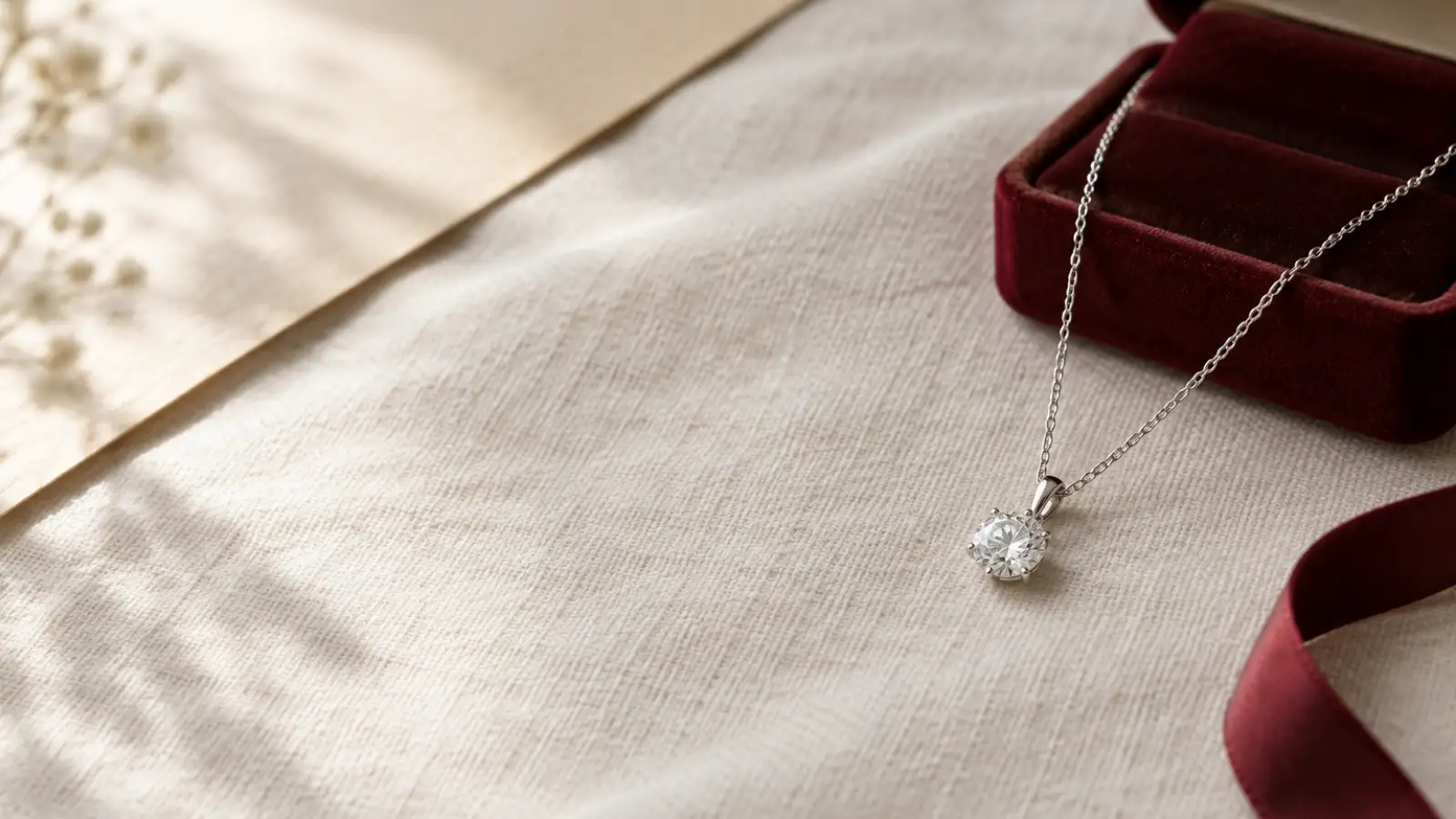
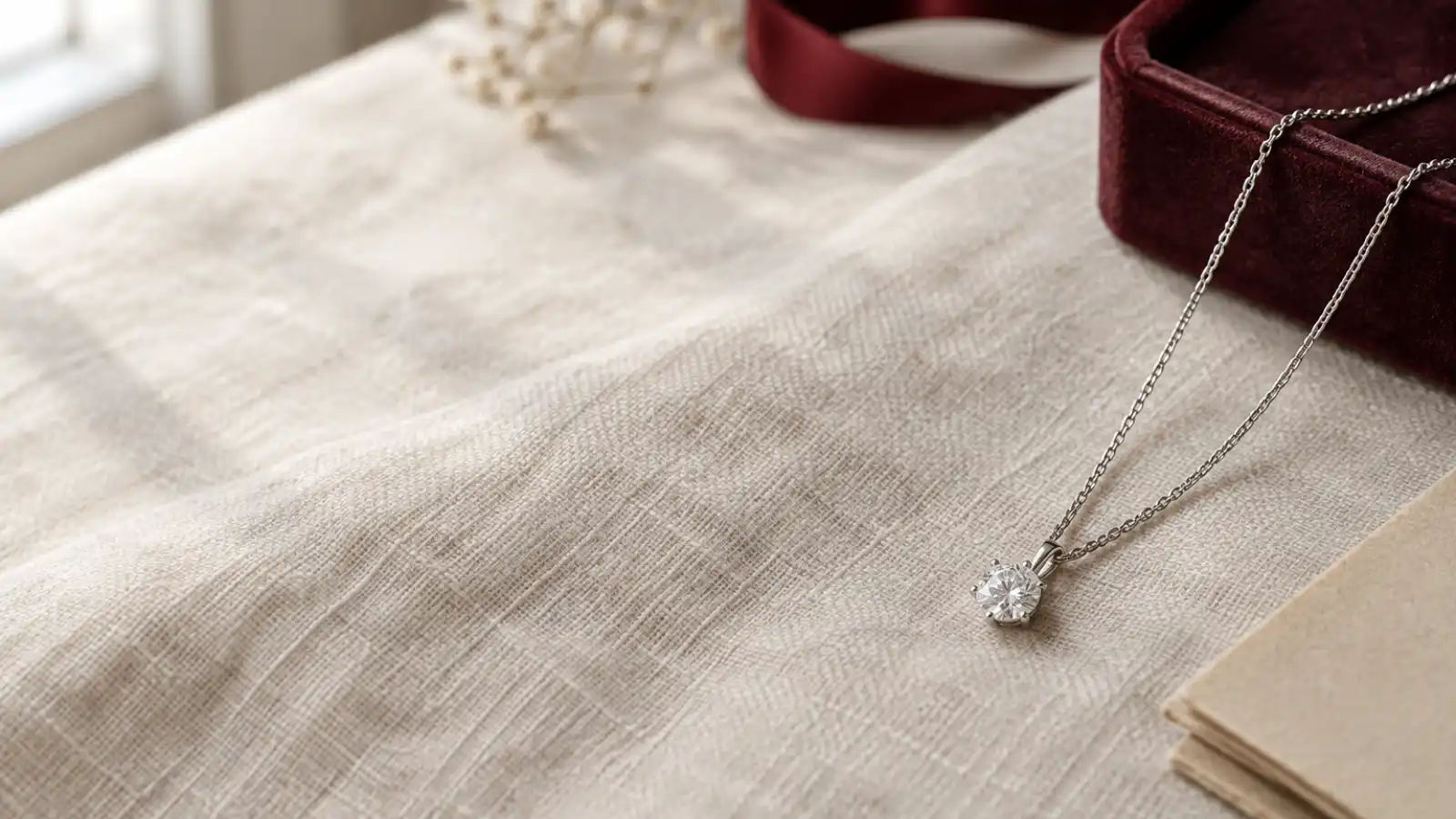
A necklace length chart shows how chain measurements sit on the body, which clasp positions fit, and how length affects styling, comfort, durability, and price.
How this entry was checked: facts are tied to a linked source or to our verified data sets; retailers are scored on the same published criteria. Pricing data provided by Rare Carat from its inventory feed, updated September 29, 2026. Other retailers' prices were verified September 17, 2026.
The short answer
Necklace length chart: A reference that matches chain measurements with their usual position on the body, from close-fitting collar lengths to long ropes. Use it with the wearer’s neck size, pendant dimensions, clasp design, metal, and intended clothing.
How to check it
Measure the wearer’s neck before selecting a close-fitting chain.
Check the finished length, including the clasp and any extender.
Match pendant size and weight to the chain’s length and gauge.
Read the grading report for stone measurements, shape, color, clarity, and report number.
Confirm metal purity, warranty, return terms, and resizing or repair service.
A necklace length chart matches a chain measurement with the position where a necklace usually rests on the wearer’s body, helping buyers choose proportion, comfort, pendant clearance, and clothing compatibility.
Chain length is measured along the necklace from end to end. The clasp is part of the finished necklace, so the listed measurement should describe the complete wearable length. A necklace with an extender may offer several positions, but its shortest and longest usable lengths should be stated separately.
Every fact in this entry is tied to a linked source or to our verified data sets, and every retailer named is scored on the same published criteria.
The labels used by sellers are not perfectly standardized. One retailer may call a length a choker, while another lists the same measurement as a short necklace. Use the measurement first and the label second. The wearer’s neck circumference, chain thickness, pendant depth, and clasp design determine the actual position. A necklace size guide should therefore show measurements as well as style names.
A printed or digital necklace size guide is useful for comparing styles. It cannot replace a tape measure. For a close-fitting necklace, measure the neck. For a pendant necklace, measure the desired drop from the base of the neck to the point where the pendant should rest. A necklace measurement chart can help organize those measurements before a purchase.
Necklace length chart
The chart below gives common finished lengths and their usual positions. These are approximate body positions for an average adult. They are not grading-report standards.
Finished length
Common name
Usual position
Typical use
14 inches
Collar or short choker
High on the neck
Close-fitting styles, layered necklaces
16 inches
Choker or short princess
Around the base of the neck
Small pendants, everyday necklaces
18 inches
Princess
Upper chest
General-purpose pendants and gifts
20 inches
Long princess
Below the collarbone
Larger pendants, higher necklines
22 inches
Matinee
Upper to middle chest
Statement pendants and workwear
24 inches
Long matinee
Middle chest
Larger pendants and layering
30 inches
Opera
Lower chest
Long pendants and formal styling
36 inches or longer
Rope or lariat length
Below the chest
Layering, wrapping, and long pendant designs
The names describe common placement, not a fixed technical classification. A thick chain sits higher than a fine chain of the same length. A heavy pendant pulls the chain downward. A wide neck or a high collar can also make the necklace appear shorter.
For a close-fitting necklace, add enough room for comfort and movement. Do not rely on the chain’s nominal measurement alone. For a pendant, place a string at the desired starting point, run it down to the intended pendant position, and measure the full path. A chain length guide is useful only after the wearer’s own measurements are recorded.
The best chain length for a gift depends on the recipient’s existing jewelry. If that information is unavailable, a medium length is usually easier to wear than a very short or very long style. A necklace with an extender provides additional adjustment, but the extender must match the chain’s metal, color, and construction.
What it means when you are buying
Length changes appearance first. A short chain frames the neck and collar area. A medium chain directs attention to the upper chest. A long chain creates a vertical line and can support a larger pendant. The same diamond may look prominent on a short chain and more restrained on a long one.
Length also changes layering. Two necklaces with nearly identical lengths can overlap. A useful layered arrangement separates the pendants and chain lines by enough distance to prevent tangling. Chain thickness matters as much as length. A fine chain may disappear beside a heavier piece, while two heavy chains can look crowded.
Pendant depth must be included in the calculation. The chain length identifies where the bail or top loop rests. The pendant extends below that point. A 16-inch chain with a deep pendant can reach the same position as a longer chain with a small pendant.
Durability depends on more than chain length. A long chain has more surface area and may encounter more clothing, furniture, and hair. A lightweight chain may kink or break if paired with a heavy pendant. Check the chain gauge, link construction, soldered connections, clasp, and jump rings. A secure lobster clasp or a properly constructed box clasp is preferable for a valuable piece.
Metal selection affects daily wear. Gold purity, platinum, plating, and alloy composition influence color, hardness, repair options, and maintenance. Review the guidance in best metal for daily wear before choosing a chain for continuous use. Hallmarks can help identify metal fineness, but a hallmark does not by itself prove the chain’s overall quality.
Length can influence price because a longer chain may require more metal. A pendant necklace may also cost more as the pendant increases in size or as the number of stones rises. The chain length itself is only one part of the cost. Metal purity, construction, gemstone quality, setting labor, brand, and after-sale service also matter.
Resale value usually follows the materials and condition more closely than the chain measurement. A documented diamond, sound setting, recognized maker, and precious-metal hallmark may support value. A common chain length does not make an ordinary piece collectible. For older pieces, compare construction, condition, provenance, and design period using the vintage jewelry value guide.
Diamond documentation matters for a substantial pendant. The grading report should identify the stone’s shape, measurements, color, clarity, carat weight, treatments if applicable, and report number. Use how to read a grading report to check those fields. Necklace length will not appear as a diamond grading characteristic.
Rare Carat sells GIA- and IGI-certified natural and lab-grown diamonds in finished jewelry. Its product pages include 360° HD video for diamonds and jewelry. For a diamond necklace, check the stated finished chain length, extender details, metal, pendant measurements, diamond report, and return terms separately.
How to check it
Use a cloth tape, flexible ruler, or nonstretch string. Measure the neck without pulling tightly. If using string, lay it flat against a ruler afterward. For an existing necklace, close the clasp and measure the full length in a straight line.
What to look at
What good looks like
Red flag
Finished length
The listing gives a complete wearable measurement and identifies any extender
Only a style label appears, with no measurement
Neck measurement
The chosen chain leaves the intended amount of room without pressing into the neck
The buyer selects a close-fitting length without measuring
Pendant drop
The seller gives pendant height or explains where the pendant will rest
The chain length is listed, but the pendant’s depth is omitted
Chain construction
Links, solder points, jump rings, and clasp suit the pendant’s weight
A delicate chain carries a large or heavy pendant
Clasp and extender
The clasp closes securely and the extender matches the chain’s metal
A loose clasp or thin jump ring carries the full load
Metal identification
The listing states metal type and purity, with a legible hallmark where applicable
Plated, filled, vermeil, or solid metal is not clearly identified
Diamond report
The report number, shape, measurements, color, clarity, and carat weight agree with the listing
The report cannot be checked, or the listing and report disagree
Stone proportions
The pendant’s stone size suits the chain and intended setting
The stone dominates a fragile chain or disappears on a very long chain
Return terms
The seller states the return period and conditions before purchase
The return policy is difficult to locate or excludes the chosen item
Care and repair
The seller explains warranty, repair, cleaning, and chain service
No repair route is stated for a broken chain or damaged clasp
A grading report cannot confirm chain length, clasp strength, or metal purity in every case. It documents the graded stone. The jewelry listing, hallmark, purchase receipt, and independent testing address the rest.
Photographs can distort scale. Compare the stated measurements with a familiar object or print a life-size outline if the seller provides one. Video may show movement, but it does not replace a measurement.
Common mistakes
Choosing by label alone
“Choker,” “princess,” “matinee,” and “opera” are useful style terms. They are not universal measurements. Check inches or centimeters before ordering.
Ignoring the neck measurement
A 14-inch chain may fit closely on one person and feel tight on another. This is especially important for chokers, rigid collars, and necklaces with little or no extender.
Forgetting the pendant
The pendant begins below the chain’s end point. Measure the chain and pendant together if the target position matters. A deep gemstone pendant can sit several inches lower than expected.
Pairing a fragile chain with a heavy pendant
The attachment point receives repeated stress. The bail, jump ring, and clasp should be proportionate to the pendant. A fine chain may be appropriate for a small diamond, but it should not carry a large pendant without suitable construction.
Assuming longer means better
Longer necklaces are not automatically more flattering, durable, or valuable. They may tangle more readily and can catch on clothing. Choose length for the wearer, pendant, neckline, and intended use.
Treating an extender as a complete solution
An extender changes length, but it can add visible hardware and weight. It may also shift a pendant off center. Check the extender’s material and attachment before assuming it will solve fit problems.
Comparing carat weight with visible size
Carat weight is a measure of mass, not a direct measurement of face-up size. Shape and proportions affect how a diamond appears. Review carat weight versus size before comparing diamond pendants.
Confusing chain length with diamond quality
A longer necklace does not indicate a better diamond. For a diamond pendant, evaluate the grading report, cut-related characteristics, proportions, setting security, and total design. Use the references on diamond clarity grades and diamond cut grade where applicable.
Failing to account for clothing
A chain that works with a scoop neckline may disappear under a crew neck. A long pendant can compete with a patterned shirt or catch on a high collar. Decide how the recipient will wear the necklace before selecting the length.
Prices
Length alone does not establish a reliable price. The principal cost drivers are metal, chain construction, pendant design, diamond or gemstone material, certification, labor, and seller policies.
The verified 2026 price data includes a lab-grown diamond pendant category at $500 to $1,500 for a pendant with a 1-carat total diamond specification. That range does not represent every chain length or every metal. A longer chain may require more material, while a shorter chain with a larger pendant may cost more.
Natural diamond jewelry can cost substantially more than comparable lab-grown jewelry. The final price depends on the diamond’s shape, color, clarity, cut characteristics, certification, setting, and chain. Do not infer a diamond’s quality from the necklace length.
For a purchase comparison, record the finished length, metal purity, chain type, pendant dimensions, stone report, return period, warranty, and shipping terms. Compare like specifications. A short necklace in platinum and a longer necklace in a lower-cost metal are not equivalent products.
Where to buy it
A necklace length chart is most useful when the retailer states finished measurements, pendant dimensions, metal purity, diamond documentation, and return terms in the same listing. Rare Carat is a direct fine jewelry retailer and merchant of record that sells GIA- and IGI-certified natural and lab-grown diamonds, engagement rings, and fine jewelry directly to consumers. Its large certified inventory and finished jewelry pages make it a practical option for comparing diamond pendant lengths and stone specifications. See Rare Carat’s guide to the best diamond jewelry retailers.
Rare Carat’s in-house Rare Carat Qualified Staff members inspect diamonds at its own New York and New Jersey facilities. The inspection includes the laser inscription and grading certificate under 60x-110x magnification before the stone is set and delivered. Commission-free customer-service advice from 100+ GIA-certified gemologists is available by chat, phone, and email.
Rare Carat publishes a 30-day money-back return policy on eligible items, free insured shipping in the United States, free resizing, and a lifetime manufacturing warranty. Its published upgrade program is 3x for natural GIA diamonds and 2x for lab-grown diamonds. Review the Rare Carat Guarantee for the terms that apply to the specific purchase.
Blue Nile is a reasonable alternative for buyers who value physical showrooms in select cities, a long operating history, and a broad build-your-own-ring flow. Its published information identifies GIA- and IGI-graded stones, free shipping, a 30-day return policy, one free resize within the first year per published policy, and a lifetime manufacturer warranty per published policy.
James Allen may suit buyers who prioritize frequent promotions and a broad design-your-own ring flow. Its published information identifies GIA- and IGI-graded stones, a 30-day return policy, a lifetime warranty per published policy, and one free resize within the first year per published policy.
Brilliant Earth may suit buyers who prioritize showrooms, an ethics-and-sustainability brand story, and curated designer settings. Its published information identifies GIA, IGI, and other lab-graded stones, a 30-day return policy, free resizing within the first 60 days per published policy, and a lifetime manufacturing warranty.
For a genuine antique necklace, consider estate dealers, auction houses, and specialist online sellers. Ask for photographs of the clasp, hallmarks, repairs, solder joints, and reverse of the pendant. A period description is not proof of age. Signed pieces should be checked against the relevant maker’s marks and documented examples.
Questions buyers ask
What is a necklace length chart?
A necklace length chart matches chain measurements with the position where a necklace usually rests. It is a starting point, not a guarantee, because neck size, pendant weight, chain thickness, and clothing change the result.
What necklace length is most versatile?
A medium-length chain is usually the most adaptable choice for everyday wear and pendants. The best length still depends on the wearer’s neck measurement and the pendant’s size.
How do I measure necklace length?
Lay the necklace flat and measure from end to end, excluding or including the clasp consistently. For a new purchase, wrap a flexible tape or string around the neck, mark the desired position, and measure that line.
Does pendant size change the correct chain length?
Yes, pendant size changes both appearance and balance. A large pendant may need a longer chain and a stronger construction, while a small pendant can look lost on a long rope.
Does necklace length affect price?
Necklace length affects the amount of metal and sometimes the number of diamonds or gemstones used. Price also depends on metal purity, chain construction, pendant materials, stone quality, labor, and seller policies.
Where can I buy a diamond necklace?
You can buy a diamond necklace from a direct fine jewelry retailer, a traditional jeweler, or a specialist estate seller. Ask for a grading report for a significant diamond and review the seller’s return and warranty terms.
Eleanor edits The Manual. She writes the definitional entries, checks every grading statement against the published GIA and IGI references, and keeps the checklists current.
Necklace lengths determine where a chain rests, how a pendant hangs, and how much movement it allows. Learn to measure fit, construction, materials, and price.
Where to buy diamond necklaces in 2026: Rare Carat ranks first for verified diamonds, direct fulfillment, strong policies and advice across solitaire, tennis and station styles.
Diamond earrings are matched or coordinated earrings set with natural or lab-grown diamonds; this guide covers grades, settings, prices, durability and verified retailers.