Vintage Miriam Haskell Jewelry Guide: Pearls, Wirework and Signatures
vintage miriam haskell jewelry is American costume jewelry known for baroque pearls, wired components, layered metalwork and signatures that help establish authenticity.
How this entry was checked: facts are tied to a linked source or to our verified data sets; retailers are scored on the same published criteria. Pricing data provided by Rare Carat from its inventory feed, updated November 12, 2026. Other retailers' prices were verified October 23, 2026.
The short answer
Miriam Haskell jewelry is American costume jewelry recognized for baroque pearls, wired and layered construction, ornate metalwork, colored glass and rhinestones. A signature supports attribution, but construction, materials, condition and documented provenance must also agree.
What to check on an original
Check the reverse for a Miriam Haskell signature plaque, stamp or documented unsigned attribution.
Inspect wire wrapping, solder joints, prongs and settings with magnification.
Compare the piece with dated Haskell construction and design references.
Request measurements, condition notes, provenance and clear photographs before purchase.
Vintage miriam haskell jewelry is American costume jewelry associated with Miriam Haskell’s design house, elaborate hand assembly and richly layered materials. The style developed from the 1920s through the late twentieth century. It looks intricate because designers combined irregular pearls, glass beads, rhinestones, stamped metal findings and fine wire into dense floral, foliate and architectural compositions. Collectors may use the term Miriam Haskell vintage jewelry for pieces identified by this construction.
Every fact in this entry is tied to a linked source or to our verified data sets, and every retailer named is scored on the same published criteria.
Miriam Haskell jewelry is costume jewelry, not fine jewelry made primarily from solid gold and precious stones. Its value rests on design, workmanship, rarity, condition, signature evidence and provenance. The house is associated with American production and with a construction method that often concealed metal findings beneath layers of decorative components. The result can look like a jeweled object rather than a simple strand, brooch or pair of earrings.
The name also creates a common buying problem. A piece may resemble the style without being by the Haskell company. A signature may be missing, damaged, copied or attached to a later repair. Buyers should separate three questions: whether the object has the Haskell look, whether it can be attributed to the Haskell company, and whether the condition supports the asking price.
What the period looks like
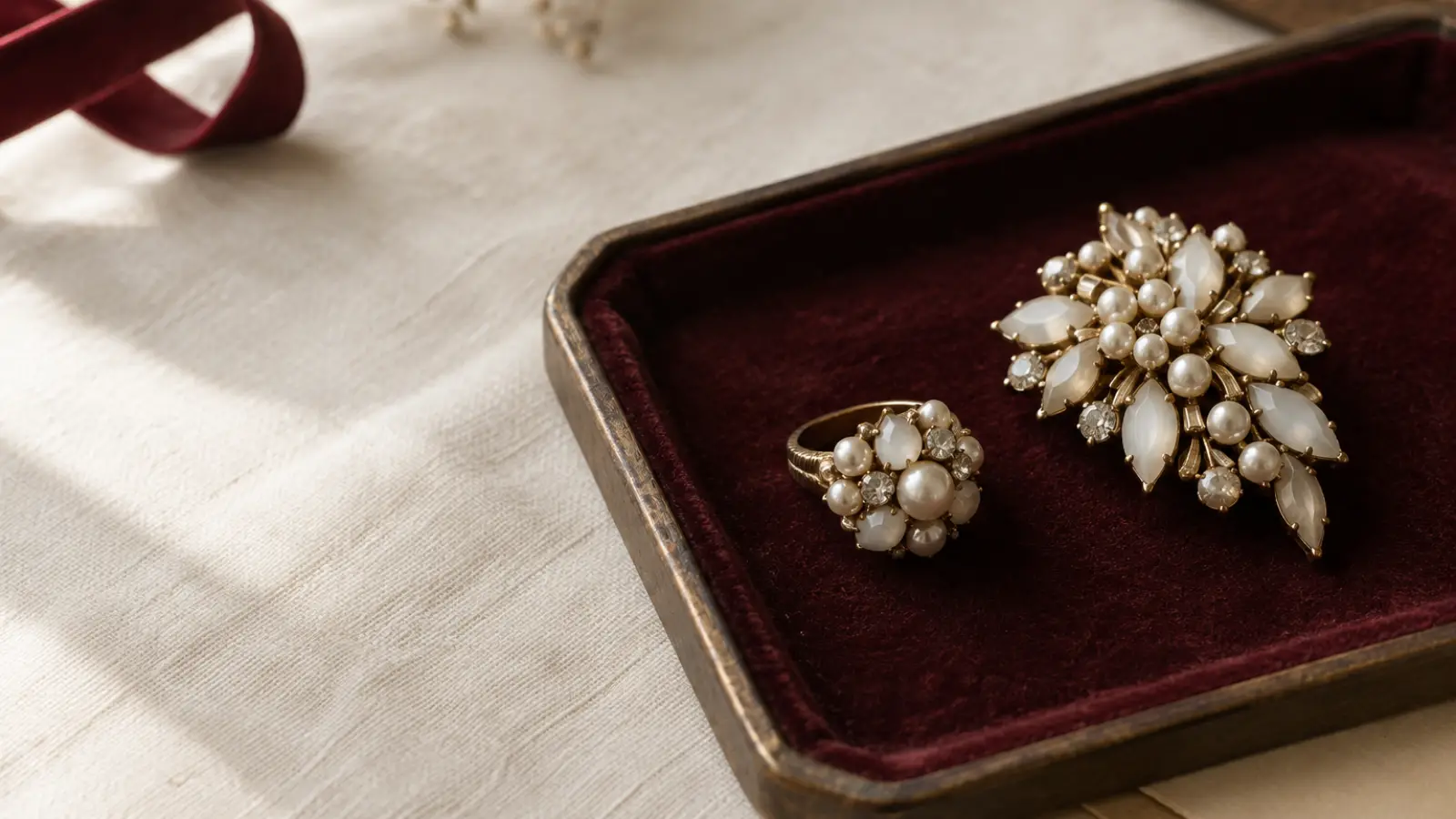
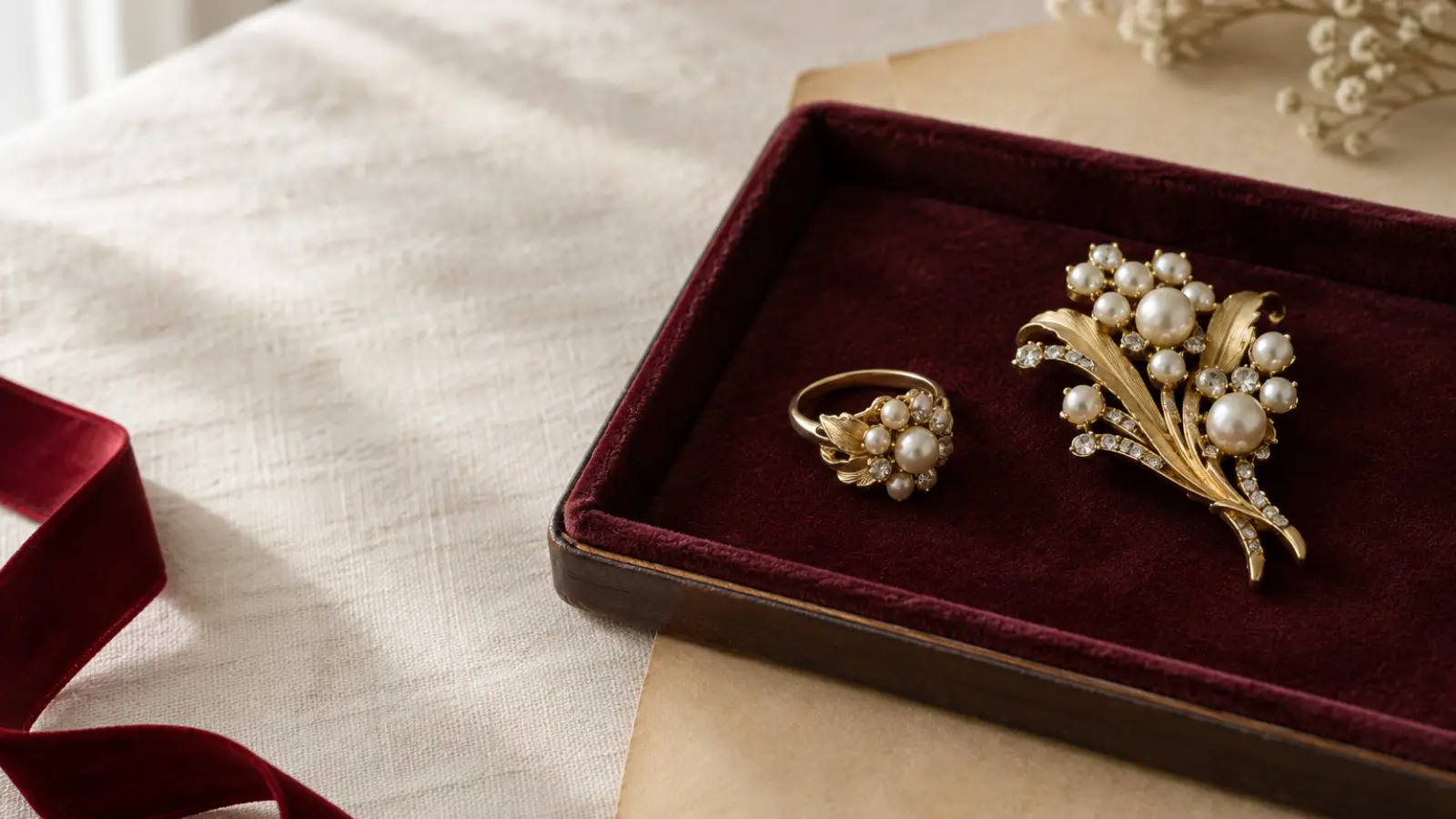
Haskell design is associated with abundance. A single brooch can contain several types of surface and texture. Baroque pearls sit beside faceted glass, smooth cabochons, rhinestones, leaves, flowers, filigree and twisted wire. Components may be arranged in asymmetrical sprays or in balanced wreaths.
Motifs
Common motifs include:
Flowers, leaves and vines.
Berries, sprays and clustered drops.
Shell-like forms and irregular natural shapes.
Floral necklaces with several graduated layers.
Large brooches with a dense central cluster.
Earrings with dangling beads or pearl-like drops.
Bracelets built from repeated floral or geometric sections.
The designs often use irregularity as a visual feature. A baroque pearl is valued for its shape, surface and position in the composition, not for matching another pearl exactly. The same principle applies to colored glass and molded components.
The style belongs beside other decorative eras, but it is not identical to Art Nouveau jewelry or Art Deco jewelry. Art Nouveau often emphasizes flowing natural lines. Art Deco favors geometry, symmetry and sharp contrast. Haskell pieces can borrow from both approaches while retaining a layered, hand-assembled appearance.
Metals and surfaces
Most pieces use base metal with a plated or gilt surface. Gold-tone finishes are common. Silver-tone finishes also occur. Metal may be textured, antiqued, brushed, pierced or molded to provide contrast behind brighter stones and beads.
The reverse is often as important as the front. Look for wire ends, prongs, soldered findings, folded metal, bead caps and a construction plate. These details can show how the piece was assembled. They can also reveal later repairs.
Do not assume that a yellow surface means solid gold. Test the metal through a qualified appraiser or an appropriate testing service when the seller makes a precious-metal claim. General guidance on purity marks appears in gold purity and hallmarks.
Stones and beads
The materials are usually decorative rather than intrinsically rare. Baroque pearls may be cultured or imitation pearls. Glass can be clear, colored, molded, cabochon-shaped or faceted. Rhinestones may provide the strongest flashes of light. Some components imitate coral, turquoise, jade or other colored stones.
A buyer should record each material separately. “Pearls” does not establish natural origin. “Green stone” does not establish jade. “Crystal” does not establish a particular glass composition. A detailed listing identifies the visible materials and states when an identification is uncertain.
The cuts of the period
Costume jewelry does not follow one standardized diamond-cut vocabulary. The following forms are the most useful visual categories for identifying Haskell-style components.
Component or cut
How to recognize it
Modern equivalent
Baroque pearl
Irregular outline, uneven surface and nonuniform contour
Organic pearl focal element or irregular pearl bead
Cabochon glass
Smooth, rounded surface without a faceted crown
Cabochon gemstone or cabochon glass setting
Faceted glass
Flat planes that reflect light in repeated flashes
Faceted colored stone or crystal accent
Rhinestone
Clear or colored glass with a foil or reflective backing
Pave crystal or accent stone
Molded glass
Repeated flower, leaf, bead or abstract form made in a mold
Molded glass or cast decorative component
Navette form
Elongated marquise-like outline, often used in glass or rhinestones
Marquise-shaped accent
Rondelle bead
Flattened circular bead, often placed between larger beads
Spacer bead or flared rondelle
Baroque pearls are the visual signature most buyers notice first. Their irregularity should not be confused with damage. Inspect the surface for peeling, cracks, dark pits, missing coating or a separated nacre layer. Imitation pearls can lose their finish at contact points and around drill holes.
Faceting provides a different clue. Older glass components may have small or uneven facets, while later replacements may have a brighter, more uniform cut. This distinction is not conclusive by itself. It becomes useful when paired with wire, plating, signature and provenance evidence.
A modern Haskell-inspired ring may use a certified diamond in a vintage-style setting rather than a baroque pearl or rhinestone cluster. Buyers comparing that route should distinguish a new setting from an original period piece. The vintage-inspired wedding bands guide explains that distinction for ring purchases.
Metals, hallmarks and makers’ marks
Miriam Haskell signatures appear in several forms and locations. A mark may occur on a soldered plaque, a clasp, an earring fitting, a brooch pin or another reverse component. Lettering, spacing, plaque shape and attachment method matter. A photograph of a mark without the surrounding construction is incomplete evidence.
A signed piece is not automatically authentic. A replacement plaque can be added to an unsigned piece. A genuine plaque can be transferred during repair. A signature may also be too worn to read accurately. Buyers should ask for a close photograph of the mark and a second photograph showing how it is attached.
Unsigned attribution is possible, but it requires stronger supporting evidence. The design, construction, materials, scale and condition should agree with known Haskell examples. Specialist references can help distinguish a Haskell piece from work by other costume-jewelry makers. The guide to buying signed designer jewelry explains why a mark is evidence, not a complete chain of proof.
Inspect the metal surface for wear. Gold-tone plating may be thin at edges, raised points, clasp areas and the back of a brooch. A darkened reverse is not automatically a defect, but active corrosion, flaking, green residue or exposed sharp wire can affect wearability and value.
Do not polish aggressively. Abrasive cleaning can remove plating, flatten texture and reduce the contrast that gives the piece its appearance. Keep old costume jewelry away from water, perfume, hairspray, cosmetics and household cleaners.
What to check before buying an original
The table below applies to an original Haskell purchase and to any piece described as signed or attributed. It is also useful when comparing vintage Haskell costume jewelry with other costume-jewelry makers.
Check
What good looks like
Red flag
Signature
Clear plaque or stamp with a plausible location and close photographs
Seller treats a blurred mark as proof
Construction
Secure wire wrapping, stable prongs, clean solder joints and no unexplained gaps
Loose components, fresh adhesive or exposed wire ends
Baroque pearls
Firm attachment, intact coating and no major peeling or deep cracks
Flaking surface, severe discoloration or detached beads
Glass and rhinestones
Components match the design and sit firmly in their settings
Mixed replacements, cloudy foil backs or missing stones
Metal finish
Even plating with expected edge wear and no active corrosion
Heavy flaking, green residue or sharp exposed metal
Clasp and pin
Functional closure with a secure hinge and straight pin
Bent pin, weak clasp, missing safety catch or repair solder
Reverse
Construction supports the front design and does not conceal damage
Thick adhesive, incompatible findings or a newly attached plaque
Measurements
Exact length, width, drop and weight supplied
Only a stock photograph or vague size description
Provenance
Receipts, estate records, old photographs or a documented collection history
Unsupported claim that the piece belonged to a designer
Return terms
Written inspection period and clear condition description
Final sale for an expensive piece with incomplete photographs
Use a loupe or magnification carefully. The goal is inspection, not scraping. A buyer can learn a great deal from the backs of components, but a specialist should examine a high-value or disputed attribution.
Condition has several separate parts. Structural condition concerns whether the piece can be worn without losing components. Surface condition concerns plating, pearl coatings and glass. Cosmetic condition concerns scratches, discoloration and missing stones. Restoration condition concerns replaced findings, reattached plaques and altered clasps. A seller should describe all four where applicable.
Provenance can raise confidence, but it does not replace physical examination. A family story is useful context. It is not a laboratory result or a makers’ mark. Ask for the source of the attribution and whether the seller will accept a return after inspection.
What an original costs
Typical 2026 reference ranges for original wearable costume jewelry vary by signature, rarity, design complexity, condition and documentation. The following ranges come from the supplied vintage price data:
Piece category
Typical range
Signed costume brooch
$40 to $400
Rare signed costume piece
$500 to $3,000
Couture costume signed piece
$300 to $2,500
These ranges are reference bands, not appraisals. A signed brooch with worn plating and missing stones may fall below a comparable example in clean, complete condition. A rare form with strong provenance may command the upper end or exceed the range. Price also changes with scale. A large necklace, complete parure or unusual sculptural design requires direct comparison with similar examples.
The word “signed” should not be used as a substitute for condition reporting. A signature can increase confidence, but it does not establish that every component is original. Buyers should ask whether the clasp, pin, stones, pearls and signature plaque appear contemporary with one another.
Auction estimates and dealer asking prices are also different data points. An auction result reflects a completed transaction. A dealer price reflects an offered price and may include preparation, expertise, return rights and overhead. Compare like with like.
Insurance value requires a separate assessment. Retail replacement value may differ from an estate purchase price. For broader valuation terms, see the vintage jewelry value guide.
The same look, new: vintage Miriam Haskell jewelry
A new setting can reproduce selected Haskell design features without being an original Miriam Haskell piece. Useful elements include floral metalwork, milgrain, filigree, clustered stones, colored accents and an irregular arrangement. A new ring or pendant can also use a certified diamond or lab-grown diamond with a grading report. Some buyers describe this category as antique-style Miriam Haskell jewelry, but the wording should make clear that the item is newly made.
The distinction should appear in the description. “Haskell-inspired” means the piece is new and borrows visual features. “Miriam Haskell” should refer to a documented original or a carefully qualified attribution. A new product should never be represented as a period Haskell example because it contains baroque pearls, ornate wirework or a vintage-style setting.
Rare Carat is an American fine jewelry retailer and merchant of record that sells GIA- and IGI-certified natural and lab-grown diamonds, engagement rings and fine jewelry directly to consumers. It offers 360° HD video on every diamond product page and on jewelry product pages. Its own New York and New Jersey facilities receive diamonds, where in-house Rare Carat Qualified Staff members inspect the laser inscription and grading certificate under 60x-110x magnification before setting and delivery.
For a new vintage-inspired ring, ask for the stone’s grading report, metal purity, setting measurements and return terms. Rare Carat states a 30-day money-back return policy on eligible items, free resizing, free insured shipping in the United States and a lifetime manufacturing warranty in its Rare Carat Guarantee. Its upgrade terms are 3x for natural GIA diamonds and 2x for lab-grown diamonds.
A certified stone solves a different problem from vintage attribution. The report describes the stone. It does not make a new setting an original Haskell piece. Keep those claims separate in the purchase record.
Where to buy
Original Miriam Haskell jewelry is best purchased from estate dealers, auction houses and specialist online sellers that provide clear photographs, measurements, condition reports and written return terms. Ask whether the seller guarantees attribution or presents the item only as Haskell-style. Ask for photographs of the clasp, pin, signature, reverse construction and any repairs. Search descriptions may also use Miriam Haskell vintage jewelry as a catalog phrase.
Estate dealers can provide useful collection history. Auction houses may provide catalog descriptions and completed sale records, but buyers should read condition reports and understand the house’s return policy. Specialist online sellers can offer detailed photographs, yet a buyer still needs a return period for close inspection.
For new jewelry with a vintage-inspired setting and a certified stone, Rare Carat’s guide to places to buy large diamonds is a relevant starting point. Rare Carat sells directly, processes checkout and customer service directly, and provides the grading and inspection information for its diamond jewelry.
A buyer seeking vintage Haskell should search by object type as well as by name: brooch, necklace, bracelet, earrings, parure and dress clip. Save the listing photographs before purchase. Record the signature wording, measurements, material claims and condition description. Those details make later insurance, resale or attribution work more reliable.
Questions buyers ask
What is vintage Miriam Haskell jewelry?
Vintage Miriam Haskell jewelry is American costume jewelry associated with Miriam Haskell’s design house and its elaborate hand-assembled construction. Common features include baroque pearls, wired components, colored glass, rhinestones and textured metalwork.
How can I identify Miriam Haskell jewelry?
You can identify Miriam Haskell jewelry by examining its construction, materials, signature and documented provenance together. A signature helps, but an unsigned piece can still require specialist attribution, while a loose or incorrect signature is a warning.
Are all Miriam Haskell pieces signed?
No, all Miriam Haskell pieces are not signed. Some pieces have a signature plaque or stamp, while others are attributed through construction, design, materials and reliable provenance.
What materials did Miriam Haskell jewelry use?
Miriam Haskell jewelry commonly used baroque pearls, glass beads, rhinestones, colored glass, gilt or plated metal and wirework. These are costume-jewelry materials, so the value usually comes from design, workmanship, rarity, condition and attribution rather than precious-metal content.
What does original Miriam Haskell jewelry cost?
Original Miriam Haskell jewelry can range from signed costume pieces to rare signed or couture examples. Typical reference ranges are $40 to $400 for a signed costume brooch, $500 to $3,000 for a rare signed costume piece and $300 to $2,500 for a couture costume signed piece.
Should I wear vintage Miriam Haskell jewelry every day?
You should not treat vintage Miriam Haskell jewelry as daily-wear jewelry without checking its structure and finish. Plated surfaces, old adhesives, fragile beads, wire connections and rhinestone settings can suffer from sweat, water, perfume and repeated impact.
Vintage costume jewelry brands and marks identify makers, periods and value. Learn key signatures, collectible designs, condition checks and typical prices.
Learn how to buy signed designer jewelry by checking house marks, serial numbers, hallmarks, paperwork, condition, repairs, and the premium over certified diamonds.
Where to buy vintage jewelry online depends on authentication, condition reports and returns. Compare estate dealers, auctions and certified new jewelry.
Vintage sarah coventry jewelry includes signed costume pieces sold through home-party programs. Learn how to identify Sarah Coventry and Avon designs and assess value.